


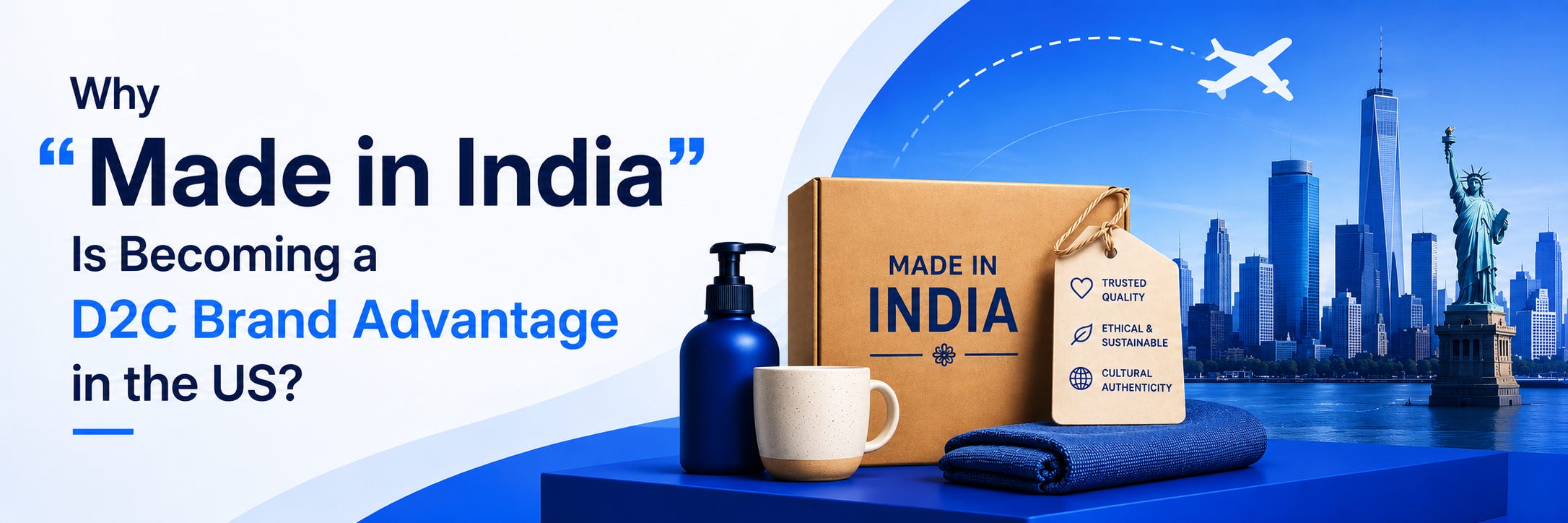
Here is something most Indian exporters still don’t fully realise. American consumers are a little obsessed with where things come from. They want to know which valley their coffee beans were grown in, who stitched their clothes, and what the founder was doing before they started the company. For a lot of American buyers, the origin story is the reason they buy at all.
And yet, when Indian exporters enter the US market, they often lead with price. Or worse, they quietly soften their Indian roots, assuming “Made in India” might read as a disadvantage.
In 2026, that instinct is exactly backwards. Being an Indian brand is not something to dilute. It is one of the strongest and most underused assets an exporter has. This is about how to turn that origin story into a real advantage, not in theory, but in the way you actually build and sell.
The Indian Story Advantage
Let’s be specific about what the Indian story gives you that your competitors simply don’t have.
1. Craft heritage that is genuinely rare
Block printing from Jaipur.
Handloom weaving from Pochampally.
Brass casting from Moradabad.
Natural dye techniques that take years to learn.
American consumers are surrounded by mass-produced everything. When they encounter something genuinely handmade, using methods that are centuries old, it lands differently. It feels like the antidote to everything else in their cart.
2. Ingredient provenance that wellness buyers actively chase
The US wellness market is enormous, and a large part of it is built on ingredients that originate in India. If you’re selling a wellness product and not leaning into the source story, you’re leaving your best marketing untouched on the table.
3. A founder story Americans actually find compelling
Whether it’s a first-generation entrepreneur, a multi-generational family business, or a founder reviving a dying craft, these stories strike a chord in the US market. They travel further, attract media attention, and help brands build authentic communities around their mission.
So the question is not whether you have a story. Because you do! The question is whether you’ve figured out how to tell it in a way that lands with an American audience.
STEP 1: Build Your D2C Foundation
D2C without a foundation is just an expensive hobby. Before you spend a rupee on ads or influencers, get the basics right.
Your website
Shopify is the default for Indian exporters entering the US D2C, and for good reason. It handles payments, taxes, shipping integrations and international storefronts without you building infrastructure from scratch. The platform is mature, the ecosystem of apps and agencies is huge, and the learning curve is manageable.
What does your US store actually need?
A homepage that leads with a story, not a product. American D2C has trained consumers to expect a brand world before a product catalogue. What do you stand for? Why do you exist? Who makes this, and where? Answer that before you show a price.
Photography that does the work. In D2C, photography is your primary sales tool. The buyer can’t touch or smell the product, or ask a shopkeeper a question. The image has to do everything. If there’s a craft process, show it.
Social proof built for a US audience. Indian reviews help less than you’d hope. Getting your first 20–30 US reviews, press mentions, or creator shout-outs is a critical early task.
Shipping and returns that meet US expectations. Free shipping over a threshold (usually $35–50) is effectively table stakes. So is an easy returns process and delivery times you can actually meet.
Email and SMS
D2C brands live and die by owned media, and email is still the highest-ROI channel in e-commerce. Build your list from day one. A welcome flow, the automated series a new subscriber gets after signing up, is the single highest-converting sequence you’ll ever build. It should tell your story, introduce your products, and give a reason to buy.
Klaviyo is the standard email and SMS platform for Shopify brands. Set it up before you drive a single visitor.
STEP 2: Use Social Commerce to Drive Brand Discovery
Americans aren’t discovering new brands through Google searches anymore. They’re finding them on TikTok while scrolling through videos, spotting them in their Instagram feeds, or hearing about them from creators they trust.
Social commerce is the dominant discovery mechanism for consumer brands in 2026. And it is one where the Indian story has a specific, structural edge.
1. TikTok Shop
TikTok Shop has reshaped US e-commerce faster than almost anyone predicted. Products go viral, and ordinary people become brand ambassadors overnight. Whole categories that had no presence two years ago are now driven almost entirely by the platform.
TikTok Shop also lets you sell inside the app- a viewer taps the product tag and buys without ever leaving. The friction is low, the impulse rate is high. Getting started needs a US entity or a US-based partner, and the compliance rules are still evolving. But if your product has visual appeal and a story, it deserves serious attention.
2. Instagram
Instagram is older and more saturated than TikTok, but it remains the home of lifestyle, home goods, beauty, fashion and wellness in the US. Discovery here is a mix of organic content, paid ads and influencer partnerships.
Micro-influencers, roughly 10,000 to 100,000 followers, in the right niche often beat the big names on ROI for emerging brands. A home decor creator with 40,000 engaged followers who genuinely loves your handcrafted Rajasthani cushion covers will drive more real sales than a celebrity with two million followers who has clearly been paid to hold up your product.
When you approach US creators, lead with the story. Send a proper PR package. Write a personal note about where the product comes from and why it exists.
3. Pinterest
Pinterest is chronically underrated by Indian exporters. It works like a visual search engine, and its users are in active buying-consideration mode in a way TikTok and Instagram users often aren’t. Home decor, food, fashion, wedding and wellness all perform beautifully here. And pins have a long shelf life, months to years, so a well-optimised presence keeps building organic traffic with relatively little ongoing effort.
4. YouTube
Long-form video is where a brand story really has room to breathe. A five-minute film about the process, the community, and the founder can build the kind of emotional connection that drives genuine loyalty. YouTube is also a search engine. “How Dhokra brass casting works” or “Why natural indigo dye is different” are exactly the searches an interested buyer makes before they commit. Being there with a well-made video is a real advantage.
STEP 3: Build Credibility Through PR
American media, from the New York Times’ Wirecutter to niche category blogs, still influence purchase decisions, especially for premium products. A favourable write-up in a respected publication carries a credibility that paid ads simply cannot buy.
Indian brands with a strong craft or sustainability story are genuinely interesting to US editors. The pitch often is “here is a story your readers will find fascinating, and by the way, there’s a great product attached.”
Here’s something to help you out in the beginning: How to do US PR without a $10,000-a-month agency?
Research the journalists and editors who cover your category. Read their recent pieces. Understand what angle they respond to.
Write a pitch that leads with the story. “A family in Kutch that has woven the same pattern for four generations is now selling directly to American homes” is a story.
Send samples, generously. Editors don’t write about products they haven’t experienced.
Be patient. Editorial cycles are long. A pitch sent today might become coverage six months from now, and that coverage can drive sales for years.
STEP 4: Build a Community
The most durable US brands are built on communities- people who identify with what the brand stands for, who talk to each other, who bring in new members, and who stay because the relationship is worth more to them than the transaction.
It looks different for everyone. For some, it’s a private Facebook group. For others, a Discord server, or an email newsletter, people actually forward to friends.
When your ad costs go up, and they will, when a competitor undercuts you, when an algorithm change quietly drops your organic reach, the brands with real communities survive. The ones built purely on paid acquisition don’t. So start building community before you think you need it.
What to Actually Do in Year One?
This is the part most articles skip. Here is a tried & tested sequence.
Get your Shopify store live with proper photography, a real brand-story page, and a working email flow, before you drive a single visitor to it.
Set up Klaviyo. Build a welcome flow. Add an abandoned-cart sequence. These two automations alone will recover meaningful revenue.
Find 10–15 micro-influencers in your category. Send product. See who posts organically; those are your people.
List on Amazon in parallel. Amazon drives discovery for price-conscious and repeat buyers.
Post consistently on one platform. Go deep where your visual story lands best- TikTok for process and discovery, Instagram for lifestyle, Pinterest for home and food, YouTube for story.
Pitch three journalists a month. Keep a simple spreadsheet.
After six months, read your data. Where are your best customers coming from? What’s your repeat purchase rate? What does acquisition cost look like by channel? Then double down on what’s working.
Final Thoughts
Building a US brand from India is harder than it sounds, and more possible than it used to be. The tools have never been better, the appetite for authentic stories has never been stronger, and the infrastructure has genuinely removed barriers that once needed years to clear.
The Indian story, told well, is a competitive advantage in the US market. It is not a liability. It is not something to hide, soften, or package differently to appear more “global.”
Figure out what your story is. Understand the experiences, values, and beliefs that shaped your business. Then tell that story consistently- through your website, your founder narrative, your content, your customers, and your brand.
Related Articles


Dive into Vault today & unlock a world of possibilities.