


The US has a far more structured and demanding regulatory environment for imported goods. Compliance is taken seriously, and the expectations are higher than what most Indian exporters are used to.
If you’re not prepared, you could face delays at customs, product delistings, or even recalls. In this article, we’ll walk through what US product readiness actually involves, from certifications and standards to labelling and consumer expectations.
Compliance Standards in the US Market
In India, compliance is often treated as a documentation exercise. In the US, it’s tied directly to liability.
Consumers can take legal action, and class action lawsuits are common. Regulatory bodies actively enforce standards—the Consumer Product Safety Commission can issue recalls and fines, the FDA can block shipments, and marketplaces like Amazon can suspend listings based on customer complaints. At the border, Customs authorities can hold or even destroy non-compliant goods, with the cost borne entirely by the exporter.
So how do you approach this the right way?
Step 1: Know Which Agency Governs Your Product
The first thing to figure out is who regulates what you’re selling. In the US, multiple federal agencies have jurisdiction over consumer goods.
Consumer Product Safety Commission (CPSC) covers most general consumer products: toys, furniture, home goods, apparel, electronics, accessories, sporting goods, and more.
The Food and Drug Administration (FDA) covers food, beverages, dietary supplements, cosmetics, skincare, medical devices, and some packaging materials.
The Federal Communications Commission (FCC) covers anything that emits radio frequency energy: electronics, wireless devices, chargers, and Bluetooth accessories. FCC certification (usually FCC ID) is mandatory.
The Federal Trade Commission (FTC) governs labelling claims, advertising, and marketing.
The Environmental Protection Agency (EPA) covers pesticides, certain cleaning products, and goods that make environmental claims.
The Department of Agriculture (USDA) covers organic certification for food and agricultural products.
Important Note: Identify your product’s HS code (Harmonised System code) and look it up on the CBP website. This will tell you which agencies have jurisdiction and what documentation you need at the border.
Step 2: Understand the Core Certifications
Certifications vary by product category, but here are the most common ones Indian exporters need to know.
1. CPSC: Children’s Products and General Use
Children’s Product Certificate (CPC) Mandatory for any product designed or intended for children under 12. This includes toys, clothing, accessories, and furniture. Requires third-party testing by a CPSC-approved laboratory.
Key standards to know:
ASTM F963: Toy safety standard
Lead content limits: 100 ppm in surface coatings, 300 ppm in substrate
Phthalate limits for toys and childcare articles
Flammability standards for children’s sleepwear
A General Conformity Certificate (GCC) is required for non-child consumer products. Can be self-certified (no third-party lab required), but you must have a reasonable basis for the claims.
Flammability Standards apply to textiles, upholstered furniture, mattresses, and carpets. The standard varies by product type (16 CFR Part 1610 for textiles, 16 CFR Part 1633 for mattresses, etc.).
2. FDA: Food, Supplements, Cosmetics & Skincare
Food Facility Registration: If you’re exporting food or beverages, your manufacturing facility must be registered with the FDA. Registration is free and done online, but it’s mandatory.
FSMA Compliance (Food Safety Modernisation Act): The FDA’s food safety framework. Requires documented food safety plans, hazard analysis, and preventive controls.
Dietary Supplements: Structure/Function Claims: If you’re selling Ayurvedic or herbal supplements, you cannot make disease claims (”cures diabetes,” “treats arthritis”). You can make structure/function claims (”supports joint health,” “promotes digestion”), but these must be truthful, substantiated, and accompanied by a specific FDA disclaimer on the label.
Cosmetics & Skincare The Modernisation of Cosmetics Regulation Act (MoCRA), passed in 2022, significantly tightened FDA oversight of cosmetics.
Key requirements:
Facility registration with the FDA
Product listing for each SKU
Serious adverse event reporting
Labelling in English with full ingredient list (INCI names)
No prohibited ingredients (full list on FDA website)
3. FCC: Electronics and Wireless Devices
Any product that emits radio frequency (RF) energy needs FCC authorisation before it can be sold in the US. This includes:
Bluetooth speakers, headphones, earbuds
Wi-Fi-enabled devices
Wireless chargers
Smart home devices
FCC authorisation requires testing by an accredited laboratory and, for most devices, a formal grant of authorisation with an FCC ID. This ID must appear on the product and its packaging.
Budget: $1,500-5,000 for testing and certification per product, depending on complexity.
Timeline: 6-12 weeks
4. UL Certification
UL (Underwriters Laboratories) certification is widely required by US retailers and is effectively mandatory for electrical products sold on Amazon and in physical retail. If your product plugs into a wall, expect retailers and platforms to ask for UL certification.
Budget: $3,000-10,000+, depending on product complexity.
Timeline: 8-16 weeks
Step 3: Get Your Labelling Right
US labelling requirements are specific, and non-compliance at the port of entry can mean your entire shipment is held or returned.
General Labelling Requirements (All Products)
Country of origin: “Made in India” must appear on the product itself (not just the packaging). This is a CBP requirement.
English language: All required label information must be in English. Additional languages are fine, but English is mandatory.
Importer information: Name and address of the US importer of record must appear on the label or packaging.
Net quantity: Must be stated in both metric and US customary units (e.g., “250g / 8.8 oz”).
Textile and Apparel Labelling (16 CFR Part 303)
Fibre content by percentage (e.g., “100% Cotton” or “60% Cotton, 40% Polyester”)
Country of origin
Care instructions (using standardised ASTM care symbols or written instructions)
RN number or company name (RN = Registered Number, issued by FTC, free to obtain)
Food Labelling (FDA 21 CFR)
Nutrition Facts panel (specific format required)
Ingredient list in descending order by weight
Allergen declarations (the “Big 9”: milk, eggs, fish, shellfish, tree nuts, peanuts, wheat, soybeans, sesame)
Net weight
Name and address of US distributor or importer
Supplement Labelling
“Supplement Facts” panel (different format from Nutrition Facts)
Structure/function claims with FDA disclaimer: “This statement has not been evaluated by the Food and Drug Administration. This product is not intended to diagnose, treat, cure, or prevent any disease.”
Full ingredient list, including other ingredients (fillers, capsule material, etc.)
Cosmetics Labelling (MoCRA + FD&C Act)
INCI ingredient names in descending order
Warning statements, wherever required
Net weight or volume
Name and address of the responsible person (US-based)
No drug claims
Step 4: Meet Consumer Expectations in the US Market
Compliance helps you enter the market. Meeting consumer expectations is what keeps you there. US consumers are informed, discerning, and have access to a wide range of options. Here’s what builds trust and drives repeat demand:
1. Credible Certifications (Good-to-have)
Beyond mandatory certifications, certain voluntary certifications dramatically increase consumer confidence and conversion rates on platforms like Amazon:
USDA Organic: For food, supplements, and some personal care products. Highly valued, commands a 20-40% price premium.
Fair Trade Certified: Resonates strongly with American values around ethical sourcing. Particularly effective for textiles, coffee, and food.
B Corp Certification: For brands with a strong sustainability story. Increasingly important for younger consumer segments.
NSF International: For dietary supplements. The gold standard for quality assurance in the US supplement market.
OEKO-TEX Standard 100: For textiles. Signals that fabrics are free from harmful substances. Highly valued in baby products and sustainable fashion.
2. US-approved Packaging
Invest in packaging design that’s built for the US market. On Amazon, especially, your main image and packaging design determine whether someone clicks through or scrolls past.
3. Consistent Quality
Build quality control checkpoints into your production process before you export, not after complaints arrive.
A pre-shipment inspection (PSI) by a third-party inspection company like SGS, Bureau Veritas, or Intertek costs $200-400 per inspection and is one of the best investments you can make early in your US export journey.
Step 5: Plan Your Testing and Certification Timeline
Testing and certification are not last-minute tasks—they need to be planned early. In the US, timelines for lab testing, approvals, and documentation can vary significantly depending on your product category.
Typical timelines:
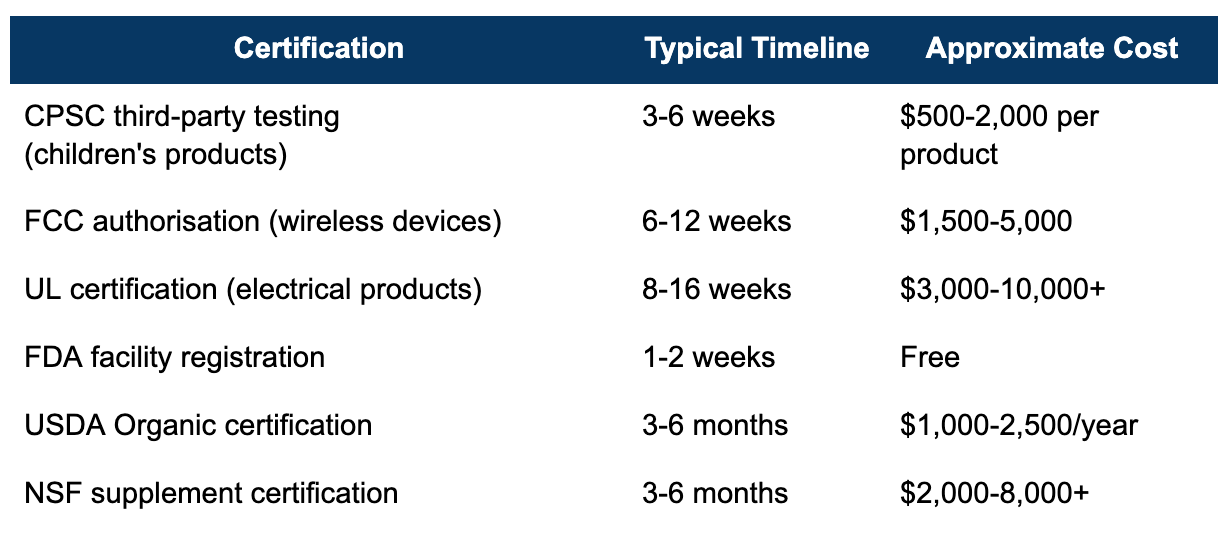
Start your certification process before you finalise your production run. Build at least 3 months of buffer between your certification start date and your intended launch date.
Important Note: Engage a customs broker before your first shipment, not during. Brief them on your product category and ask them to do a compliance review. A licensed US Customs Broker can:
Classify your product with the correct HTS (Harmonised Tariff Schedule) code
Advise on applicable duties and compliance requirements
Handle import documentation on your behalf
Flag potential issues before your shipment arrives at the port
Cost: $150-300 per shipment for standard brokerage.
Final Thoughts
Product readiness is the foundation of success in the US market. It may not get as much attention as marketing or pricing, but it plays a critical role in whether your business sustains beyond the first year.
The Indian exporters who struggle in the US often have genuinely good products. They stumble because they underestimated what “ready” actually means in this market. So, do the work upfront. It’s the only way to build something in the US that lasts.
Related Articles


Dive into Vault today & unlock a world of possibilities.