


Selling directly to consumers is one way to enter the US market, but it’s not the only route, and often not the fastest for Indian exporters.
The alternative is B2B: working with US distributors, retailers, and wholesale buyers who already have access to customers, shelf space, and established distribution networks.
This guide walks you through how to identify the right buyers, approach them effectively, understand what they look for, and structure your deals to reduce risk.
Understanding Distribution Channels in the US
Before you start reaching out to buyers, understand how distribution in the US actually works. It’s more layered than most markets Indian exporters have dealt with.
The Three-Tier Structure
Importers & Distributors: These are companies that buy in volume directly from overseas manufacturers, handle customs and domestic logistics, and sell to retailers or end-users. They take on significant risk (inventory, compliance, logistics) and price accordingly.
Wholesalers: They buy from importers or manufacturers and sell to retailers, often in smaller volumes than distributors. More flexible than distributors, more accessible as a starting point, but less powerful as a scale partner.
Retailers: Department stores, speciality retailers, big-box chains, and independent boutiques. Buying direct from a retailer gives you better margins than going through a distributor, but the requirements are significantly higher, and payment terms can be brutal.
Each tier has a different risk appetite, different volume expectations, and different entry criteria. A first-time exporter testing 500 units has no business pitching Walmart. But that same exporter is a perfect candidate for a regional speciality wholesaler or a boutique retail buyer. Knowing your tier is the first strategic decision, and most exporters get it wrong.
Where do US Buyers Actually Come From?
Most Indian exporters default to cold email and LinkedIn. Both work, but they’re slow and low-conversion compared to channels where buyers are actively looking for new products.
1. Trade Shows
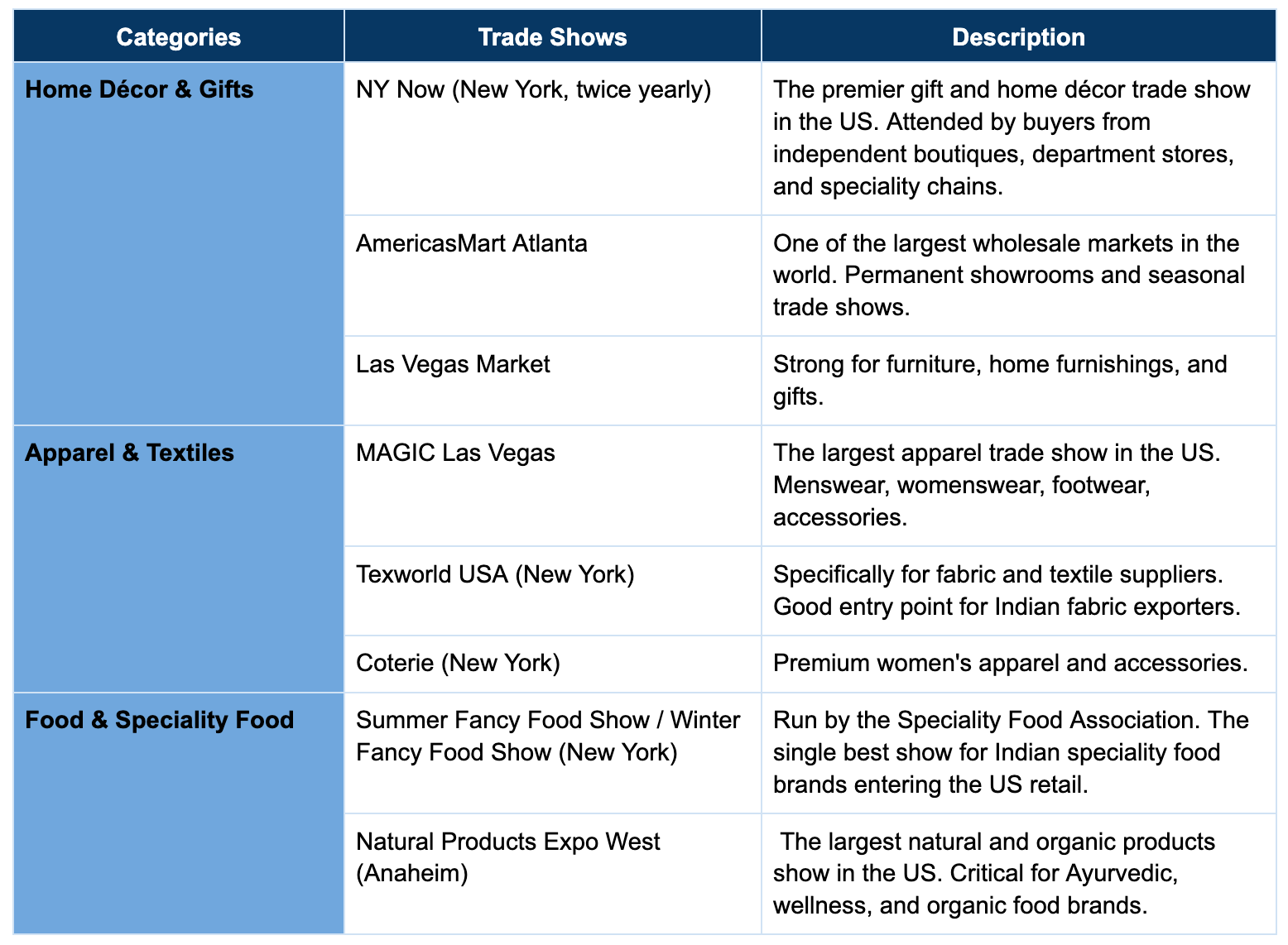
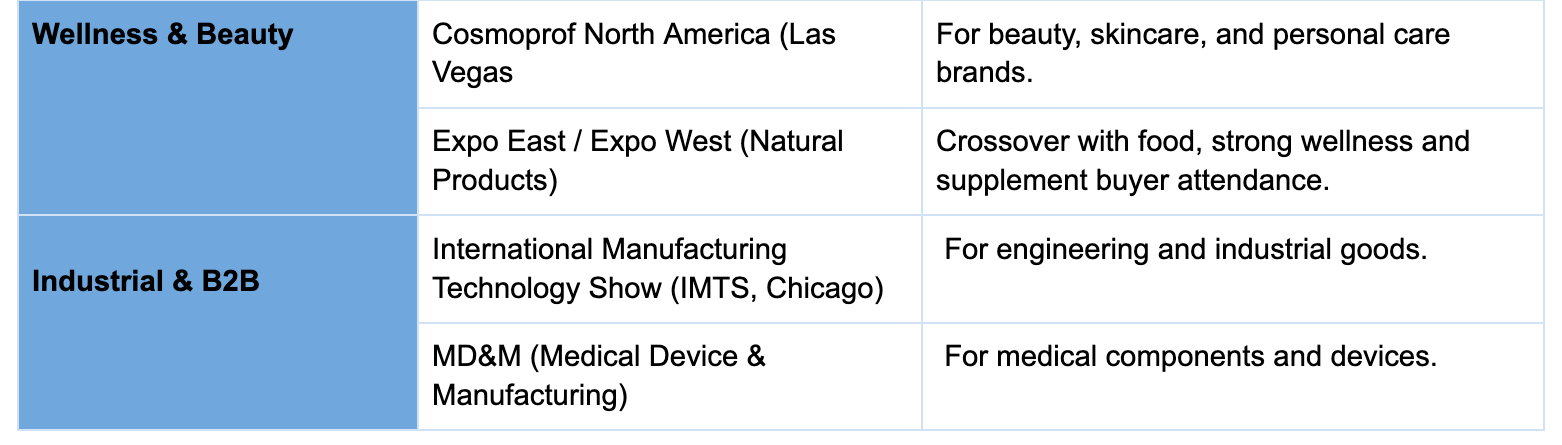
American trade shows are where buyers go specifically to discover new suppliers. A well-prepared booth puts you in front of hundreds of qualified buyers in three days, something that would take months of cold outreach to replicate.
The shows that matter most for Indian exporters, by category:
What does a good trade show presence cost?
Booth space: $3,000-15,000, depending on the show and size
Travel, accommodation, shipping samples: $3,000-8,000
Booth design and display materials: $2,000-10,000
Total first show budget: $8,000-30,000
It’s not cheap! But one distributor relationship from a trade show can generate $100,000+ in annual orders. The math works if you’re prepared.
2. Online Wholesale Marketplaces
The rise of B2B e-commerce has created platforms where US buyers actively source new products. These are particularly effective for smaller retailers and boutiques.
Faire: The dominant wholesale marketplace for independent US retailers. Over 700,000 retailers are actively buying on Faire. Indian exporters with strong product aesthetics in home, gift, apparel, and food have found significant traction here. Faire handles payment terms (offering retailers Net 60) and takes 15-25% commission.
RangeMe: A supplier discovery platform used by major US retailers, including Whole Foods, Target, Walmart, and CVS. It’s not instant, but it’s how many Indian brands have gotten their first conversation with a major chain buyer. Premium subscriptions ($1,500-3,500/year) increase visibility significantly.
Tundra: Zero-commission wholesale marketplace. Smaller than Faire but growing. Good for home goods, gifts, and food categories.
Abound: Focused on independent retailers, similar positioning to Faire but with a different buyer base. Worth listing on if you’re already on Faire.
Global Sources / Alibaba (for B2B): Yes, these are primarily used for China sourcing, but Indian exporters are increasingly getting traction here, especially as buyers look for China alternatives.
3. Import Brokers and Trading Companies
Import brokers specialise in connecting overseas manufacturers with US buyers. They work on commission (typically 5-15% of the order value) and bring relationships you’d take years to build independently.
How to find reputable import brokers?
Trade show exhibitor directories (brokers often attend as buyers)
National Association of Sales Professionals (NASP)
Category-specific trade associations
Referrals from other Indian exporters who’ve successfully entered the US
4. LinkedIn and Cold Outreach
Cold outreach is often slower and tends to have lower conversion rates compared to trade shows or marketplaces, but it can still be highly effective when approached strategically. The key lies in reaching the right decision-makers with a clear and relevant pitch.
On platforms like LinkedIn, founders should focus on connecting with roles such as “Buyer” or “Category Manager” at target retailers, “VP of Sourcing” or “Head of Procurement” at distribution companies, and “Import Manager” at trading firms. Personalised outreach, backed by a strong product story and market fit, can gradually open doors to valuable distribution partnerships in the US market.
What works in cold outreach to US buyers?
Lead with what makes your product different, not what it is
Reference specific trends in their category that your product addresses
Include a direct link to your line sheet or product catalogue
Keep it under 150 words
Have a clear ask: “Would a 15-minute call this week or next make sense?”
5. The Indian Diaspora Network
Indian-American entrepreneurs and professionals are embedded in US retail, distribution, and food service at every level. They’re often more accessible than mainstream American buyers, more willing to take a chance on an Indian brand, and better positioned to advocate for your product internally.
How to tap this network?
FICCI, CII, and NASSCOM have US chapters with active business communities
Indian American Chamber of Commerce (IACC) chapters in major cities
TiE (The Indus Entrepreneurs) chapters across the US
Indian grocery distribution networks (especially for food brands) are almost entirely run by Indian-Americans and are a direct pipeline into ethnic retail and beyond
Final Thoughts
There’s no single playbook for finding buyers in the US market. Sometimes a distributor opens the first door. Sometimes a trade show conversation turns into a retail partnership months later. Sometimes a cold LinkedIn message unexpectedly leads to a breakthrough.
The important thing is to keep building momentum across channels while continuously improving your product, positioning, and credibility. Over time, those small efforts start compounding into real market access.
Related Articles


Dive into Vault today & unlock a world of possibilities.