


Nobody gets excited about compliance. It is the part of the US market entry conversation that causes eyes to glaze over, the section of every export guide that founders skim and then regret skimming six months later when a shipment is sitting at the port of Los Angeles with a hold notice attached to it.
So here is the deal. This article will be as painless as possible. But you need to read it. Because customs and compliance is the single area where ignorance is most expensive. A rejected shipment, a product recall, or an FDA import alert does not just cost you that shipment. It can cost you your US market access entirely.
The good news: the rules are knowable. The agencies are navigable. And the Indian exporters who do their compliance homework before their first shipment find that it becomes a competitive advantage, because their less-prepared competitors are the ones getting held at the border.
The Compliance Agencies You Need to Know
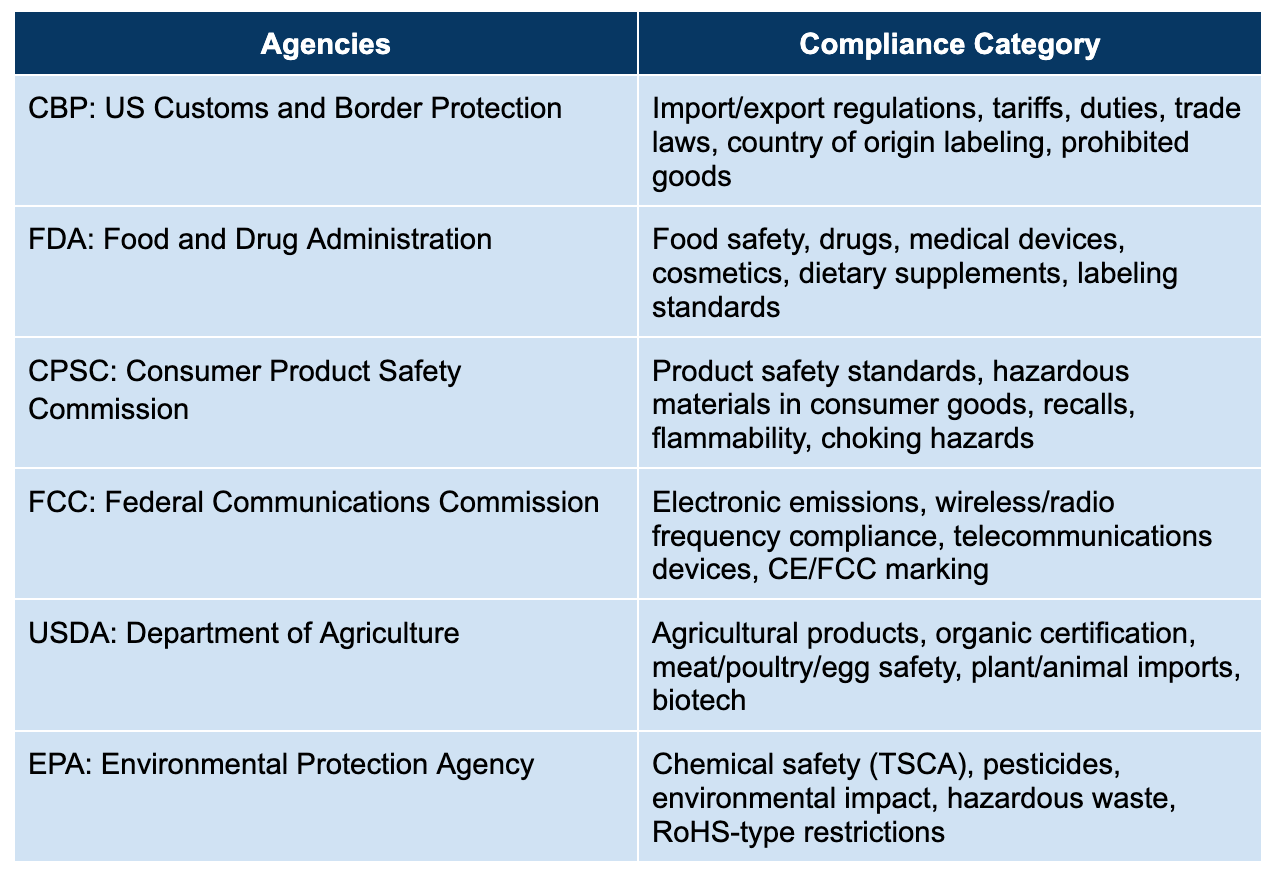
When it comes to imports, the US works through multiple federal agencies, each responsible for specific product categories. So before you worry about paperwork or shipping, you need to know which regulator your product falls under.
1. CBP: US Customs and Border Protection
Every commercial shipment entering the US passes through CBP first. They are the agency responsible for verifying import documents, collecting duties, checking for restricted items, and deciding whether goods can enter the country or need further inspection.
The important thing to understand is that CBP works entirely on documentation and compliance standards.
What does CBP look at on every shipment?
Commercial invoice: Must include the seller and buyer’s full names and addresses, a detailed description of goods (what they are, what they are made of, what they are used for), quantity, unit value, total value, country of origin, and the correct HTS (Harmonised Tariff Schedule) code.
Packing list: Itemises exactly what is in each box or pallet. Must match the commercial invoice.
Bill of lading or airway bill: The contract between you and the carrier. Issued by the freight forwarder or carrier.
Country of origin marking: Almost every product entering the US must be marked with its country of origin in a legible, permanent manner visible to the ultimate purchaser. “Made in India” must appear on the product itself or its packaging. The requirements for how and where this marking appears vary by product category.
ACE (Automated Commercial Environment) is the system through which your customs broker files your entry with CBP electronically.
CBP does not just enforce its own rules. It also enforces the import requirements of a dozen other federal agencies, called Partner Government Agencies (PGAs). When you import a product that falls under the jurisdiction of the FDA, CPSC, EPA, USDA, or others, CBP checks compliance with those agencies’ requirements too before clearing your shipment.
2. FDA: Food and Drug Administration
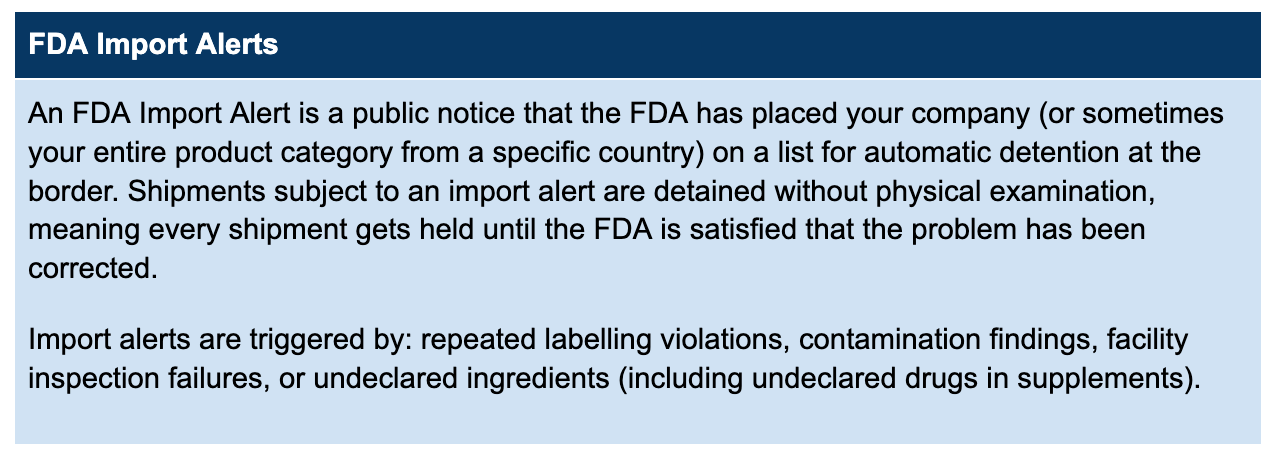
The FDA regulates food, beverages, dietary supplements, cosmetics, medical devices, and drugs. If your export falls into any of these categories, the FDA is the most important agency in your compliance picture.
Food and Beverages
If you are exporting food to the US, you must be registered with the FDA as a food facility. This is not optional. FDA food facility registration is free and done online through the FDA’s FURLS system. Registration must be renewed every two years (in even-numbered years).
For every food shipment entering the US, you must submit Prior Notice to the FDA before the shipment arrives. This is submitted electronically through the FDA’s Prior Notice System Interface (PNSI) or through your customs broker.
The timing requirements:
For ocean shipments- At least 8 hours before arrival
For air shipments- At least 4 hours before arrival
If you are selling food to a US importer (rather than directly to consumers), your US importer is legally required to have a Foreign Supplier Verification Programme (FSVP) in place for you as their foreign supplier. This means they need to verify that your food meets US food safety standards.
US food labelling requirements are specific and non-negotiable. Mandatory elements include:
Product name
Net quantity of contents (in both metric and US customary units)
Ingredient list (in descending order of weight)
Nutrition Facts panel (in the specific FDA format)
Name and address of the manufacturer, packer, or distributor
Allergen declarations (the US has 9 major allergens: milk, eggs, fish, shellfish, tree nuts, peanuts, wheat, soybeans, and sesame)
Dietary Supplements
The US supplement market is enormous and attractive for Indian exporters of Ayurvedic products, herbal extracts, and nutraceuticals. Supplements in the US are regulated under DSHEA (Dietary Supplement Health and Education Act).
Key requirements:
Must be manufactured in a facility compliant with FDA’s Dietary Supplement GMPs (Good Manufacturing Practices, 21 CFR Part 111)
Labels must include a Supplement Facts panel (different format from the Nutrition Facts panel on food)
Structure/function claims (”supports immune health”, “promotes joint flexibility”) are permitted but must be substantiated and accompanied by a specific disclaimer
If your supplement contains an ingredient not marketed in the US before 1994, you may need to submit a New Dietary Ingredients (NDI) notification to the FDA before selling
Cosmetics
The Modernisation of Cosmetics Regulation Act (MoCRA), which came into full effect in 2024, significantly upgraded US cosmetic regulations for the first time in decades. Indian cosmetic exporters need to know:
Cosmetic manufacturing and processing facilities must be registered with the FDA
Each cosmetic product must be listed with the FDA, including its ingredient list
There must be evidence that your product is safe for its intended use
If your product causes a serious adverse event, you are required to report it to the FDA within 15 business days
3. CPSC: Consumer Product Safety Commission
If your products are meant for consumers, the CPSC is likely one of the agencies you will deal with. They oversee safety standards for categories like toys, children’s products, household goods, electronics, furniture, and more.
Children’s Products
Products intended for children under 12 face the most rigorous CPSC requirements. The Children’s Product Safety Improvement Act (CPSIA) requires:
Third-party testing by a CPSC-accepted laboratory: Children’s products must be tested by an accredited lab for compliance with applicable safety standards.
Children’s Product Certificate (CPC): Based on the test results, you must issue a CPC that identifies the product, the applicable safety rules it complies with, the testing lab, and the date and location of manufacture.
Tracking labels: Children’s products must have a permanent label that identifies the manufacturer, production location, date of manufacture, and batch number. This allows for targeted recalls if a safety issue is identified.
Lead and phthalate limits: Children’s products have strict limits on lead content (both surface coating and substrate) and phthalate content in plastic components.
General Products
For general consumer products not in the children’s category, the requirements are less prescriptive but still real. For many product categories, there are specific voluntary or mandatory standards:
Furniture: ASTM F2057 for clothing storage units (tip-over prevention).
Bedding and mattresses: Flammability standards under 16 CFR Part 1633 (mattresses) and 16 CFR Part 1632 (mattress pads).
Apparel: Children’s sleepwear has specific flammability requirements (16 CFR Parts 1615 and 1616). General apparel has less stringent requirements, but is not exempt.
Electronics and electrical products: While the CPSC covers safety, electronics also need to address FCC requirements (see below).
For non-children’s consumer products, the CPSC requires a General Certificate of Conformity stating that the product meets all applicable CPSC rules.
4. FCC: Federal Communications Commission
If your product emits radio frequency energy (intentionally or unintentionally), the FCC has requirements. This covers:
Electronics with wireless connectivity (Bluetooth, WiFi, cellular)
Devices with switching power supplies (most electronics)
LED lighting
Anything with a microprocessor that might emit RF interference
FCC authorisation comes in three forms: Certification (required for most intentional radiators like WiFi devices), Supplier’s Declaration of Conformity (SDoC, for most unintentional radiators), and Verification.

5. USDA: Department of Agriculture
The USDA controls the import of agricultural products, plants, and animal products. For Indian exporters in the food and agricultural space:
APHIS (Animal and Plant Health Inspection Service): Governs plant and plant product imports. Many agricultural commodities require phytosanitary certificates from India’s NPPO (National Plant Protection Organisation) before export.
Organic certification: If you want to label your product as organic in the US, you need USDA organic certification. Indian organic products certified under NPOP (National Programme for Organic Production) have equivalency recognition with the USDA organic standard, which simplifies the certification process.
Meat and poultry: India is not currently on the USDA FSIS list of countries eligible to export meat or poultry to the US.
6. EPA: Environmental Protection Agency
The EPA’s jurisdiction matters for Indian exporters primarily in two areas:
Pesticide residues: The EPA sets Maximum Residue Limits (MRLs) for pesticides on food products. Food that exceeds these limits can be refused entry. This is particularly relevant for Indian spice, tea, and agricultural exporters.
Certain chemical products: Cleaning products, disinfectants, and products containing regulated chemicals may require EPA registration.
How to Build Your Compliance Infrastructure?
The good news is that you do not need a massive legal team to handle compliance well. What you do need is structure. Most successful exporters build a simple but disciplined system that ensures documentation, testing, labelling, and shipment processes are handled consistently from day one.
Start with your HTS code and identify your regulatory universe
Your 10-digit HTS code tells you your tariff rate. It also signals which PGAs have jurisdiction over your product.
Get a US customs broker before your first shipment
A licensed US customs broker (licensed by CBP) is the most important compliance hire you will make. They file your entries, flag documentation issues before they become port holds, and know when something requires additional PGA clearance.
Use accredited third-party labs for testing
For products requiring third-party testing (children’s products, certain electronics, supplements), use a CPSC-accepted or FDA-registered laboratory. SGS, Bureau Veritas, Intertek, and UL are the names you will encounter most often. They have offices in India and can test your products before export.
Document everything
Test reports, facility registrations, certificates of conformity, certificates of origin, and safety data sheets need to be organised, current, and retrievable quickly. A customs hold can require you to produce documentation within 24-48 hours. If you are searching for a test report from two years ago during a port hold, you are going to have a bad week.
Build a compliance calendar
FDA food facility registration renews every two years. FCC certifications need to be renewed if product changes are made. USDA organic certificates have annual renewal requirements. Build a simple calendar that tracks expiry dates for every certification and registration you hold.
The Importer of Record: Who Is Legally Responsible?
One of the most important compliance decisions you will make is identifying the Importer of Record (IOR). This is the party legally responsible for ensuring that goods entering the US comply with all customs and regulatory requirements.
If you are shipping DDP (Delivered Duty Paid) to a US buyer, you may be the IOR.
If you are shipping DAP or FOB, your US buyer is typically the IOR.
Many Indian exporters prefer to sell on terms where the US buyer is the IOR, transferring that legal and compliance risk. US buyers, particularly large importers and distributors, often accept this because they have the infrastructure to manage it. This is a negotiation point worth understanding before you get to the contract stage.
Final Thoughts
The encouraging part in this entire compliance process is that the system is not designed to work against you. US agencies are primarily focused on product safety, transparency, and proper documentation. Meet those standards consistently, and the process becomes far more predictable.
So take compliance seriously from the beginning. Hire experienced partners where needed. Get your certifications and testing done early. Build clean documentation systems. Then get back to building, selling, and growing!
Related Articles


Dive into Vault today & unlock a world of possibilities.