



For many Indian exporters, the first few wins can be misleading. The product performs well, buyers show interest, and orders begin to come in. Yet profitability remains elusive. The reason is often hidden in the numbers.
Shipping, duties, packaging, marketplace fees, marketing costs, and customer expectations in the US market can significantly affect a product’s economics. What appears profitable on paper in India can quickly become unsustainable abroad. The challenge is not simply setting a price, but building one that reflects your true costs while remaining competitive in the market you are entering.
In this article, we’ll break down the true cost of exporting to the US, uncover the hidden expenses that erode margins, and show you how to build a pricing model that works for both sides of the market.
Start With Landed Cost
The single most common pricing mistake is building your US price off your factory or ex-works cost, adding a margin, and calling it done. That number is fiction. It ignores everything that happens between your warehouse and the buyer’s door.
Landed cost is the true baseline. It is every rupee and every dollar spent getting your product into the hands of a US buyer:
Ex-works or FOB price (your production cost plus your margin)
Freight, whether ocean or air
Marine insurance, typically 0.5–1% of cargo value
US customs duties and tariffs
Port handling and customs clearance fees
Drayage, moving containers from the port to the warehouse
US warehousing and fulfilment, if you use it
Last-mile delivery to the buyer
How Tariffs Impact Your Pricing?
Tariffs are a tax the US government charges on imported goods. They are calculated as a percentage of the customs value of your shipment, which is usually the FOB price.
Every product carries an HTS (Harmonised Tariff Schedule) code, and that code decides your rate. The rates vary wildly- 0% for some industrial components, around 12% for apparel, 25% or more for certain steel and aluminium products.
A few things worth knowing about the environment Indian exporters are actually pricing into right now:
The US-India tariff situation in 2026 is in flux: The broad tariffs introduced in early 2025 created real uncertainty. As of mid-2026, Indian goods face a baseline tariff in most categories, but the picture is actively shifting as trade negotiations continue. Before pricing any shipment, verify your specific HTS code rate through the USITC database or with a licensed US customs broker. Do not rely on what a competitor or a trade body told you six months ago.
Section 301 tariffs on China have changed the competitive picture: Many categories once dominated by Chinese manufacturers are now significantly more expensive for US buyers to source from China. This is a genuine opening for Indian exporters, but only if your landed cost makes the switch worth it for the buyer.
GSP has a complicated history: India was removed from the Generalised System of Preferences in 2019. Reinstatement has been discussed, but as things stand, Indian goods do not get GSP duty-free treatment. Build full tariff rates into your landed cost.
To find your rate, identify your 10-digit HTS code (your customs broker can help), check the current rate at hts.usitc.gov, and account for any additional duties- anti-dumping or countervailing- that may apply to your category.
Building the Landed Cost Calculation
Here is a simple framework to run before you quote any US buyer. Take a product with an ex-works cost of $10 per unit, shipping 1,000 units.
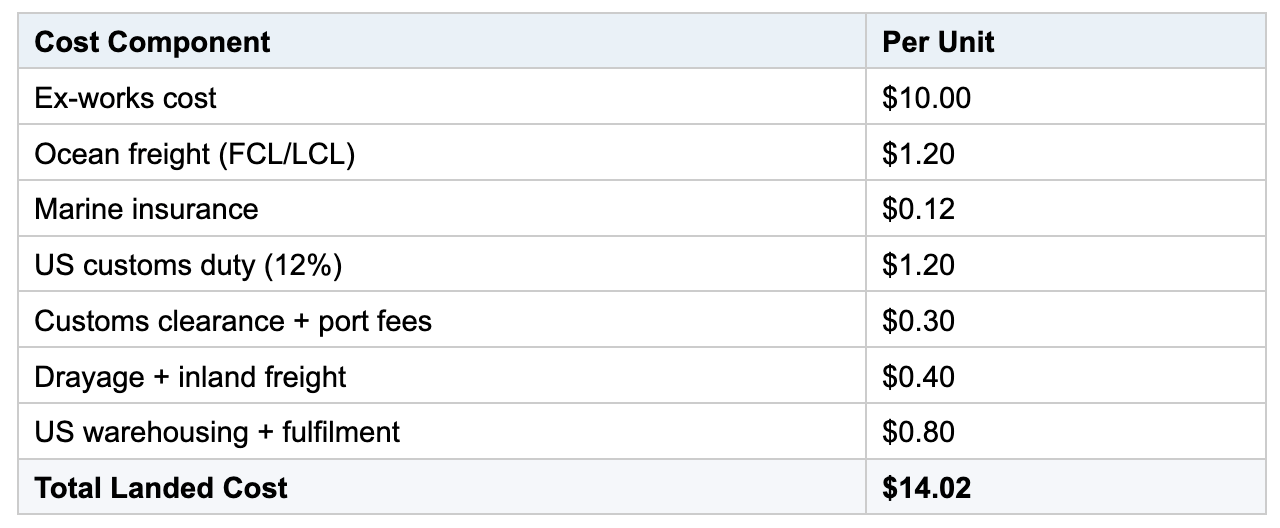
Your landed cost is $14.02. This is the floor below which you cannot sell without losing money. Everything above this number is your margin for the US market.
Breaking Down the US Price Tag
Calculating your landed cost is only the starting point. To price effectively, you also need to understand how the US pricing ecosystem works. Your product doesn’t move straight from your warehouse to the customer. It passes through multiple hands, and every participant in the chain expects to earn a margin.
A typical stack looks like this:
Your price to a distributor or importer: Landed cost plus your margin, usually 20–40% above landed cost for branded goods, tighter for commodities.
Distributor to retailer: Distributors typically mark up 20–40% on top of what they pay you.
Retailer to consumer: Retailers typically mark up 50–100%.
If your product lands at $14 and you sell to a distributor at $18, the distributor sells to a retailer at $24–25, and the retailer puts it on the shelf at $48–50. Now, if comparable products in that category retail for $35, you have a problem.
This is exactly why understanding US consumer price expectations for your category is non-negotiable before you finalise your export pricing.
Benchmarking Against the US Market
Before you quote anyone, spend real time understanding what your category actually sells for in the US.
For retail products:
Search for your exact product type, sort by bestseller, and look at the price range of products with high review counts on Amazon. That is your consumer price window.
Check Target, Walmart, and Whole Foods (for food) online. These are the reference points your buyer is already using.
Look at speciality retailers for comparable items. Selling handcrafted home goods? See what West Elm or Anthropologie retails similar products for.
For B2B and wholesale:
Faire and other wholesale marketplaces show wholesale prices directly. The wholesale-to-retail ratio is usually around 50% - a product retailing at $40 wholesales at $20.
Talk to your buyer honestly. Ask what price point they need to make the product work. Good buyers will tell you.
The question to answer is simple: given your landed cost and the margins the chain needs, can your product reach the consumer at a price that is actually competitive in the category? If the answer is no, you have three honest options: Reduce your production cost, reduce your margin, or find a channel where fewer hands touch the product before it reaches the consumer.
Pricing Strategies That Work in the US Market
Minimum Order Quantities: Larger orders reduce your per-unit shipping, handling, and operational costs. Creating pricing tiers for quantities such as 500, 1,000, and 5,000 units allows you to reward bigger commitments while maintaining healthy margins on smaller orders.
FOB vs. DDP pricing: Many US buyers prefer DDP (Delivered Duty Paid) because it offers a single, all-inclusive price with logistics, duties, and delivery handled by the seller. While this simplifies purchasing for the buyer, it increases your operational complexity and financial risk.
If you offer DDP, your landed cost calculations need to be highly accurate because you are responsible for every cost along the way.
Currency risk: If you quote in USD while your costs sit in INR, build in a buffer for exchange-rate movement. A 3–5% buffer on quotes with long lead times is reasonable.
Payment terms: US buyers commonly negotiate payment terms such as Net 30, Net 60, or even Net 90. Extended payment cycles create a real financing cost for your business, as capital remains tied up long after the order has been fulfilled.
Factor this cost into your pricing strategy or explore invoice financing solutions to maintain healthy cash flow.
What US Buyers Actually Negotiate On?
One of the biggest pricing mistakes exporters make is focusing only on the product price. In reality, US buyers negotiate the total cost of the relationship. The things they will push on:
Unit price
Freight terms
Payment terms
Return policy
Compliance costs
A buyer who gets Net 60 terms, free shipping to their warehouse, and a generous return allowance is getting a far better deal than the unit price alone suggests.
Final Thoughts
Every exporter eventually learns the same lesson: margins are not lost in the factory. They are lost in the details.
The freight costs you ignored, the payment terms you agreed to, the currency movement you did not anticipate, and the duty changes you failed to account for can quietly erode even the best products.
So build pricing models you can update quickly. Know your true landed cost at all times. Understand the full distribution chain before you quote a single number. And when in doubt, talk to a US customs broker and a freight forwarder before you commit to a price.
In the long run, buyers rarely remember who offered the lowest price. They remember who delivered consistently, solved problems quickly, and became a partner they could trust.
Related Articles


Dive into Vault today & unlock a world of possibilities.