


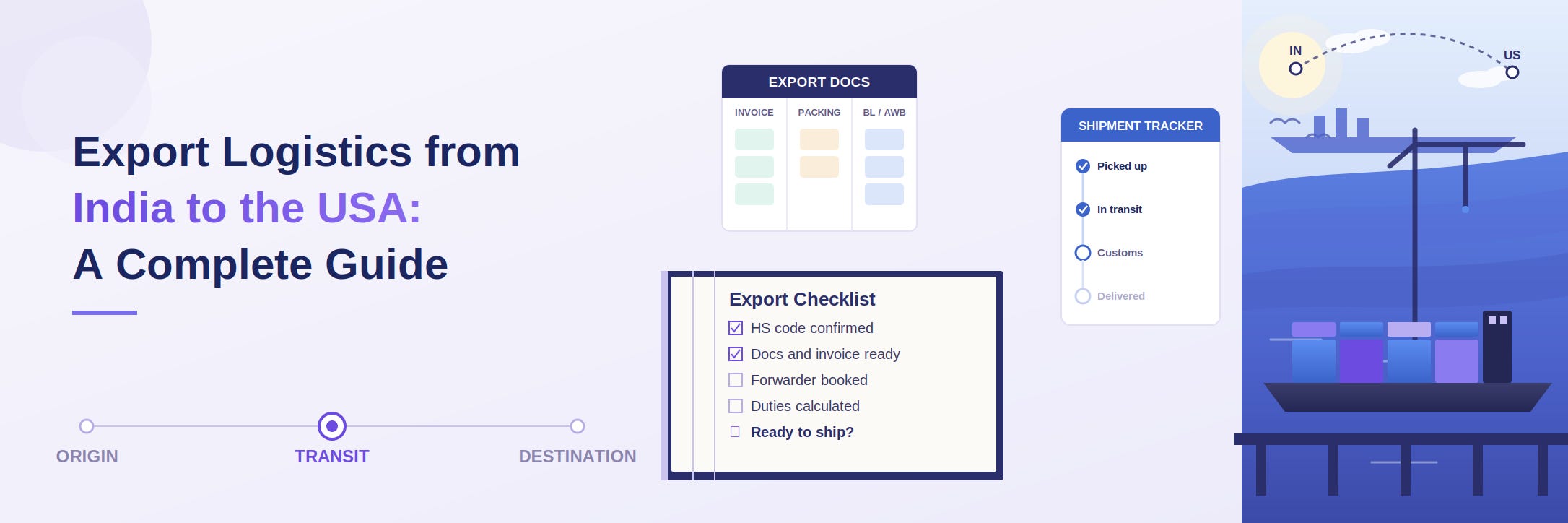
Shipping a product from a factory in Tirupur or Moradabad to a customer’s doorstep in Texas is far more complex than simply handing the goods to a freight forwarder. It involves multiple stages- packaging, documentation, customs clearance, freight, warehousing, last-mile delivery, and more. Each stage comes with its own costs, risks, timelines, and potential points of failure.
In this guide, we’ll walk through the complete logistics journey from the moment your goods leave the factory to the moment they reach an American customer’s doorstep. We’ll also look at why Amazon FBA has emerged as one of the most powerful distribution options for Indian exporters looking to build and scale their presence in the US market.
Warehouse to Port: International Freight
This stage of the export journey covers everything from inland transportation and port handling in India to international ocean or air freight and arrival at a US port or fulfilment centre. Choosing between air and sea freight, selecting the right shipping route, consolidating cargo, and working with the right logistics partners can make a substantial difference to your overall economics.
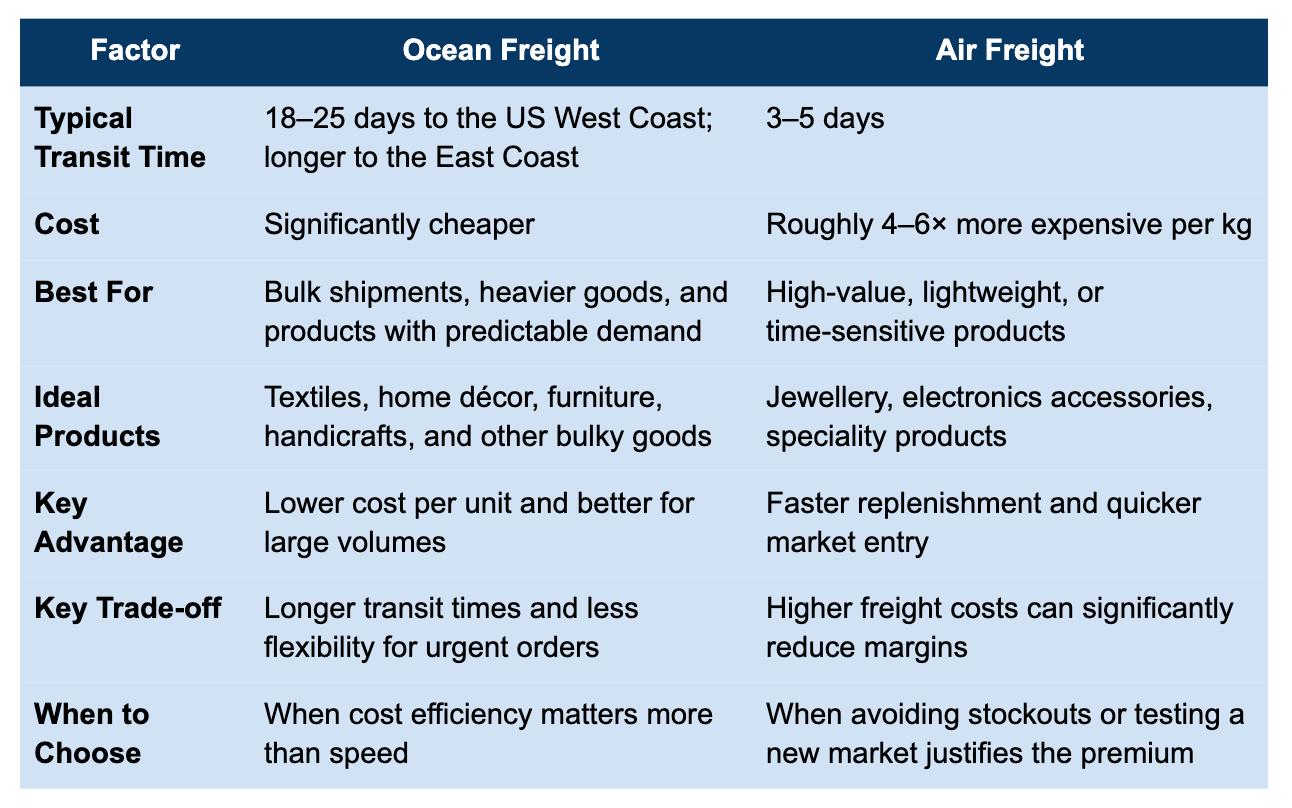
Ocean Freight vs. Air Freight
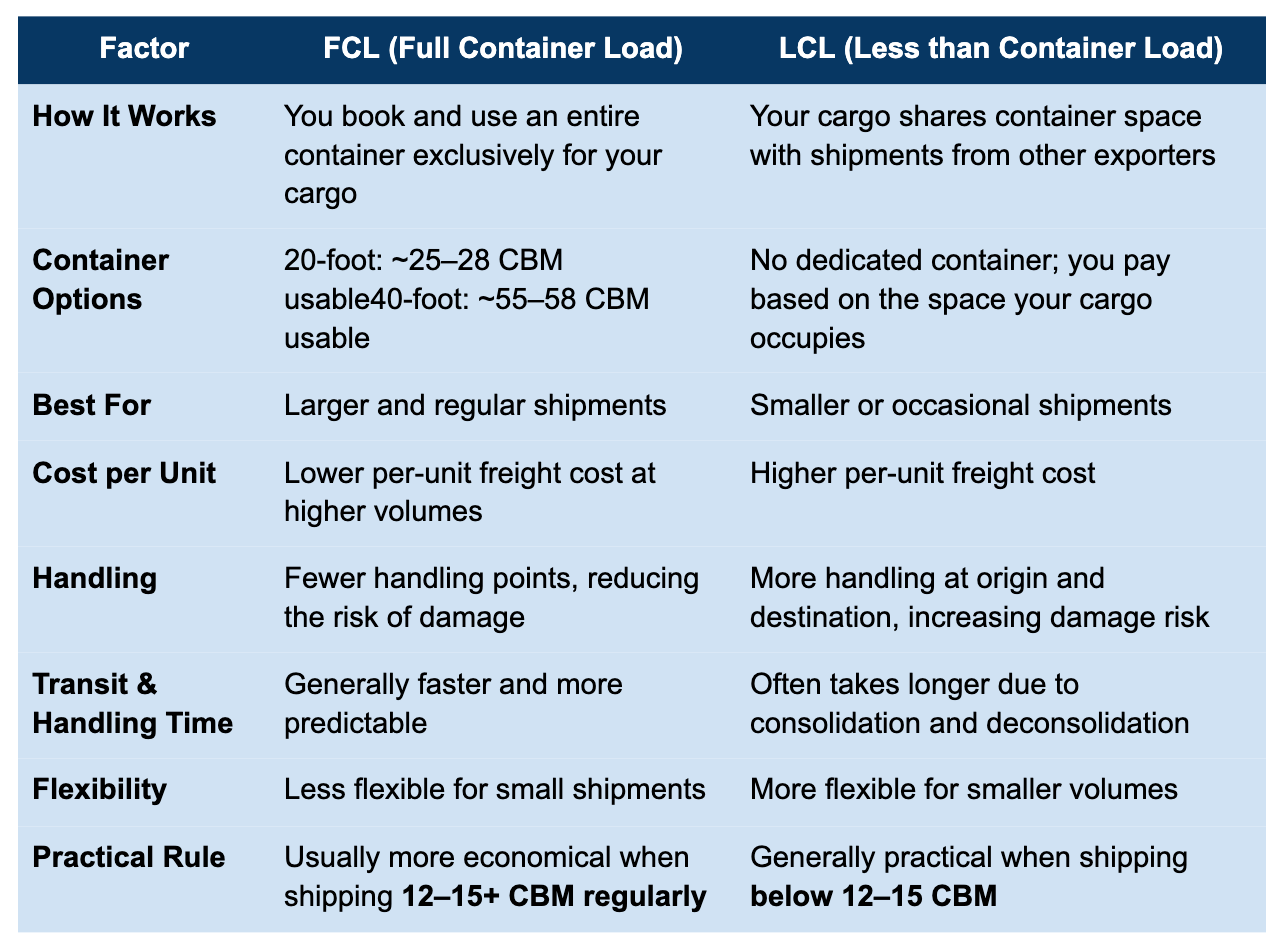
FCL vs. LCL
How to Choose the Right Freight Forwarder?
Your freight forwarder is arguably the most important logistics partner you will have. They handle booking, documentation, customs at origin, and coordination with your customs broker at the US end.
What to look for:
Experience specifically with India-to-US shipments (not just general international freight)
In-house or strong partner relationships with a licensed US customs broker
Familiarity with your product category (hazmat, food, textiles, and other categories have specific documentation requirements)
Transparent fee structures (watch for destination handling charges that are not quoted upfront)
References from other Indian exporters you can actually call
Do not default to the cheapest forwarder. One documentation error can get your shipment held at US customs for weeks. The cost of that delay dwarfs any savings on freight.
US Customs
Once your shipment reaches the US, it still has one important hurdle to clear: customs. US Customs and Border Protection (CBP) reviews commercial shipments entering the country, and while most shipments move through smoothly, missing or incorrect paperwork can quickly turn into delays, extra charges, and frustrated customers.
Here’s what you’ll typically need:
Commercial Invoice: Think of this as the primary document for your shipment. It should clearly state what you are shipping, the HS code, country of origin, and declared value.
Packing List: This tells customs and your logistics partners what is actually inside the shipment, including the number of packages, weight, dimensions, and contents.
Bill of Lading or Air Waybill: This is the transport document that accompanies your shipment, depending on whether you are shipping by sea or air.
Certificate of Origin: Depending on your product and the applicable import requirements, you may need to provide proof of where the goods were manufactured.
Product-Specific Certifications: Some products come with additional compliance requirements. Food products, for example, may have FDA requirements, while certain electronics may need FCC compliance and children’s products may fall under CPSC requirements.
For routine shipments, an experienced broker can often complete the clearance process within 24-48 hours of arrival, provided all documentation is in order.
While customs broker fees, typically around 150-400 per shipment for standard cargo, add to your logistics costs, they can be well worth it.
Fulfilment Centre to Customer Doorstep
The last mile is the final leg of your logistics journey, getting your product from a US warehouse or fulfilment centre to the end customer or retail location. Despite being the shortest part of the journey, it can often be one of the most expensive and operationally challenging.
For B2B shipments, last-mile delivery is relatively simple. If you are supplying a retailer or distributor, a trucking company can move pallets from the port or warehouse to the buyer’s facility, after which the buyer typically takes care of the remaining distribution.
DTC (direct-to-consumer) shipping is a different story. Instead of moving one large shipment to a single location, you may need to send hundreds or thousands of individual packages to different addresses across the US. Customers also expect these orders to arrive quickly, often within 2–5 days.
Some of the major last-mile delivery options in the US include:
UPS and FedEx
USPS
Amazon Logistics
Regional carriers: Companies such as OnTrac, LSO, and Spee-Dee can offer lower rates in the regions they serve and can be useful for larger-volume shippers looking to reduce delivery costs
For a typical 1 lb parcel, last-mile shipping can cost around 6–12, depending on the delivery zone, package dimensions, service level, and carrier. Costs increase as the package gets heavier or larger.
How Amazon FBA Simplifies US Logistics
If there is one logistics solution that has made it significantly easier for international sellers, including Indian exporters, to enter the US market, it is Amazon FBA (Fulfilment by Amazon)!
You send your inventory to Amazon’s fulfilment centres in the US, and Amazon takes care of what happens next. It stores your products, picks and packs orders as they come in, ships them to customers, and manages returns.
Products fulfilled through Amazon FBA are eligible for Prime, giving them access to Amazon’s fast delivery network and making them more attractive to the millions of Prime customers in the US.
In return, you pay Amazon storage fees for holding your inventory and fulfilment fees when orders are shipped.
FBA Cost Breakdown
FBA fees depend on product size and weight. For a standard-size item (let us say a 1 lb product in a box under 15 x 12 x 0.75 inches):
Fulfilment fee: Approximately $3.50-5.00 per unit (picking, packing, shipping, customer service, returns)
Storage fee: Approximately $0.75-2.40 per cubic foot per month (lower in Jan-Sept, higher in Oct-Dec peak season)
How to Ship to Amazon FBA?
You don’t send individual customer orders from India to Amazon. Instead, you ship your inventory in bulk, usually cartons or pallets, to Amazon’s fulfilment centres in the US.
The process typically looks like this:
Create your Amazon listings: Set up your products in Amazon Seller Central and enrol the eligible products in FBA.
Create an FBA shipment plan: Amazon will provide instructions on where your inventory needs to be sent and which fulfilment centre or centres to use.
Apply the required labels: Products need the appropriate Amazon FNSKU barcodes. You can label the products yourself or pay Amazon to apply the labels for you.
Ship your inventory from India: Your goods can be shipped directly to the designated Amazon fulfilment centre or routed through a US-based 3PL or prep centre that handles labelling, inspection, and Amazon-compliant packaging.
Amazon receives your inventory: Once Amazon receives and processes the shipment, your inventory becomes available for sale, and Amazon takes over fulfilment when customers place orders.
However, while FBA simplifies much of the fulfilment process, it comes with its own limitations like:
Inventory placement fees
Long-term storage fees
Stranded inventory
Return rates in some categories (apparel, electronics) can run 15-30%
FBA vs. 3PL: Which Is Right for You?
Third-party logistics providers, or 3PLs, are US-based fulfilment companies that store your inventory, process customer orders, ship products, and often manage returns. Unlike FBA, a 3PL isn’t tied to a single marketplace, giving you the flexibility to fulfil orders across Amazon, your own website, wholesale customers, and other sales channels from the same inventory pool.
A 3PL can be a better fit when:
You sell across multiple channels
Your products are large or heavy
You need custom fulfilment
You want greater control
Good 3PLs for Indian exporters entering the US market: ShipBob, Flexport Logistics (formerly Deliverr), Red Stag Fulfilment and regional 3PLs near your target customer base.
Building a Scalable Logistics Strategy
A scalable logistics setup might evolve like this:
Early Stage (Years 1–2):
Start with one reliable freight forwarder, a US customs broker, FBA for DTC fulfilment, and LCL ocean freight for smaller shipment volumes.
Growth Stage:
As volumes increase, move from LCL to FCL where it makes economic sense. Add a 3PL to handle orders from your own website and other non-Amazon channels. At this stage, you can also start negotiating better freight rates directly with carriers or through digital freight platforms.
Scale Stage:
With larger and more predictable volumes, you may move to dedicated container shipments, use a bonded warehouse near a major US port, and eventually bring in a US-based logistics manager or third-party logistics account manager.
Final Thoughts
A shipment stuck at customs, an unexpected freight charge, or a last-mile cost you didn’t account for can turn a profitable order into a loss. And the bigger you get, the more expensive those small mistakes become.
Before your first shipment, find a freight forwarder and customs broker you can rely on. Understand the numbers behind FBA before choosing it. And make sure you know exactly what it will cost to get your product from your factory to your customer’s doorstep.
Related Articles


Dive into Vault today & unlock a world of possibilities.