


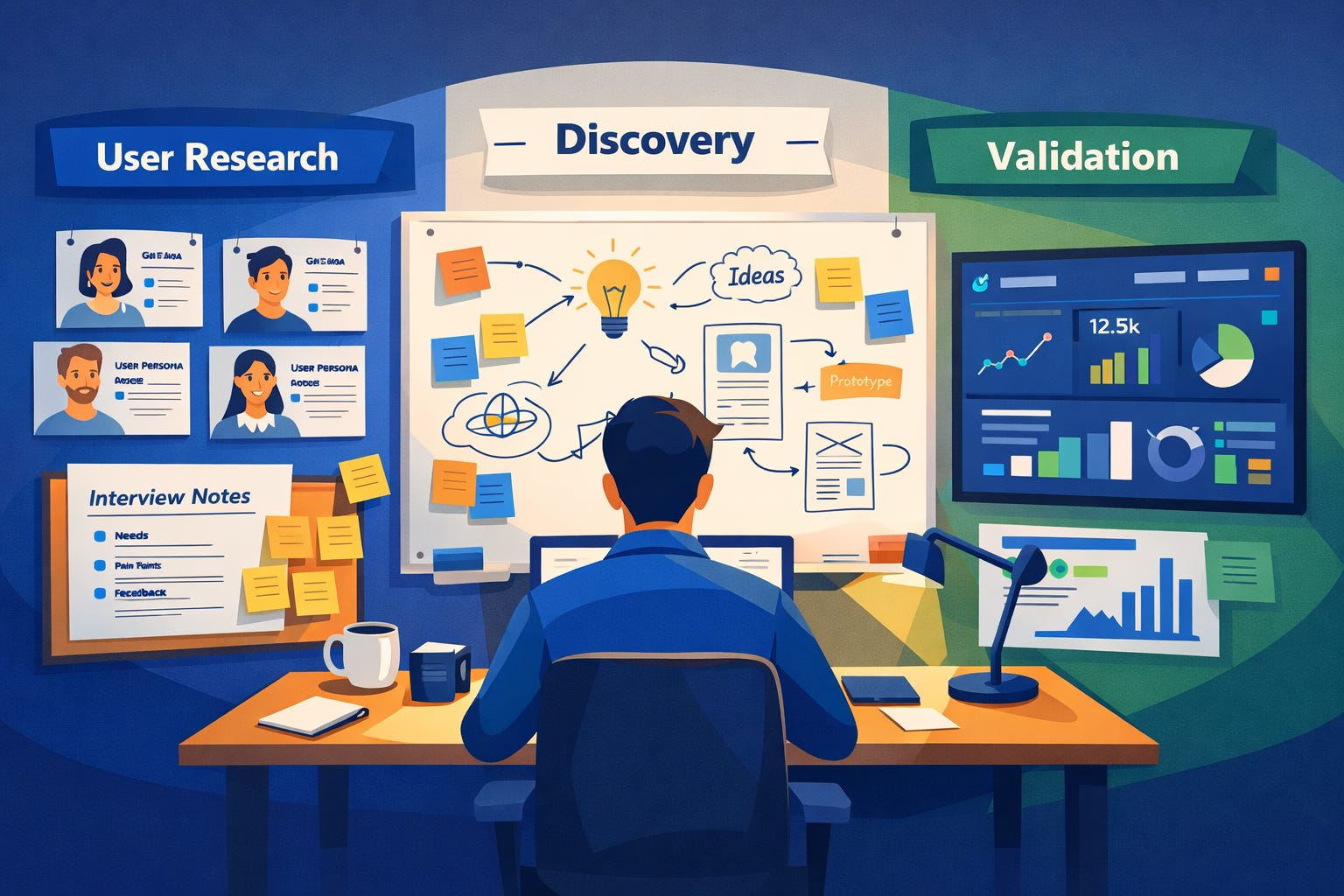
Before building any product, there are three questions you need to answer: Who are your users, and what do they need? What problem is actually worth solving? And will your solution work in the real world? These questions map directly to user research, discovery, and validation.
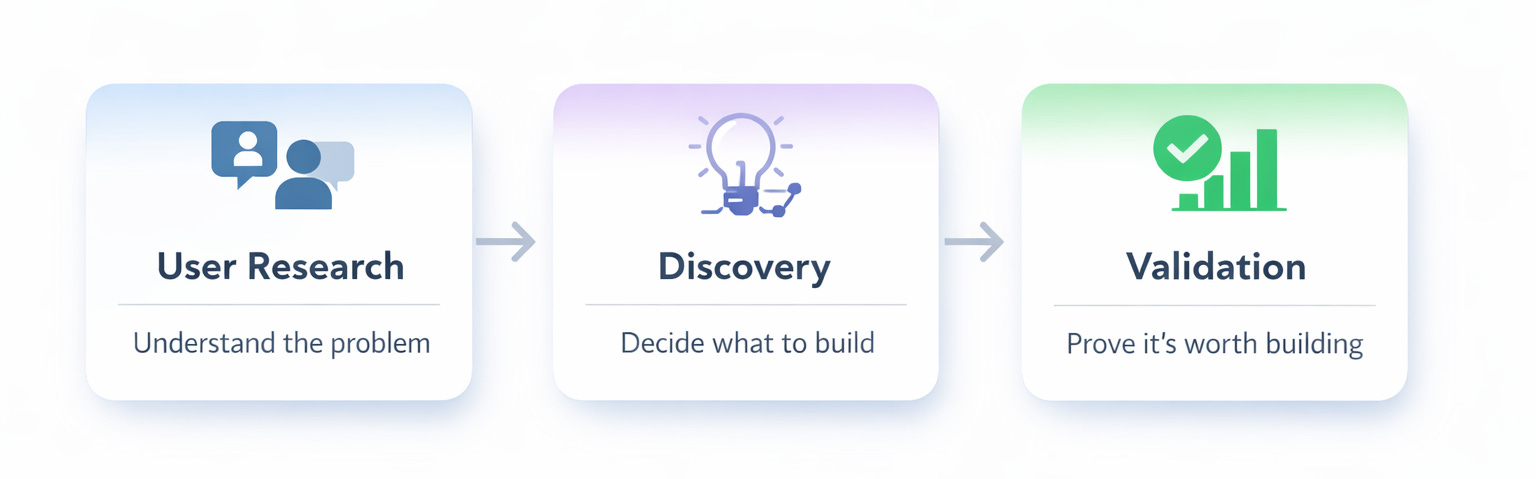
In this article, we’ll break down what each stage really means, how they differ, and how to use them together so you spend less time guessing and more time building things that actually matter.
1. User Research
User research is the process of systematically understanding your users, their behaviours, needs, motivations, and pain points, so you can make better product and business decisions. Instead of relying on assumptions or internal opinions, user research grounds your thinking in real-world evidence by observing how people actually think, act, and solve problems in their daily lives.
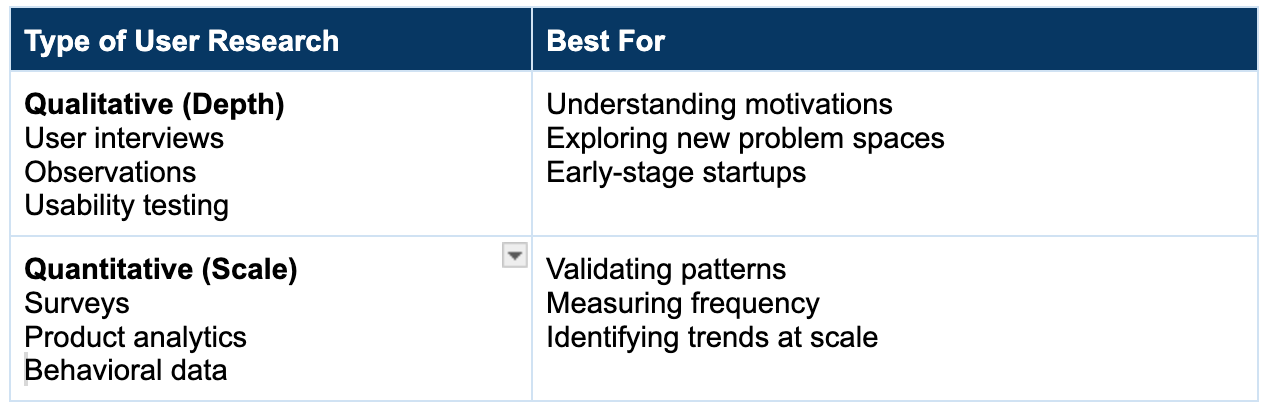
User research isn’t one method- It’s a combination of approaches depending on what you’re trying to learn.
Example
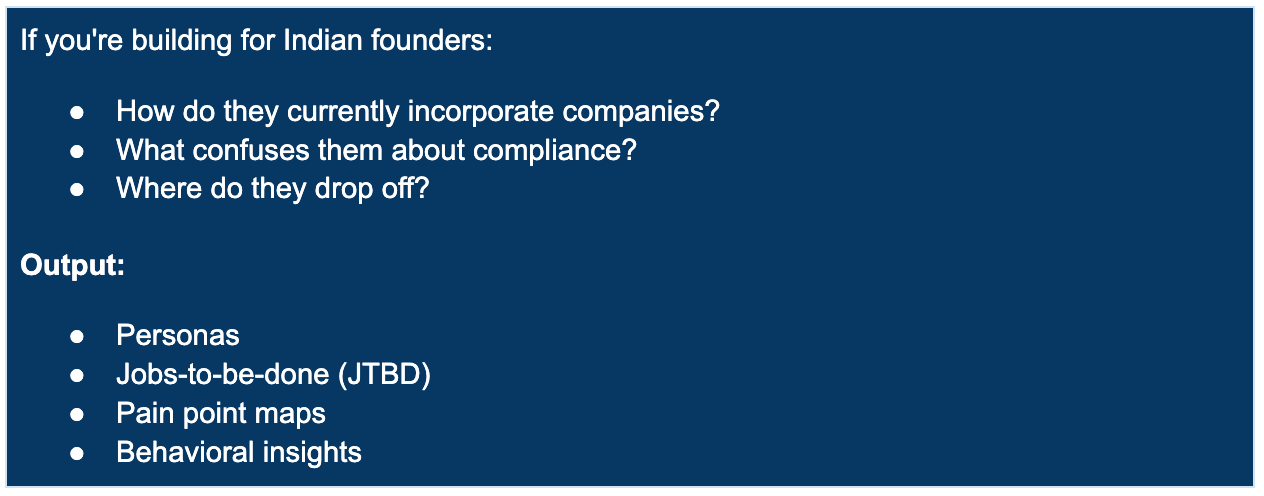
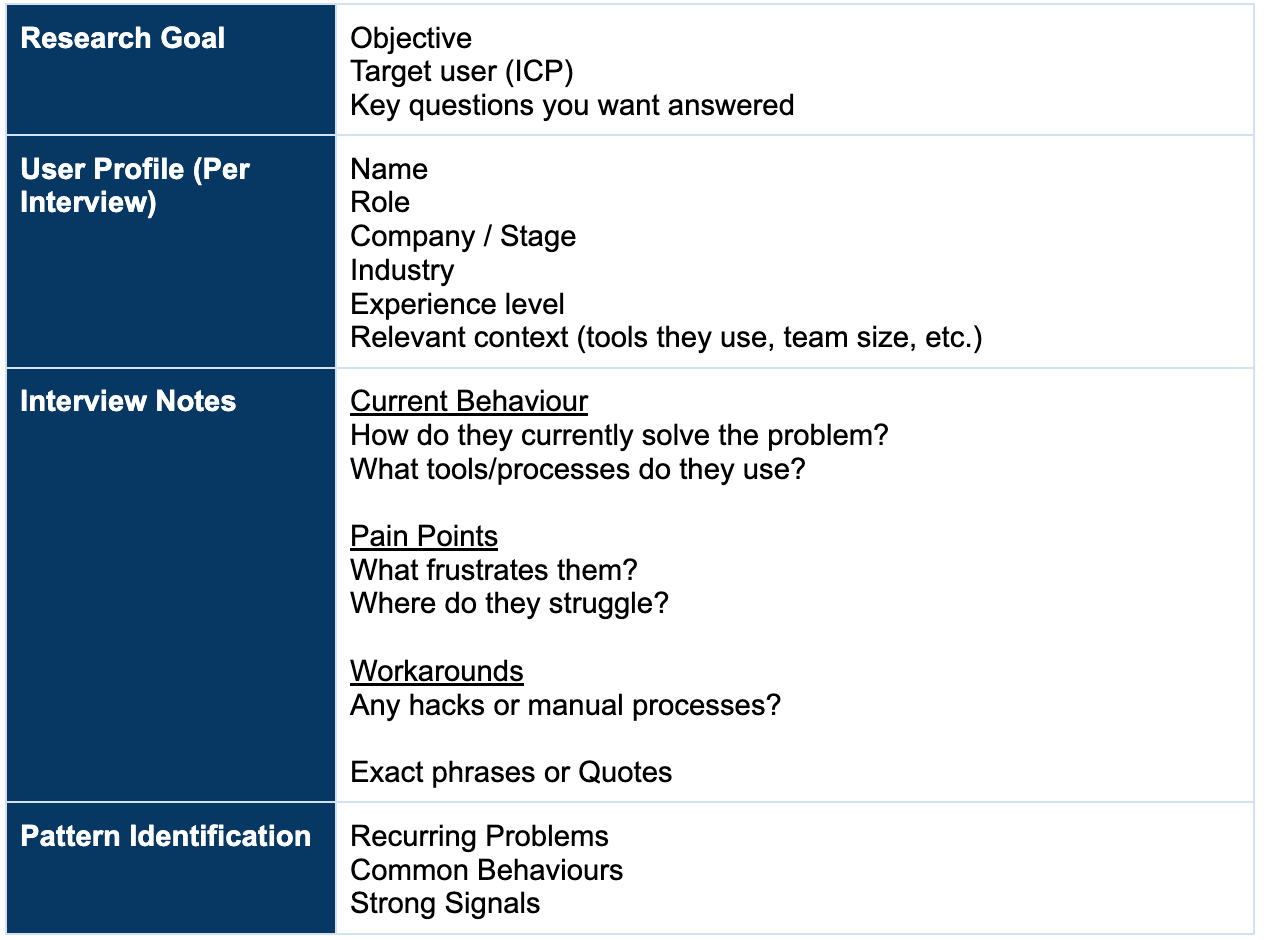
Template for User Research
Before jumping into user interviews, it helps to have a clear structure for what you want to learn.
One of the simplest ways to do this is by organising your conversations around key themes. The following sections outline some of the most important themes to explore, along with guiding questions that help you dig deeper and uncover meaningful insights.
Tools for User Research
Maze: Runs AI-moderated interviews, asks follow-up questions, and conducts research across time zones
Dovetail: Automatically transcribes and organises interviews
UserBit: Handles noisy audio, overlapping speakers, and converts conversations into structured data
Google Forms: Quick and free surveys
Typeform: Better UX, higher completion rates
SurveyMonkey: Advanced survey logic and analytics
2. Discovery
Discovery is the stage where you decide what is actually worth building, before you invest time and resources into building it. After understanding users and their problems through research, discovery is about narrowing focus- identifying which problem truly matters, which users to prioritise, and what potential solutions could work.
Breaking Down the Discovery Phase
Identifying Patterns:
Move beyond individual user conversations to identify trends.
What problems keep repeating?
Where do users show strong emotion or frustration?
What workarounds are common?
Prioritising Problems:
Evaluate problems based on:
Frequency- How often does this occur?
Intensity- How painful is it?
Urgency- Do users need this solved now?
Willingness to pay- Will they spend money to fix it?
Defining Your Target User
When you clearly define your target user, you begin to understand the context in which the problem exists: their stage of growth, the tools they already use, when the problem becomes most painful, and what it actually costs them if left unsolved.
Exploring Multiple Solutions
This is where you expand your thinking and explore:
Different approaches to solving the same problem
Simpler vs more complex solutions
Manual vs automated workflows
Short-term fixes vs scalable systems
Testing Assumptions Early
Before building fully, you test your thinking. This could include:
Wireframes or mockups
Notion workflows or manual solutions
Conversations around proposed solutions
Example
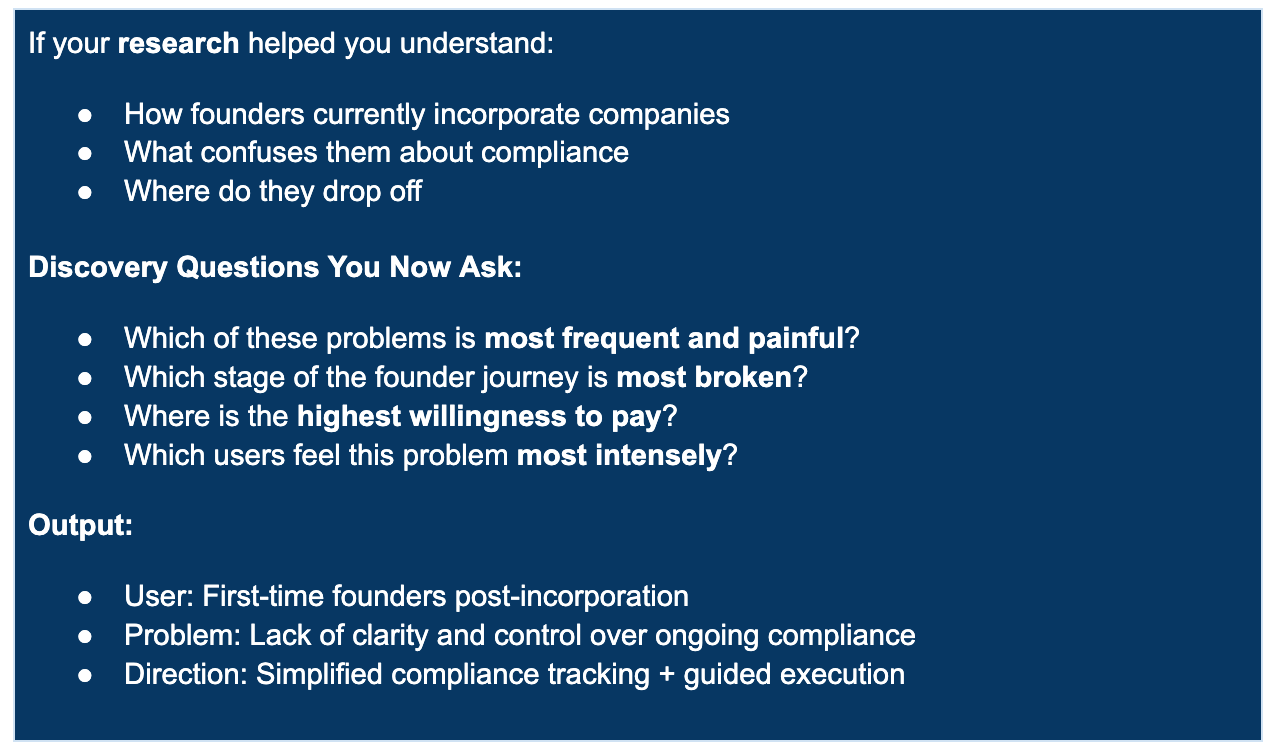
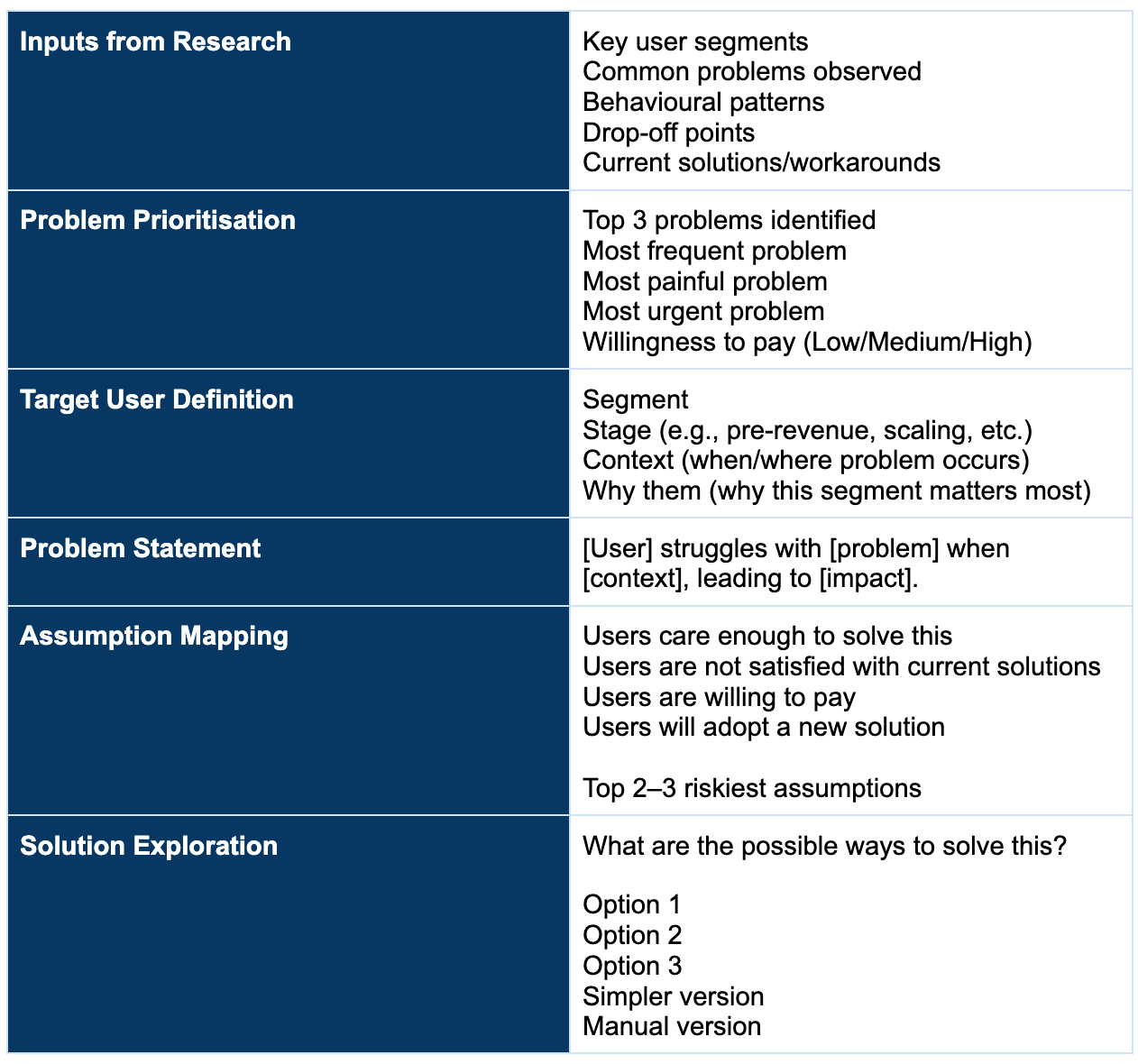
Template for User Discovery
So, how do you actually put discovery into practice? Start with this.
Tools for Discovery
Here are some of the most useful AI tools across different parts of discovery:
Condens: Helps tag and organise qualitative research at scale
HeyMarvin: Extracts patterns and key quotes from user conversations
QoQo: Turns messy notes into structured insights and generates interview questions
ChatPRD: Helps define product requirements and refine problem statements
Notion AI: Useful for synthesising research and drafting problem statements
Hotjar: Heatmaps and session recordings
FullStory: Tracks user journeys and friction points
3. Validation
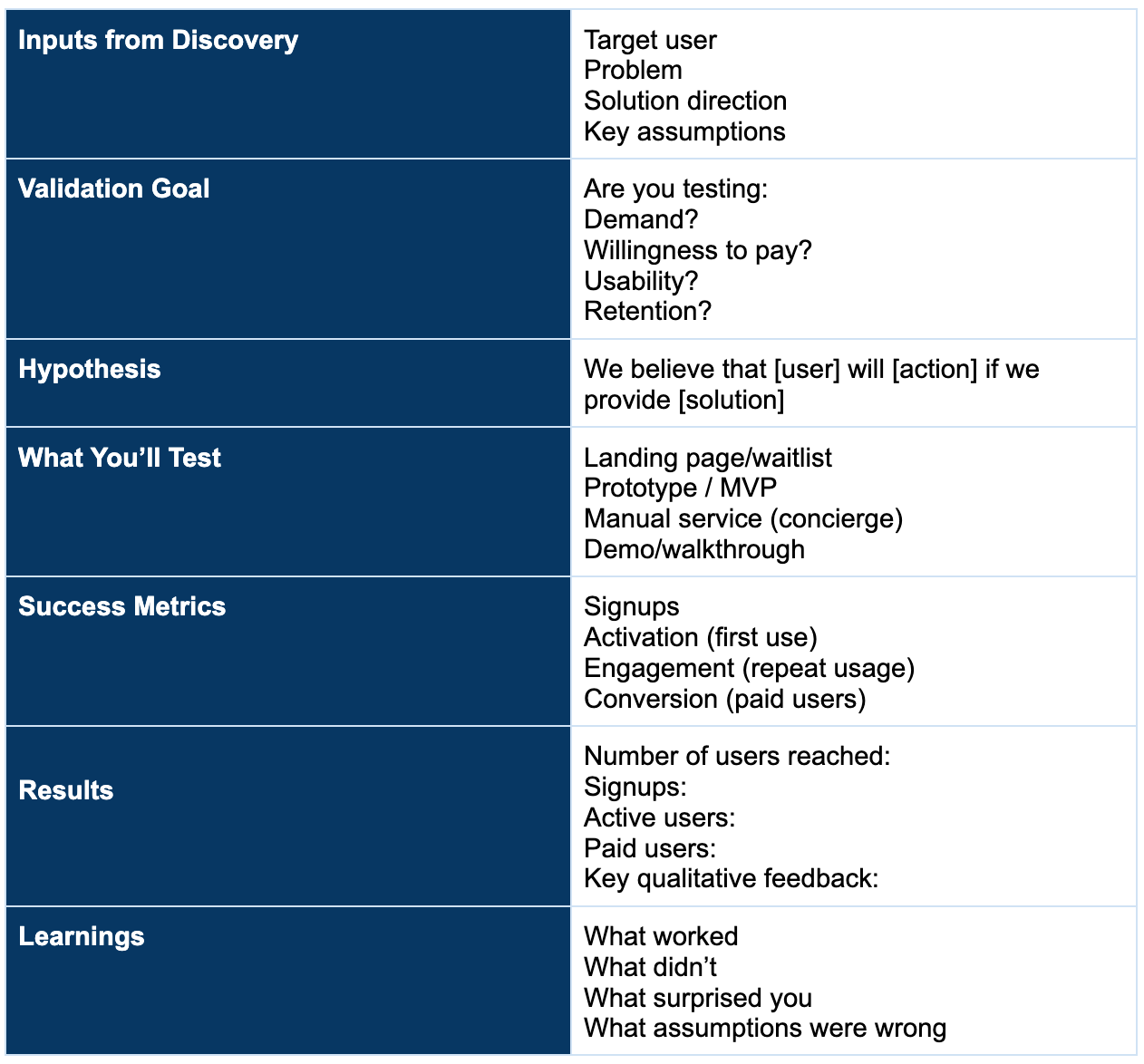
Validation is the stage where you prove whether your solution actually works in the real world by testing if users are willing to commit, not just agree.
The intent is to present your idea to users in a tangible way and observe how they use it. This could include:
Landing pages with signups
Waitlists
Pre-orders or early payments
MVP usage
Pilot programs or beta access
Example
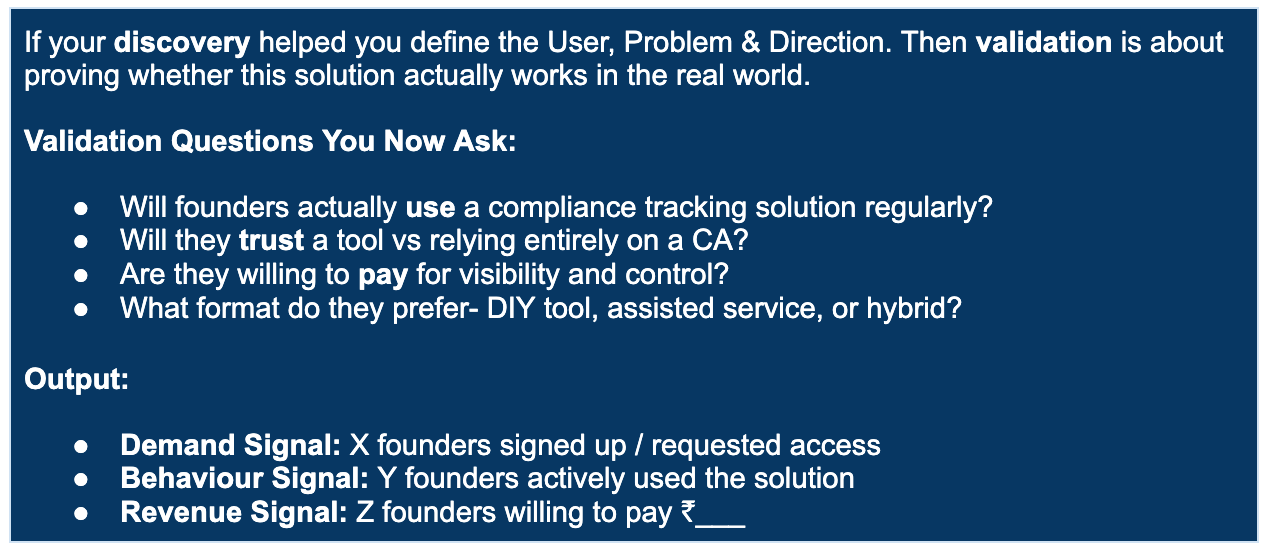
Template for Validation
Tools for Validation
Validator AI: Acts like an AI mentor that evaluates your idea and gives structured feedback
SaaS Idea Validator: Scores your idea on demand, competition, monetisation, and clarity
Trickle: Generate landing pages with waitlists, pricing polls, and conversion tracking
Based Labs AI: Build landing pages and launch experiments without code
ProtoBoost: Generates interactive prototypes and runs user testing + A/B tests
Final Thoughts
Great founders don’t just build fast- they build the right thing fast. Because speed without direction only gets you to the wrong place quicker. Almost every founder has experienced the frustration of building something that seemed right but didn’t land.
But, you know who gets it right? The ones who slow down just enough to understand their users deeply, make clear decisions on what to focus on, and validate honestly. even when the answers aren’t what they hoped for. Because in the long run, it’s not speed that saves you, it’s building something people actually need.
At Razorpay Rize, we get it- building a startup is tough. That’s why we’re more than just a space for connecting with other founders. We’ve got programs, tools, and services designed to take some of the weight off the shoulders and make the journey just a little bit easier.
Curious about how we support startup founders?

Dive into Vault today & unlock a world of possibilities.