


For SaaS companies selling to enterprises, security becomes part of the product and, increasingly, part of the sales process. Today, 83% of enterprise buyers require SOC 2 certification before they’ll even sign a SaaS contract.
But what does that architecture actually look like - the practical version a lean team can build, operate, and evolve without slowing the business down?
This guide breaks down the essential components of B2B SaaS security architecture, how they fit together, and what founders and engineering teams should prioritise at different growth stages.
1. Start with a zero-trust security model
Traditional security often works on the idea that people and systems inside a company’s network can be trusted. But once someone gets in, they may be able to access other internal resources without much additional verification.
For a modern SaaS platform operating across cloud infrastructure, distributed teams, third-party integrations, and customer environments, a zero-trust model is the way to approach security. Its underlying principle is simple: no user, device, service, or network connection should receive access solely because of where it originates.
A B2B SaaS startup can apply zero-trust principles through three foundational controls.
Verify identity explicitly: Every user and service must authenticate before accessing protected resources.
Apply least-privilege access: Users and services should receive only the permissions necessary to perform their assigned tasks.
Always assume a breach is possible: Design systems to limit the damage caused by compromised credentials, vulnerable applications, or malicious insiders.
The approach is consistent with NIST’s Zero Trust Architecture framework, which emphasises protecting individual resources rather than relying on traditional network boundaries.
2. Build a strong identity and access management layer
Identity and access management (IAM) determines who can access and which actions they can perform. It is one of the first security capabilities enterprise customers are likely to evaluate.
A scalable IAM architecture should include the following capabilities:
Multi-factor authentication (MFA): Multi-factor authentication adds another verification step beyond a password.
Single sign-on: SAML 2.0 or OpenID Connect allows customers to integrate your application with identity platforms such as Microsoft Entra ID or Okta.
Single sign-on (SSO) reduces the number of passwords employees must manage and enables organisations to centrally administer authentication. For B2B Saas startups targeting mid-market and enterprise customers, SSO should be part of the product roadmap.
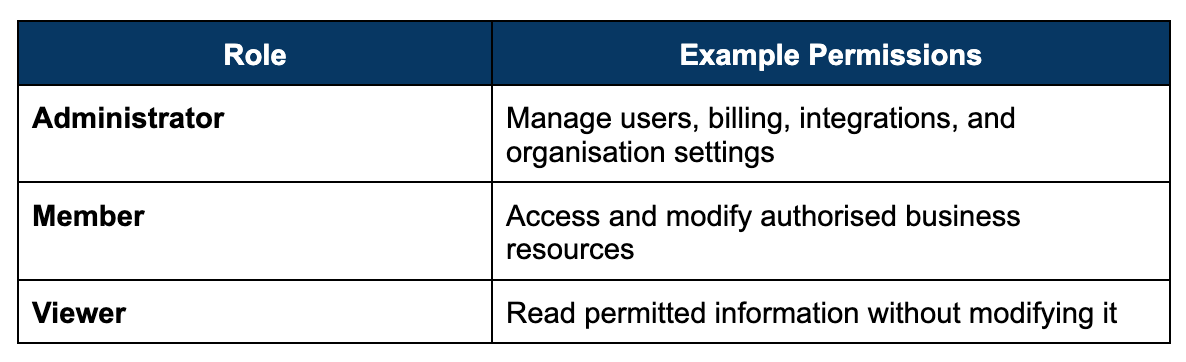
Role-based access control: Not every user should have the same permissions. Crucially, permissions must be enforced by backend services.
For example: A typical B2B SaaS application might support three roles:
Automated user provisioning: When an employee leaves a customer’s organisation, their access to your SaaS product should be revoked promptly. This is where Support for the System for Cross-domain Identity Management (SCIM) comes into play.
If your startup doesn’t have SCIM yet, that’s okay. Start with the basics: make sure admins can manage user access, revoke active sessions when needed, and follow a clear offboarding process.
Production access: Production environments should not be accessible to everyone with a standing set of credentials. Use just-in-time (JIT) access so engineers receive production privileges only when they need them, for a limited period and, where appropriate, with an approval or audit trail.
Maintain a documented break-glass account for genuine emergencies. Access to this account should be tightly restricted, strongly protected with phishing-resistant MFA, logged, and reviewed after every use.
Session management: Authentication does not end when a user successfully signs in. Your application should have clear controls for managing active sessions and tokens.
At a minimum, cover:
Session timeouts
Session revocation
Revocation on role changes
Refresh token rotation
User visibility
3. Design multi-tenant isolation from day one
Most B2B SaaS platforms use a multi-tenant architecture, where multiple customers share the same underlying infrastructure while their data remains separate and private.
For example, a SaaS platform is used by 100 different companies. They may all run on the same application servers and database infrastructure, but that doesn’t mean they can access each other’s data. Company A should only ever see its own records, not anything belonging to Company B.
There are 3 common approaches to multi-tenant data storage.
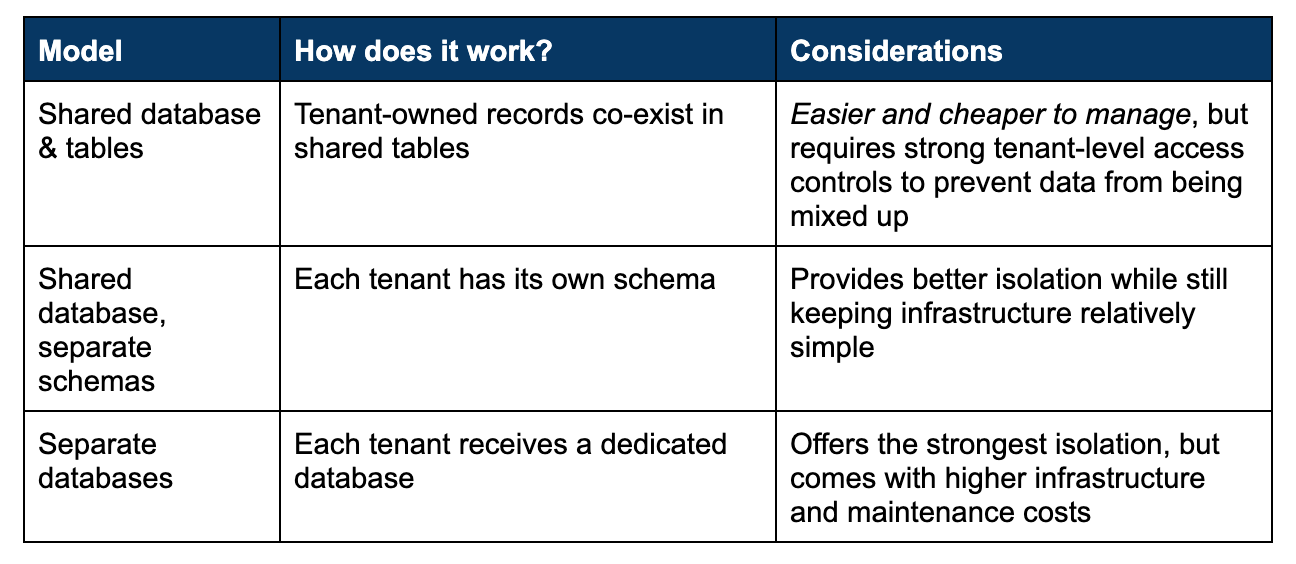
A shared database is a reasonable starting point for many early-stage startups, provided tenant isolation is enforced and thoroughly tested.
Please note: Add automated cross-tenant tests (IDOR) in CI. This is the #1 real-world B2B SaaS bug.
4. Protect data at every stage
B2B SaaS platforms frequently process commercially sensitive information, and data protection should cover information while it is transmitted, stored, processed, backed up, and eventually deleted.

Note: Protect encryption keys through a dedicated key-management service, with restricted access & rotation procedures. API tokens, database passwords, signing keys, and cloud credentials should never be stored directly in your application code. Instead, keep them in a dedicated secrets manager and make sure access is limited to the workloads that actually need them.
If the product uses LLMs, cover prompt injection and tenant data leakage via AI.
5. Secure your cloud infrastructure
Cloud providers offer a wide range of built-in security features, but simply running your application in the cloud doesn’t make it secure. Your startup remains responsible for how you configure those services, who can access them, how you protect customer data, and how you secure your application workloads.
Keep production and development separate: Production environments should be kept separate from development and testing environments. Avoid using real customer data in development systems whenever possible.
Minimise public exposure: Not every system needs to be accessible from the internet. Databases, internal admin panels, and other sensitive management services should remain private unless there’s a clear business reason to expose them.
Manage infrastructure as code: Tools such as Terraform and cloud-native infrastructure templates let teams manage infrastructure through version-controlled code. This makes infrastructure changes easier to review, test, reproduce, and audit.
Secure the software supply chain: Your application’s security also depends on the code, libraries, containers, and tools used to build it. Keep an inventory of your dependencies and container images, scan them regularly for known vulnerabilities, and use trusted build environments.
6. Make API Security a core architectural requirement
APIs connect your application to customer systems, mobile apps, third-party tools, and internal services. Every new integration adds to your attack surface, so security needs to be built in from the start.
A secure API should include:
Strong authentication and authorisation: Make sure every request is properly authenticated and that users can only access resources they’re allowed to see.
Rate limiting: Prevent a user, integration, or tenant from overwhelming shared resources. Rate limit per tenant, not only per user.
Input validation: Check incoming data and reject unexpected or malformed requests.
Secure credentials: Use scoped API keys, support rotation and revocation, and never expose secrets in URLs.
Webhook protection: Sign outgoing webhooks and verify incoming signatures to prevent tampering and replay attacks. Also, use an HMAC signature plus a timestamp to block replays.
Finally, add automated API security tests to your development workflow, especially when launching new endpoints.
7. Implement security monitoring & incident response
Your startup must be able to detect suspicious activity, investigate potential breaches and restore affected services.
Centralise security logs: Collect relevant security events like unsuccessful login attempts, privilege changes, unusual data exports, production configuration changes & any other suspicious activity.
Establish alert priority: Define alert severity, ownership, escalation procedures and expected response times.
Create an incident response plan: Maintain an accessible incident contact list and conduct periodic tabletop exercises. Use the 6 functions of NIST Cybersecurity Framework 2.0, such as Govern, Identify, Protect, Detect, Respond & Recover, to organise the wider security program.
India’s CERT-In requires incident reporting within 6 hours, and DPDP has its own board notification. Founders often miss this!
8. Prepare for enterprise security & compliance requirements
Two widely recognised assurance mechanisms are SOC 2 and ISO/IEC 27001.
SOC 2 is an attestation framework used to report on controls relevant to security and, where included in the engagement, availability, processing integrity, confidentiality and privacy.
ISO/IEC 27001 specifies requirements for establishing, maintaining and continually improving an information security management system.
Neither should be seen as a replacement for secure engineering.
If your startup is preparing for an audit, start by getting the basics in place. This means having clear processes for access reviews, employee onboarding and offboarding, vulnerability management, incident response, change management, and vendor risk.
9. Build privacy into your SaaS architecture
The Digital Personal Data Protection (DPDP) Act, 2023, along with the DPDP Rules, 2025, sets out requirements around how organisations collect, use, store, and protect digital personal data.
Start with the basics:
Know your data: Map what personal data you collect, where it lives, who can access it, and which vendors process it.
Limit access: Use role-based access controls and give employees and services access only to the data they need.
Protect the data: Use appropriate encryption, logging, monitoring, backups, and other security safeguards.
Define retention: Know how long different types of personal data need to be kept and have a process for deleting it when it is no longer required.
Secure third parties: Make sure vendors that process personal data have appropriate security and contractual safeguards in place.
Prepare for incidents: Have a documented process for detecting, responding to, and reporting personal-data breaches.
Understand your role: A startup may act as a Data Fiduciary for some activities and a Data Processor for others, depending on who determines the purpose and means of processing.
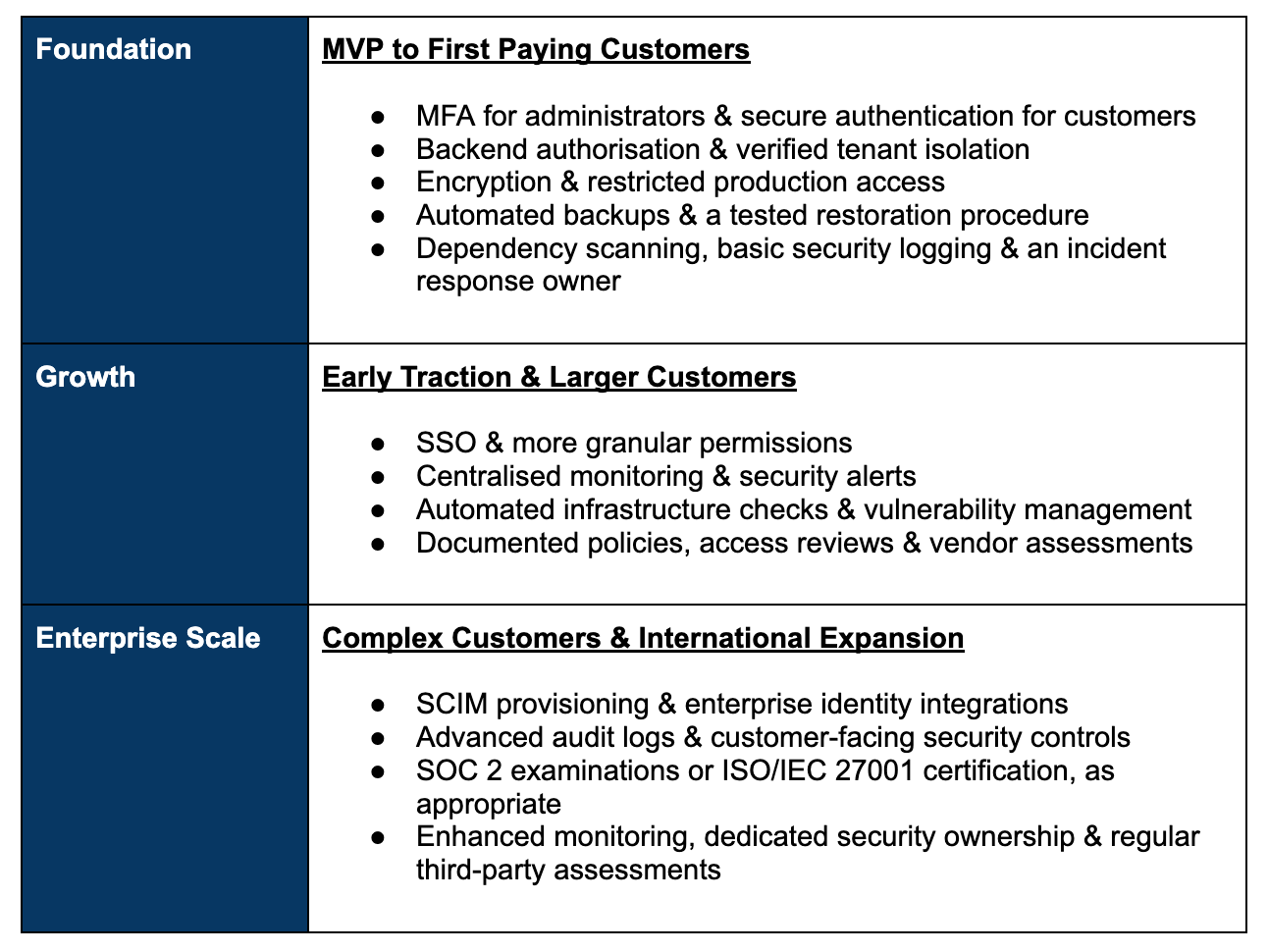
A Practical Security Roadmap for B2B SaaS Startups
You don’t need to build every security control from day one. Your priorities will depend on the kind of data you handle, how complex your architecture is, what your customers expect, and the threats you’re likely to face.
The roadmap below is a practical starting point, not a one-size-fits-all checklist. As your product and team grow, your security needs will evolve too.
Final Thoughts
Security can feel like a lot when you’re building a startup. There’s always another tool to add, another vulnerability to fix, or another compliance requirement to think about.
The most important thing is to get the fundamentals right early. Know what data you collect and where it lives. Make sure the right people have access to the right systems. From there, build security into the way your team works.
If security hasn’t been a priority yet, it’s not too late to start. The best time to build security into your SaaS product is before your customers have to ask for it!
The recommendations outlined above are general security recommendations based on common industry practices and expert guidance. The appropriate controls may vary depending on the company’s size, architecture, risk profile, regulatory requirements, customer expectations, and business needs.
At Razorpay Rize, we get it- building a startup is tough. That’s why we’re more than just a space for connecting with other founders. We’ve got programs, tools, and services designed to take some of the weight off your shoulders and make your journey just a little bit easier.


Dive into Vault today & unlock a world of possibilities.