


If you’ve been building a startup over the last few years, go-to-market probably feels very different today than it did when you first started.
The GTM playbooks that worked between 2018 and 2022 were built for cheaper distribution, less competition, and buyers who relied on sales and marketing to educate them. In that world, heavy paid acquisition, large outbound sales teams, static pricing, and siloed functions made sense. In today’s market, they increasingly don’t.
In this article, we explore what’s fundamentally changing in go-to-market and the concrete shifts founders need to make across product, sales, pricing, and distribution to build sustainable growth in 2026 and beyond.
So, how has GTM changed in 2024-25?
1. AI is shifting from experimentation to scaled deployments
McKinsey’s recent State of AI work found ~23% of organisations reporting that they are scaling agentic AI in at least one function, which means AI will be baked into operational workflows (not just pilots).
2. Product-led growth evolved
On average, only about 9% of free users convert to paid in PLG products. The real gains come when startups identify high-intent users early and provide the necessary human support to close larger, more valuable deals.
3. Creator & community channels matured into commerce engines
Conservative market estimates place India’s creator economy in the low single-digit billions of USD today, with growth expected to continue (examples: market write-ups predict India will reach $1.4-$2.5B by 2025, with projections to grow by multiples by 2027).
That means creator partnerships and creator-driven commerce are a material channel for consumer brands and many B2B2C plays.
The 8 GTM Changes Founders Must Make in 2026
1. Treat AI as a GTM Owner
AI will be everywhere in GTM by 2026, but the advantage will come from how deeply it is embedded, not whether it exists.
Identify repeatable tasks (lead scoring, personalisation, onboarding sequencing, content generation for campaigns) and build agentic workflows that measure outcome metrics (time saved, conversion lift, SQL quality).
List the GTM tasks your team does manually (sales follow-ups, onboarding emails, lead sorting).
Automate two of them using AI, such as lead prioritisation or onboarding support.
Measure conversion and rep time saved- double down on what improves payback.
2. Move PLG to a hybrid motion
Product-Led Growth still matters, but product usage must drive the GTM motion. Treat usage as the intent signal, hand off high-intent users to sales at the right moment, and support the funnel with strong brand narratives.
Product data should trigger timely human assistance, such as concierge onboarding, tailored pricing, or expansion outreach, when it actually adds value.
Use product activity to spot high-intent users in real time
Define clear moments when sales should step in
Create brand content that helps free users see the value of upgrading
3. Run creator programs as measurable performance channels
Content should not be one-to-many ad campaigns alone. Invest in creator partnerships, micro-communities, and UGC that convert into subscriptions, trials, or commerce.
In markets like India, creator influence already correlates with significant consumer spending and will be a primary growth lever for B2C and many B2B2C models.
Experiment:
Launch a micro-creator partner program with clear performance KPIs (revenue / LTV per creator).
Run 1-month community cohorts that funnel members into trial offers or paid pilots
4. Adopt adaptive pricing and more flexible packaging
In 2026, buyers expect usage pricing, AI feature add-ons, and outcome-based pricing in specific verticals. Build elastic plans that reflect value (e.g., seats, usage, and AI processing) and experiment with performance-based trials for high-intent customers.
Experiment:
Offer a pilot where the first month is performance-discounted and measure conversion to full price.
Introduce a “pay-for-value” meter for premium AI features.
5. Shift metrics to payback and unit economics
VCs and buyers now care most about efficient growth. Your GTM dashboards should prioritise time to CAC payback, first-year gross margins, and expansion revenue. Shorter payback means less dependence on external funding.
Experiment:
Replace marketing KPIs with payback-focused metrics in your weekly growth standup.
Run two pricing/packaging experiments aimed at shortening payback.
6. Build a cross-functional revenue engine
Small, cross-functional “pods” are becoming the norm. These teams own specific customer segments end-to-end and, with AI support, can move faster and outperform larger, siloed teams by reducing coordination and speeding up experimentation.
Experiment:
Form 1 pod (3–6 people) focused on one ICP. Equip them with analytics, budget for ads & creator partnerships, and one AE.
Run weekly experiments.
7. Make privacy-first, personalisation standard
Personalisation still works, but it has to be earned. Privacy rules and customer expectations now demand explicit consent, minimal data collection, and transparency about how information is used. The best GTM teams make the value exchange obvious- share a few details and get faster onboarding, better recommendations, or priority support.
Bake privacy into every GTM experiment to avoid future compliance churn. (This is especially important if you expand internationally.)
Experiment:
Map data flows for every marketing and onboarding automation.
Add consent banners tied to better onboarding experiences or trials.
8. Prioritise sales enablement with AI
Sales reps should no longer rely on static decks or generic scripts. Instead, AI should generate battle cards, account-specific playbooks, and pitch materials that automatically update based on product usage and customer intent.
Enablement becomes an ongoing system- content is created when needed, tailored to each account, and surfaced at the exact moment a rep needs it.
Experiment:
Equip reps with a real-time playbook tool (AI-generated one-pagers per account).
Run enablement sprints to replace static decks with templated, data-driven assets.
A practical 90-day GTM playbook for founders (step-by-step)
Days 0-14: Set the foundation
Track key product actions and integrations.
Calculate baseline GTM metrics- CAC, payback period, and conversion from free to paid.
Identify two GTM workflows to automate with AI, such as lead scoring and onboarding nudges.
Start by understanding how people actually use your product.
Days 15-45: Launch AI + revenue pod
Create a small group that owns growth from end to end. This doesn’t need to be big, just has to have people in product, growth, sales, and creative roles.
Use AI to score leads based on product usage and route high-intent accounts to sales with suggested outreach.
Days 46-90: Test new demand and pricing
Run a creator pilot with a small group of creators using tracked links or codes.
Test a hybrid pricing model on a limited set of customers and track the impact on revenue and payback.
In short, test one new way to attract customers without incurring heavy ad spend.
Days 91-180: Scale what works
Focus on the channels and signals that show the best efficiency.
Expand the pricing model that improves ARPU and payback.
Centre investor and board updates around CAC payback and expansion revenue.
From this point on, track just two things in every investor or board conversation:
How quickly do you recover customer acquisition costs?
How much do existing customers expand over time?
Final GTM Checklist for 2026 Founders
Use product activity to spot high-intent users in real time
Have at least one AI workflow supporting sales or onboarding
Run one creator or partner channel with clear cost and conversion tracking
Organise growth around a small team that owns revenue end-to-end
Review CAC payback and unit economics every week
Build personalisation and trials with explicit consent and transparency
Final Thoughts
The next GTM advantage won’t come from new channels or clever campaigns. It will come from founders who understand that growth is a systems problem, not a hustle problem.
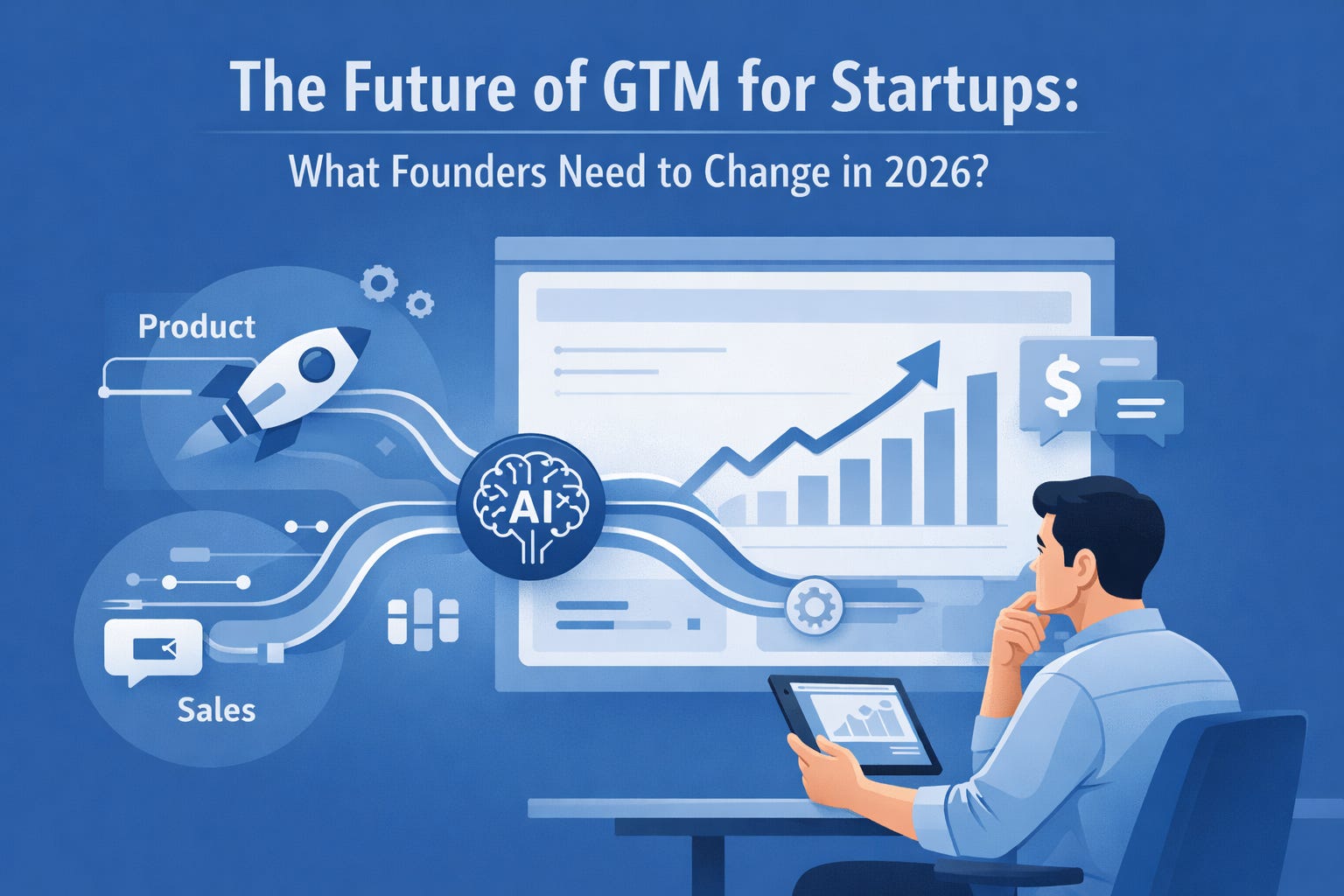
Product, AI, creators, pricing, and sales can no longer operate in silos. They are parts of the same machine. When they are designed together, they reinforce each other. When they aren’t, value leaks at every step.
The fundamental shift heading into 2026 is learning to design GTM as a system. When product usage reveals intent, AI helps you respond at speed, and humans step in only where they add real value- Growth becomes more predictable. Because the future of GTM belongs to founders who build systems that listen.
At Razorpay Rize, we get it- building a startup is tough. That’s why we’re more than just a space for connecting with other founders. We’ve got programs, tools, and services designed to take some of the weight off the shoulders and make the journey just a little bit easier.
Curious about how we support startup founders?

Dive into Vault today & unlock a world of possibilities.