


Your website can have the best content on the internet and still be invisible on Google. That’s because SEO doesn’t start with keywords.
Before Google can rank your content, it has to find your page, crawl it, understand it, and decide that your site is technically trustworthy enough to surface. That depends on decisions most founders never think about: how quickly your pages load, whether search engines can access your content, how your site is structured, and whether you’re giving Google enough context to understand what each page actually means.
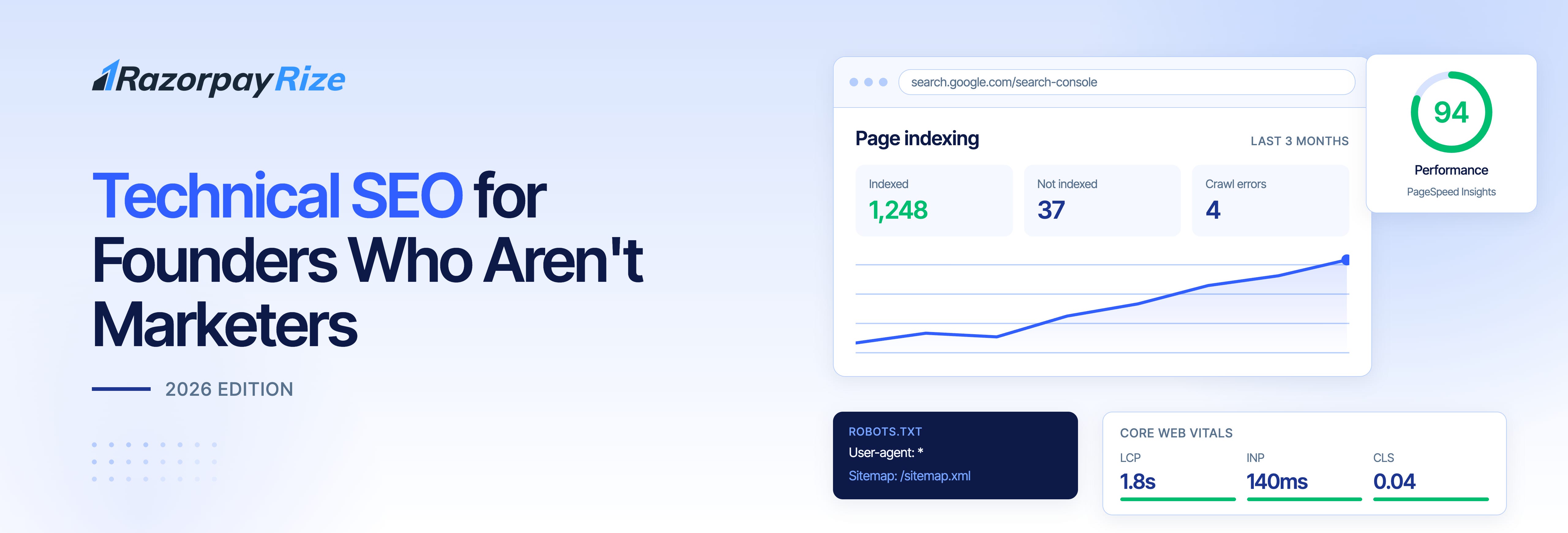
This is the side of SEO that often gets buried under keyword research and content calendars. In this article, we’ll break down the technical side of SEO, from site speed and crawlability to indexing and structured data, and show how these behind-the-scenes factors can directly impact your rankings.
Crawlability
Before Google can rank your site, it first needs to find it. That process is called crawling- Google’s bots visit your pages, follow links, read the content, and work out what each page is about.
A single line in your robots.txt file, a forgotten noindex tag from development, or a sitemap that was never submitted can prevent Google from properly discovering your pages. Your site might look completely normal to a visitor while remaining effectively invisible to search engines.
India now has over a billion internet users, and nearly all of them- upwards of 96%- are coming in through a mobile device, not a desktop. Most Indian founders are, in effect, building for a mobile-first Google that indexes the mobile version of their site by default. If crawlability breaks on mobile, it doesn’t just break for some users. It breaks for almost everyone.
What to check:
Google Search Console: Free, and the first thing you should set up. It tells you exactly which pages Google has indexed, and flags errors.
robots.txt: A simple text file at yoursite.com/robots.txt. Make sure it isn’t blocking pages you want found.
XML sitemap: A map of your site for search engines. Submit it directly in Search Console.
Site Speed
Portent’s analysis of more than 100 million pageviews across B2B and B2C websites found a clear relationship between speed and conversions: ecommerce sites that loaded in one second saw conversion rates of around 3%, compared with roughly 1% for sites taking five seconds to load.
That’s not a minor difference. It can mean the difference between turning the same amount of traffic into significantly more customers and leaving a large portion of that revenue on the table without realising that page speed is the culprit.
A one-second delay on mobile can also pull conversions down by as much as 20%, and Google’s own research has found that 53% of mobile visits are abandoned once a page crosses the three-second mark.
For founders without a technical background, “site speed” can sound like a problem best left to engineers. In practice, it often comes down to a handful of simple issues: oversized images, too many third-party scripts, bloated plugins, or a website builder that prioritises convenience over performance.
Tools that make this simple:
PageSpeed Insights: Plug in your URL, get a score, and a plain-English list of what’s slowing you down.
TinyPNG or Squoosh: Compress images before uploading, without visibly losing quality.
GTmetrix: Goes a layer deeper if PageSpeed’s suggestions feel too technical.
Mobile-Friendliness
Mobile isn’t an afterthought in SEO anymore. Google primarily uses the mobile version of your site for indexing and ranking, which means your mobile experience can directly shape how your site performs in search.
Most modern website builders take care of the basics automatically, but that doesn’t mean you should assume everything works perfectly. Open your site on your phone and look at it like a first-time visitor: Does it load quickly? Is the content easy to read? Can I navigate without frustration? And, most importantly, would I trust this business based on what I see?
Structured Data
Structured data, often called schema markup, is a way of giving search engines more context about your content.
You’ve probably seen the results without realising what powers them: star ratings, product prices, availability, recipe details, and other enhanced information that appear directly in search results.
For example, a small D2C brand could add product schema to its website and start showing prices and stock availability alongside its search listings. The brand hasn’t published a single new article, but its listings now give potential customers more information before they even click.
And that’s what makes structured data interesting for founders. Studies on rich results- the enhanced listings schema makes possible- have found click-through rates run anywhere from 20% to 80% higher than plain, unenhanced listings. FAQ-style rich results, specifically, have been recorded with click-through rates as high as 87%.
Where to start:
Google’s Rich Results Test: Paste your URL and see what structured data, if any, Google can already detect.
Schema.org: The reference library for what markup exists.
Most website builders (Shopify, Webflow, WordPress plugins like Yoast) can add basic schema without you writing a line of code.
Core Web Vitals
Core Web Vitals are three specific metrics Google uses to judge the experience of visiting your site- not just whether it loads, but how it feels to load.
Largest Contentful Paint (LCP): How long the main content takes to appear.
Interaction to Next Paint (INP): How quickly the page responds when someone clicks or taps.
Cumulative Layout Shift (CLS): Whether things jump around while loading- that infuriating moment when you go to tap a button and the page shifts under your finger
As of mid-2025, only about 41% of websites achieved a “good” Core Web Vitals score on mobile, compared with 53% on desktop. That gap is revealing: the mobile experience, the version most users actually interact with, is still falling short across much of the web.
For founders, that creates an opportunity. Simply delivering a fast, stable, user-friendly mobile experience already puts you ahead of a large share of websites competing for the same attention.
Final Thoughts
Technical SEO is the foundation everything else depends on. A brilliant blog post on a slow, poorly structured, uncrawlable website is like building a beautiful room in a house with no front door. The work might be excellent, but very few people will ever find it.
You don’t need to become an SEO expert to get the basics right. Before you publish another article, make sure Google can find the ones you’ve already written. Spend 30 minutes in Search Console, run a speed test, check how Google is crawling your site, and look for the obvious problems.
Because the content you’re proud of deserves a website that’s built to get it seen.
At Razorpay Rize, we get it- building a startup is tough. That’s why we’re more than just a space for connecting with other founders. We’ve got programs, tools, and services designed to take some of the weight off your shoulders and make your journey just a little bit easier.


Dive into Vault today & unlock a world of possibilities.