


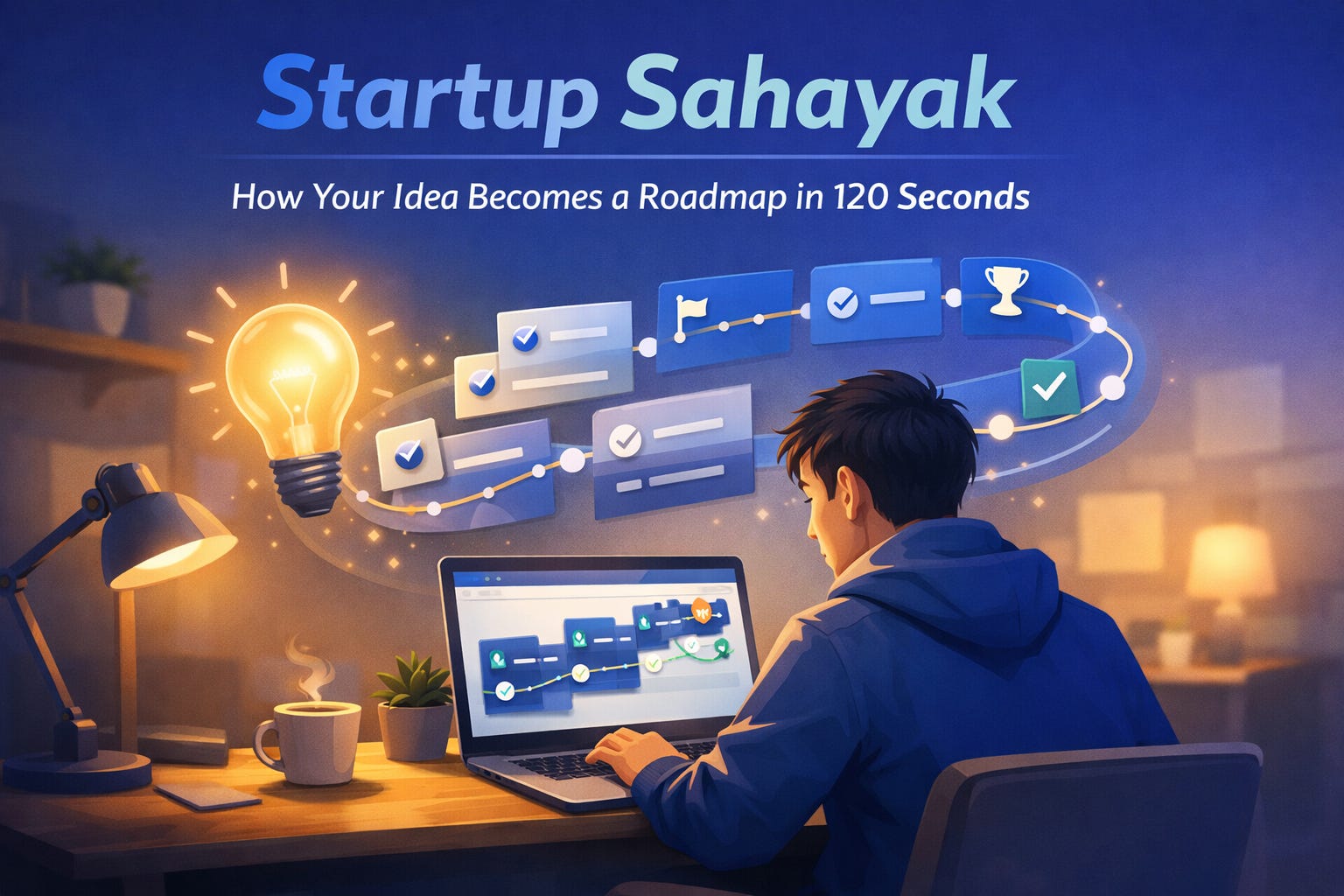
There’s a moment every founder reaches, and it’s not the one people usually talk about. It comes right after the excitement of a new idea- after you’ve imagined the product, maybe shared it with a few friends, and spent hours going down research rabbit holes.
Then you sit down, ready to begin, and a simple question shows up: What do I actually do next?
Startup Sahayak was built to solve this gap. In about 120 seconds, it generates a personalised startup roadmap based on your idea, industry, and experience. It dives into market sentiment, competitive landscape, compliance requirements, and even maps relevant government schemes and grants you could be eligible for.
But what makes this possible isn’t just AI- it’s the system behind it!
To understand the thinking behind Startup Sahayak, we sat down for a candid conversation with Hemlata Saraf, the Product Manager at Razorpay, who helped build it.
What sparked the idea for Startup Sahayak?
Honestly, it started with a pattern we kept seeing. Founders would come in with really solid ideas, but the moment you asked, “What’s your next step?”- they’d pause. Not because they weren’t serious, but because they didn’t know where to begin. There was so much information out there, but nothing that translated their idea into a clear path. That gap is what we wanted to solve.
Who do you think benefits the most from Startup Sahayak?
I think first-time founders benefit the most- especially those without access to mentors or strong networks. This includes people in Tier 2 and Tier 3 cities, students, or anyone exploring ideas alongside their jobs.
That’s really who we built this for- people who just need a clear starting point to get going.
Why was the experience designed around just eight questions?
We were very intentional about that. If you make it long or complicated, people drop off. Early-stage founders are already overwhelmed- they don’t want to fill out a form that feels like work. So the challenge was: how do we ask the right questions, not more questions? Each one is there because it actually changes the direction of the roadmap.
Can you walk us through how Startup Sahayak actually works under the hood?
The simplest way to think about it is- it’s not one AI doing everything. It’s multiple systems working together.
The moment you submit your inputs, different “skills” kick in at the same time. One part of the system looks at your idea and scans across 150+ sources to understand the market, competition, and demand. Another part focuses on government schemes- it pulls data from official sources, stores it, and then matches your idea with grants you might be eligible for.
All of this runs in parallel, which is why we’re able to give something that feels detailed but still comes in quickly. What you see as one output is actually multiple layers working behind the scenes.
How is this different from simply using AI tools directly?
Most AI tools are great, but only if you know what to ask. That’s the catch!
A lot of founders don’t have perfectly framed questions. They just have an idea. So instead of expecting them to figure out prompts, we structured the entire experience. You answer a few questions, and the system does the thinking for you- connecting everything into a roadmap instead of giving scattered answers.
What was the hardest part of building this?
Surprisingly, not the tech!
We had access to a lot of information- market data, founder journeys, compliance steps, and government schemes. The real challenge was: how do we show all of this without overwhelming the user?
Because at that stage, founders don’t need everything. So we spent a lot of time figuring out what to include, what to leave out, and how to make the output feel simple but still useful.
If you were starting a company today, how would you use Startup Sahayak?
I actually did try this myself. I had this idea for a certified nanny service for urban families- it felt like a real problem, and something that didn’t exist widely. But when I ran it through Startup Sahayak, it immediately showed me that a similar company was already operating in Bangalore. That was a bit of a reality check.
It saved me time. It made me think differently- what’s the gap here, how would I position this, is this still worth pursuing?
That’s how I see founders using it. Not to blindly validate their idea, but to see it clearly before going all in.
What’s next for Startup Sahayak?
Right now, we still ask users a few structured questions. But the goal is to make this even simpler. Ideally, you should be able to just describe your idea, and the system figures out the rest- asks what’s needed, builds the roadmap, maybe even suggests your target customers.
We also want to expand beyond government programs, bring in accelerators, ecosystem support, and more context.
Building a startup will always involve uncertainty. There’s no tool that can remove that completely, and maybe it shouldn’t. But figuring out your next step shouldn’t be the hardest part.
Sometimes, all you need is a little direction. A starting point that makes sense for you- If you’re sitting on an idea, check out Startup Sahayak and start building!
At Razorpay Rize, we get it- building a startup is tough. That’s why we’re more than just a space for connecting with other founders. We’ve got programs, tools, and services designed to take some of the weight off the shoulders and make the journey just a little bit easier.
Curious about how we support startup founders?

Dive into Vault today & unlock a world of possibilities.