

This is in collaboration with ClickPost. If you’re getting ready for the festive season this year, you’ll definitely want to go through this. There are a few things you can start planning now to make sure you’re all set when the festive rush begins!
If you run operations for a D2C brand in India, you know this feeling. An order ships, everyone moves on, and then a few days later it boomerangs right back to your warehouse. But it’s not just a box of sunk costs because it soon becomes a number in this week’s report that somehow becomes your problem to explain.
That number has a name: RTO, or return-to-origin. And if you’ve been doing this long enough, you already know it’s the kind of problem that eats into margins.
In this article, we’re sharing a few simple ways to reduce RTOs and make the festive season a little smoother for your business.
The Real Cost of RTO
Return-to-origin shipments can eat up a quarter to a third of everything you ship. Sit with that for a second. One in three boxes, coming back.
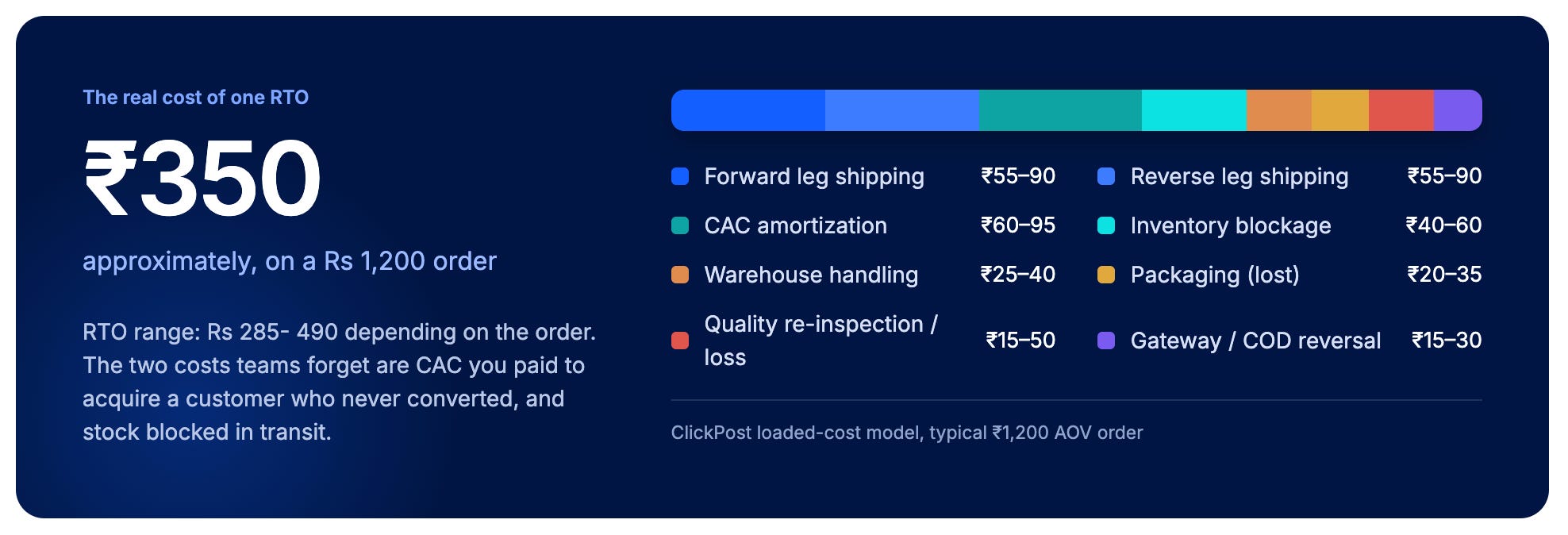
In India, RTO runs 25–40% of shipped orders for D2C brands. On a ₹100 Cr GMV business at a 30% rate, the loaded cost (logistics both ways, blocked inventory, packaging, gateway fees) totals ₹6–9 crore a year, hidden across four cost centres.
And here’s the part that rarely makes it to the boardroom slide: shipping is actually the cheaper part. The real cost of an RTO shows up elsewhere - in the ad spend you’ve already put in to acquire that customer, the warehouse hours spent processing a product, the packaging that now has to be thrown away, and the inventory stuck in limbo, neither sold nor available to sell.
RTO Benchmarks in India
The numbers vary depending on who's measuring, but the overall picture is consistent: RTO rates across Indian D2C brands average somewhere between 20 and 30 per cent, with high-growth brands typically running under 15 per cent and lagging ones drifting well above 30.

Geography matters just as much. Non-metro markets typically run 5 to 12 percentage points higher than metros, and in some tier-3 pin codes without active management, RTO can climb to 40 to 50 per cent.

The idea is simple: RTO is a business number that moves depending on how closely you manage payment mix, geography, and timing.
A 90-Day Roadmap to Lower RTOs
Before you can reduce your RTOs, you need to understand what’s actually causing them. Not every failed delivery has the same reason, and treating them all the same can make it harder to fix the real problem. Here’s how to break down your RTOs, spot the patterns, and figure out where things are going wrong.
Weeks 1–2: Understand What's Actually Happening
Pull the following data for every shipment from the last 90 days.
Order details: Order ID, AWB, dispatch date, delivery/RTO date
Location: Origin and destination pincode, along with the pincode tier (Metro/T1/T2/T3)
Shipping: Carrier and service type (surface/air/express)
Payment: COD or prepaid
Order details: Order value, product category, and SKU count
NDRs: Number of NDR events, reason codes, and resolution outcomes
Final status: Delivered, RTO, lost, or damaged
Customer history: Pin-level repeat rate, split between first-time and repeat customers
Weeks 3–6: The Quick Wins
Encourage prepaid orders: A small incentive for choosing online payment over COD can make a real difference and reduce the chances of customers changing their mind when the order arrives.
Fix address issues early: Catch incorrect or incomplete addresses right after checkout, when they’re easy to correct, rather than dealing with a failed delivery weeks later.
Give customers the flexibility to edit their orders: Whether it’s changing a size, correcting an address, or cancelling an order, making these changes easy can prevent unnecessary failed deliveries.
Treat every failed delivery attempt as a chance to recover the order: Reach out quickly, understand what went wrong, and try to get the shipment back on track instead of letting it turn into an RTO.
Weeks 7–12: The Structural Fixes
Choose the right courier for each pincode instead of assuming one courier works well everywhere. Give customers clear delivery timelines instead of broad three-day windows, and send a message or call before delivery to make sure someone is available to receive the order.
Final Thoughts
There’s no magic fix for RTOs. And if someone tells you there is, they’re probably trying to sell you something. What really works is simply paying attention to what’s happening, week after week. Keep one scorecard, review it regularly, and fix the small issues before they start becoming bigger patterns.
Give it 90 days of consistent effort, and you should start seeing a real difference in your RTO numbers. But the bigger change is in how your team thinks about RTOs. Instead of seeing them as just another cost of running an online business, you start seeing the actual reasons behind them - an incorrect address, a missed delivery, a COD refusal, a courier issue - things you can actually do something about.
If this only scratched the surface for your team, there's more where this came from. In partnership with ClickPost, we've put together the full breakdown - root-cause buckets, benchmark data by category and geography, and the complete week-by-week playbook.
Heading into the festive season? Give this a read if you want to understand what happens beyond the orders and revenue numbers.


Dive into Vault today & unlock a world of possibilities.