


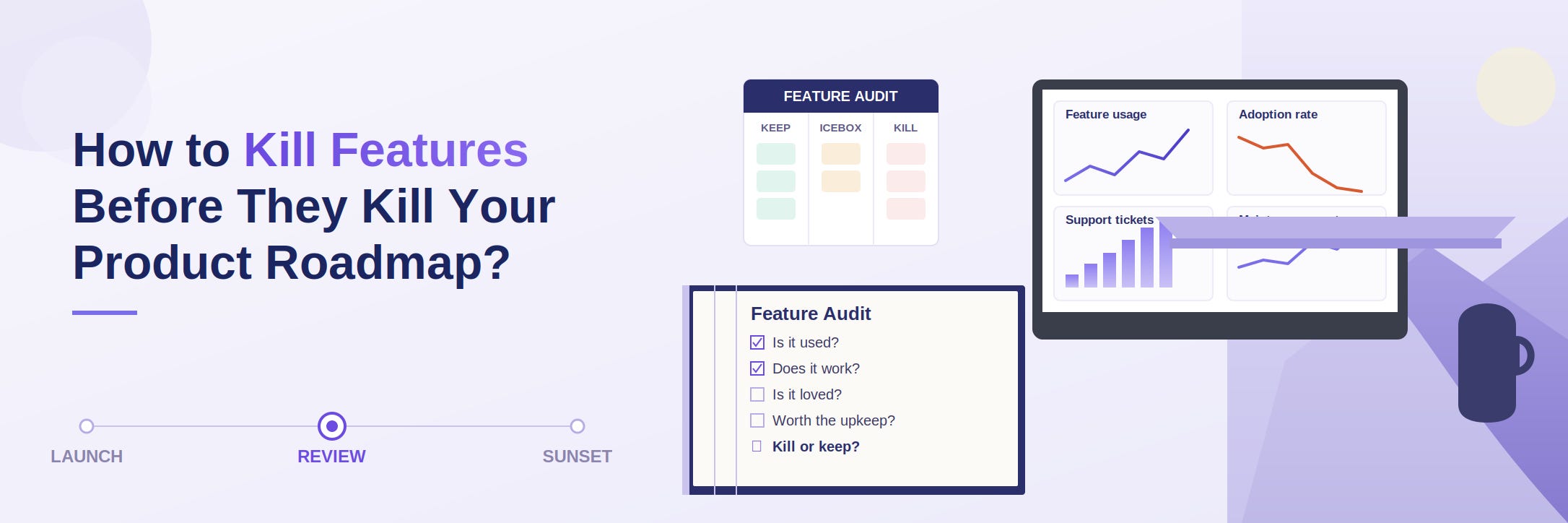
Across 615 software products studied by Pendo, an average of just 12% of features generated 80% of daily usage. Other benchmarks land in the same uncomfortable zone: a separate analysis of product usage put the median feature adoption rate at around 6.4%, meaning for every hundred features a team builds, only six or so do most of the work.
For most founders, that means you’ve probably spent weeks or months building features you were genuinely excited about, only to watch them quietly disappear into the menu, untouched. They’re not causing obvious problems, so they stay.
That’s the real story of product debt. It’s the collection of features that no longer earn their place but continue to consume your team’s time and attention. It demands maintenance, multiplies QA cycles, clutters onboarding, and slowly bends your roadmap around its dead weight.
So in this article, we are going to talk about the side of product management almost nobody teaches: what to remove, what evidence to trust, and how to simplify your product without breaking customer confidence.
The Hidden Economics of a Feature You Keep
Founders tend to price a feature by what it costs to build- the sprints, the design hours, the launch. But that’s the cheap part because the expensive part is what it costs to carry, indefinitely, after launch.
Every feature you keep alive draws down four budgets at once:
Engineering. Every dependency upgrade, security patch, and refactor now has to account for it. Lightly-used features are often the most fragile, because nobody remembers how they work.
Quality assurance. It’s a row in every regression test, a path that has to keep working even when one user a month touches it.
Support and docs. It generates tickets, needs articles, and trains your support team on edge cases that serve almost no one.
User attention. This is what the founders miss. Every extra option raises the cognitive load for the person trying to do the three things they actually came for.
There’s a name for the real loss here: opportunity cost. Engineering hours spent nursing a feature 4% of users touch are hours not spent improving the workflows that matter most.
4 Warning Signs Your Feature Isn’t Working
Dead features don’t crash or throw errors. They just sit there, drawing down attention a little at a time. Here are four signs it’s time to take a closer look.
1. Adoption has drifted below your own success bar
A niche power-user feature might be doing great at 15%, while a core workflow at 15% is a serious problem.
The real question is: Did this feature meet the goal you set when you built it?
If you expected 40% of users to adopt it and it’s been stuck at 5% for months, that’s valuable feedback. The feature is already telling you it isn’t solving the problem you thought it would.
2. Nobody can name the user and the job
Try asking your team two simple questions:
Who is this feature for?
What job does it help them get done?
If the answers are vague, inconsistent, or start with “Well, it depends…”, that’s usually a warning sign. The strongest features solve a clear problem for a specific user. The weakest ones are often built to settle internal debates rather than real customer needs.
3. It’s why your codebase feels fragile
Some features become load-bearing walls in a house you’d otherwise renovate. When engineers start sentences with “we can’t, because of…,” you’ve found a feature taxing your future, not just your present.
4. It needs a tour to be understood
A feature that requires a tooltip, an onboarding step, and a support article just to be discovered is making your whole product harder to learn.
The simplest explanation: The feature doesn’t belong there in the first place!
A Framework for Deciding What to Cut/Remove
You don’t need a twelve-tab spreadsheet. You need a consistent way to ask of every feature: Is this earning its place? Two simple approaches do most of the work.
Approach 1: The value-vs-cost map
Plot every feature on two axes- value delivered against cost to maintain. Four quadrants emerge, and each has an obvious action.
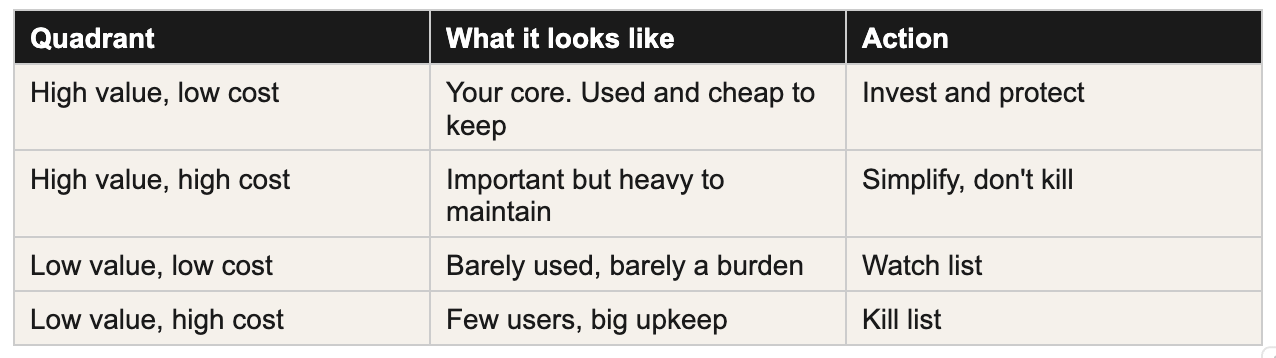
The bottom-right quadrant is where roadmaps go to die. Start there.
Approach 2: Score it before you scrap it
Before removing anything, run it past four checks- a stripped-down version of the kind of scoring product teams use to prioritise what to build, applied in reverse to decide what to remove.
Usage: Is anyone actually using it?
Real adoption among active users, and the trend over time. A feature falling from 20% to 4% is dying on its own; you’re just signing the certificate.
Value: Is it creating meaningful impact?
Usage without context lies. A low-usage feature can still be essential- if the few who use it are your highest-value accounts, or it’s tied to retention or compliance. Always pair the number with what it drives.
Cost: What does it take to keep it alive?
Honest carrying costs like maintenance, support, and the complexity it adds to everything around it. If the cost keeps growing while the value stays flat, it’s worth questioning whether it still belongs.
Strategy: Does it still fit where the product is going?
A feature that made perfect sense two years ago may no longer align with your product vision today. As your company evolves, your product should evolve with it. If a feature no longer supports your direction and isn’t delivering value in another meaningful way, it may be time to let it go.
Example
Say your app has an in-built “team chat” you shipped early. The data: 4% of active users touched it in 90 days, down from 18% at launch.
Value: The people using it are mostly free users. Your paying customers are already communicating in tools they know and use every day, like Slack or WhatsApp.
Cost: Behind the scenes, the feature keeps demanding attention. It has its own infrastructure, creates problems whenever you make technical changes, and adds a steady stream of support questions.
Strategy: Your company is moving toward larger teams and businesses. But those customers already have communication workflows in place. The feature is no longer helping you move in that direction.
At this point, the question isn’t whether the feature works. It does! The question is whether it still deserves the time, money, and attention it takes away from everything else.
What Removing a Feature Looks Like (Example)
One of the best examples is Instagram’s Following Activity tab.
When it launched in 2011, the feature helped people discover content by showing what the accounts they followed were liking and interacting with. Over time, it found a loyal audience. Marketers used it to track competitors, and many users relied on it to keep an eye on what others were doing.
But in 2019, Instagram removed it.
Instagram’s head of product explained that the company wanted to simplify the app. Many users didn’t even know the feature existed, and the Explore page had evolved to do the discovery job the feature was originally designed for. The feature had passionate supporters, but that wasn’t enough to justify keeping it.
That’s what thoughtful feature removal looks like. You remove it when it no longer fits your product strategy, when there’s a better way to solve the same user need, and when the long-term benefits of simplicity outweigh the cost of keeping it.
How to Remove a Public Feature?
Removing a feature is a product decision and a relationship decision at once. Done carelessly, it teaches users your product is unreliable. Done well, most won’t notice. A handful of steps makes the difference.
Segment before you cut: A feature with 4% overall usage might be a daily ritual for your top ten accounts. Slice the data by segment before deciding; aggregate numbers hide the people who’ll feel it most.
Announce: A short, honest note- what’s changing, why, and what to use instead- goes further than silence ever will. The surprise is what breaks trust, not the change.
Offer a path: Where you can, point to an alternative or a migration. People forgive change; they don’t forgive being stranded.
Sunset, then remove: Hide it from new users first, watch what breaks, then pull it cleanly once you’re sure. A staged deprecation surfaces the hidden dependencies that a hard delete would detonate.
Log the decision. Six months on, someone will ask why it’s gone. A one-line record of the reasoning saves you from rebuilding your own mistake.
Building a Culture That Isn’t Afraid to Subtract
That culture needs to be built deliberately. Celebrate feature retirements the same way you celebrate new launches. A roadmap shouldn’t only show what’s being built next- it should also show what’s being removed and why.
Make it a habit to review your product regularly. Every quarter, look at it with fresh eyes and ask one simple question:
Knowing what we know today, would we build this feature again?
If the answer is no, it’s worth discussing whether it still belongs.
This mindset is becoming more important than ever. AI has made it dramatically faster to build and ship new features, but users haven’t become any better at discovering, learning, or adopting them. So, removing features can actually help you out!
It will protect the user experience, keep the roadmap focused, and make sure every new addition has room to deliver real value.
Final Thoughts
Early on, building feels like the whole job. You add, and add, and for a while, more genuinely means better. But as the product matures, success is also about what you’re willing to remove.
Removing a feature rarely gets the same attention as launching one. There’s no announcement, no celebration, and no visible milestone. Yet it’s often one of the most valuable decisions a product team can make. It makes the product easier to use, the codebase easier to maintain, and the roadmap easier to execute.
So look at your product this week. Pull the adoption numbers you’ve been avoiding. Run your heaviest, least-loved feature through the four lenses. And if the answer is what you already suspect- let it go before it gets a vote on your roadmap.
At Razorpay Rize, we get it- building a startup is tough. That’s why we’re more than just a space for connecting with other founders. We’ve got programs, tools, and services designed to take some of the weight off the shoulders and make the journey just a little bit easier.
Curious about how we support startup founders?

Dive into Vault today & unlock a world of possibilities.