


At some point in the founder journey, almost everyone asks the same question: How much MRR do I really need to raise a seed round? You hear wildly different answers- ₹5 lakh, ₹10 lakh, ₹50 lakh- often from founders who raised in a completely different market, at a different time, with a very different business.
This article breaks down seed-stage MRR expectations by business model, growth quality, and founder context, so you can benchmark yourself realistically and fundraise whenever you’re ready.
Before we talk about how much MRR is needed to raise a seed round, it’s essential to first understand what MRR actually is and why it matters so much to investors at the early stage.
TL;DR- Quick rules of thumb
Pre-seed / angel: You can raise with little or no MRR if growth, users, and strong founders are present, but $0–$5k MRR & fast user growth are common.
Seed (typical benchmark): Many VCs expect $10k–$100k in MRR, depending on business model and geography; for SaaS, the common range founders cite is $25k–$200k in MRR to be comfortably fundable.
For enterprise / long sales-cycle B2B: Lower MRR (even <$10k) can be decent if you have big, repeatable contracts or strong pilot commitments.
Consumer/marketplace: Investors focus more on DAUs/growth/retention than pure MRR; fundraising can happen at lower revenue but with big user metrics.
What Is MRR (Monthly Recurring Revenue)?
MRR (Monthly Recurring Revenue) is the predictable revenue a business earns every month from recurring payments. It includes subscription fees and other contracted recurring charges, but excludes one-time payments, setup fees, and irregular income.
In simple terms, MRR tells you how much revenue you can reliably expect each month if nothing changes.
Example
If:
10 customers pay ₹5,000 per month
20 customers pay ₹2,000 per month
Your MRR is:
(10 × ₹5,000) + (20 × ₹2,000) = ₹90,000 MRR
That ₹90,000 is your baseline monthly revenue, before new sales, churn, or upgrades.
Why MRR Matters for Seed Funding?
Investors aren’t expecting meaningful revenue at the seed stage; they’re trying to understand whether the business is real, repeatable, and moving in the right direction. MRR becomes a shorthand for belief.
When investors look at early MRR, they’re really using it to answer three underlying questions:
Do customers care enough to pay? (Problem validity)
Can this revenue repeat predictably? (Business model viability)
Is there early momentum? (Growth trajectory)
This is why a startup with relatively modest MRR but strong month-over-month growth, high retention, and clear customer pull can appear far more fundable than one with higher revenue but weak fundamentals.
Typical Seed MRR Benchmarks
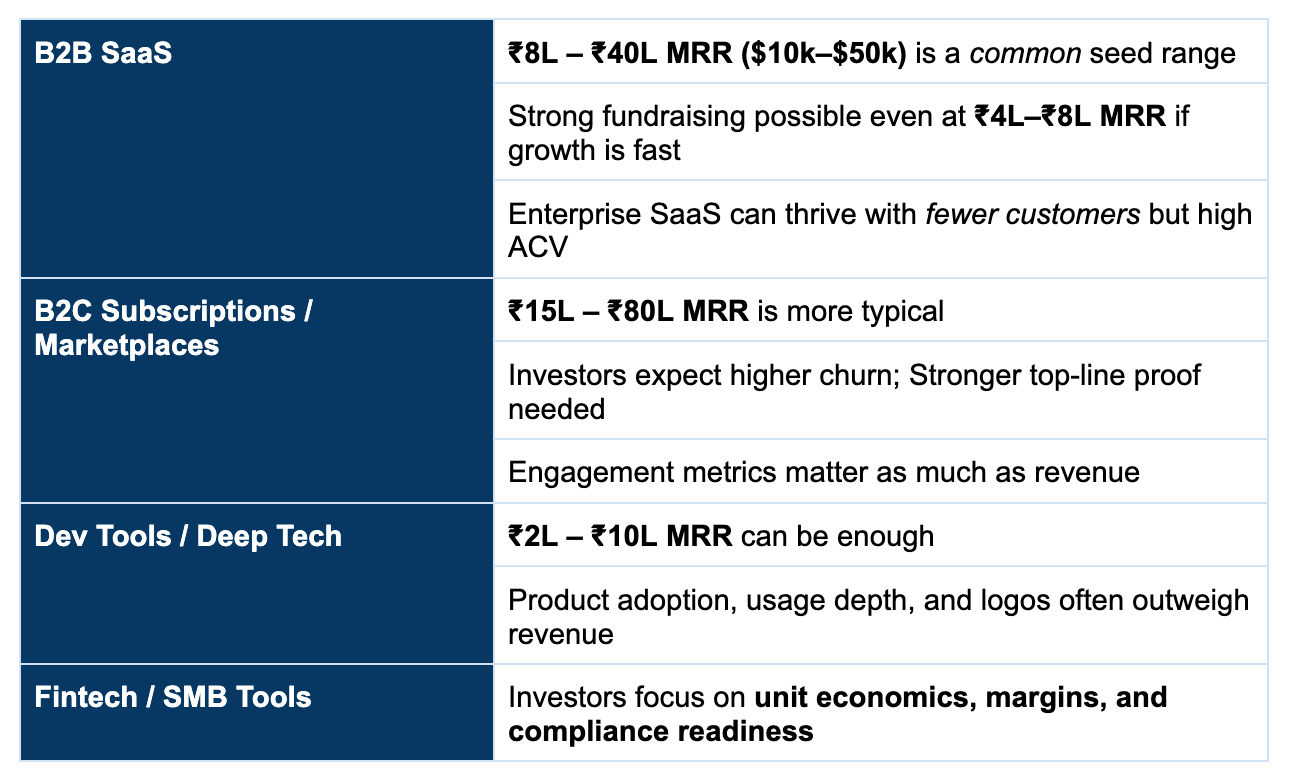
Key takeaway: Seed rounds happen across a wide MRR spectrum. Context matters more than the number. Seed rounds usually range $0.5–3M; MRR expectations are sector-sensitive (AI/niche B2B can command lower MRR if product-market fit and pilot revenue exist).
How Investors Evaluate MRR at the Seed Stage?
Investors roughly evaluate these things together while considering MRR:
Growth rate (MRR MoM): Fast growth (10–20%+ MoM) can offset lower absolute MRR. Slow growth with high MRR = less attractive.
Retention/churn: Low churn (esp. negative net churn via expansion) multiplies the value of current MRR.
Unit economics: CAC payback < 12 months (a common target for SaaS), and a reasonably positive LTV: CAC make a modest MRR look investable.
Sales pipeline/enterprise deals: A few large, committed pilots/LOIs can replace thousands in MRR on the books.
Team & signal: Founder experience, distribution advantages, and prior exits can lower the MRR bar.
Can You Raise Seed With Zero or Very Low MRR?
Yes, but only if you can replace revenue with other strong belief signals. When MRR is low or absent, investors look harder at everything else. Here’s how founders still raise seed with zero or very low MRR:
Strong founder–market fit
Clear product adoption
Credible proof of future revenue
Large, obvious market with urgent pain
Exceptional clarity on GTM and pricing
For most first-time founders, however, even ₹2–5 lakh in clean, recurring MRR dramatically improves seed readiness. Known revenue, however small, proves willingness to pay and often shortens the fundraising cycle.
How to Decide Your Seed Round Size?
Below is a deeper, operator-level breakdown of the two most credible ways to size a seed round, plus how VCs actually sanity-check your numbers.
1. Milestone-based sizing
This approach answers one question:
What will the company look like in 12–18 months that makes Series A inevitable?
Step 1: Define the Series-A-ready milestone
Common Series A milestones by model:
B2B SaaS (SMB):
$150k–$300k MRR
Consistent 8–12% MoM growth
Predictable CAC payback (<12 months)
B2B Enterprise:
$1–3M ARR or
8–15 large customers with repeatable sales motion
Consumer / Marketplace:
Strong retention curves
Clear path to monetisation (not necessarily high revenue yet)
Step 2: Map the team required to hit that milestone
Example monthly burn math (simple):
Team: $80k
Infra/tools/SaaS: $10k
Marketing/experiments: $15k
Buffer / misc: $10k
Monthly burn: ~$115k
Step 3: Multiply by runway (12–18 months)
Monthly Burn $115k × 15 months ≈ $1.7M
This becomes your base raise size.
2. Rule-of-thumb dilution method
This approach starts from ownership instead of burn.
Step 1: Estimate a justifiable post-money valuation
Sample ranges (rough estimate):
$10–15M post: early traction, high risk
$15–25M post: solid seed-ready company
$25M+ post: breakout signal + competition
Step 2: Apply dilution math

A well-sized seed round gives you 12–18 months to eliminate key risks, hit a clear milestone, and make the next round feel inevitable, without over-diluting or over-raising.
Quick Checklist Before You Start Raising Seed
6–12 month MRR trend chart ready
Cohort retention and churn numbers on hand
CAC / payback and unit economics modelled
Top customer case studies/pilots / LOIs documented
Clear milestones and 12–18 month runway plan
India-Specific Checklist: How Seed Investors Think in India?
Seed investors in India tend to evaluate early-stage startups through a more pragmatic lens. While vision and market size matter, there is a strong emphasis on how responsibly the business is being built. This directly shapes how MRR is interpreted at the seed stage.
Capital efficiency: Indian seed investors pay close attention to how much progress a startup has made relative to the capital consumed. Even reaching ₹5–10 lakh in MRR with a lean team and a controlled burn often signals strong execution.
Clear path to sustainability: Investors typically like to see a credible path to break-even at ₹1–1.5 crore ARR, especially for SaaS and fintech platforms. Even if profitability is 12–18 months away, founders who can articulate how margins improve with scale are viewed more favourably.
Revenue discipline: Seed investors in India are wary of MRR inflated through heavy discounts or incentives. Clean revenue- i.e. customers paying close to list price, churn under 5–7% monthly for SMB SaaS, and steady 8–12% MoM growth- often carries more weight than higher but unstable topline numbers.
Ultimately, in India, MRR tells investors whether founders respect capital, understand their economics, and are building something that can last beyond the next funding round.
Final Thoughts
There is no single MRR number that magically unlocks a seed round. At this stage, investors aren’t looking for scale; they’re looking for conviction. MRR is simply one of the clearest ways to build that conviction, because it shows real customers paying for a real problem in a way that can be repeated.
Clean revenue, consistent growth, strong retention, and a clear path forward often matter more than hitting an arbitrary benchmark.
If you’re thinking about raising seed, stop asking whether your MRR is “enough” in isolation. Ask whether your current traction clearly points to a much bigger outcome and whether seed capital will meaningfully accelerate that trajectory. When the answer to that is clear, the MRR conversation becomes a lot easier.
At Razorpay Rize, we get it- building a startup is tough. That’s why we’re more than just a space for connecting with other founders. We’ve got programs, tools, and services designed to take some of the weight off the shoulders and make the journey just a little bit easier.
Curious about how we support startup founders?

Dive into Vault today & unlock a world of possibilities.