



If you’re running a D2C brand, the festive season can make or break your year.
Months before the first sale goes live, you’re already making bets- how much inventory to buy, how much cash to lock into stock, how aggressively to spend on ads, and how much demand to expect.
In 2025, almost every one of those assumptions changed!
During the last week of September, India’s e-commerce market witnessed an unprecedented surge. In just 11 days, shoppers purchased over ₹60,000 crore worth of goods. Nearly 90 million people participated, and by the time the festive season ended around Diwali, online sales had crossed ₹1.15 lakh crore in GMV, growing 20–25% year over year- the best festive performance in half a decade.
If you’re building a D2C brand, that’s the part worth paying attention to before planning for October 2026.
In this article, we’ll unpack what changed in 2025, why it mattered, and what every brand should take away before the next festive rush begins.
What Actually Happened in 2025?
Looking beyond the headline numbers, the 2025 festive season revealed a market that is evolving on multiple fronts. Consumer spending patterns, category demand, logistics, taxation, and fulfilment strategies all moved in new directions.
1. The Impact of GST 2.0
The rollout of GST 2.0 coincided with the festive season. Rate cuts across apparel, electronics, and appliances made products more affordable and encouraged consumers to upgrade instead of postponing purchases. Brands like DaMENSCH passed on GST savings directly to customers on products priced below ₹2,500, and the impact showed up almost immediately in larger basket sizes.
GST 2.0 gave brands a demand-side boost, but it also changed how businesses need to operate.
Unified GST rules reduced interstate transit times and lowered logistics costs by an estimated 20–25%, making nationwide fulfilment across more than 19,000 pin codes increasingly viable even for mid-sized brands.
2. The Growth of Tier 2 and Tier 3 Markets
Another major growth driver was the increasing spending power of consumers outside metropolitan cities.
Interest rate cuts and rising rural incomes put more disposable income into consumers’ hands, particularly outside the metros. Tier 2 and Tier 3 cities accounted for nearly 60–65% of shoppers during the first festive fortnight. So, India’s next wave of e-commerce growth is increasingly coming from smaller cities rather than the country’s biggest urban markets.
3. Category Trends in 2025
Electronics continued to dominate festive sales, but they weren’t the most interesting part of the story.
The real growth came from everyday indulgences and lifestyle purchases- beauty products, home upgrades, premium food, gifting, and more. That’s especially important for D2C brands because these are categories where differentiated products and strong brand affinity matter far more than competing on price alone.
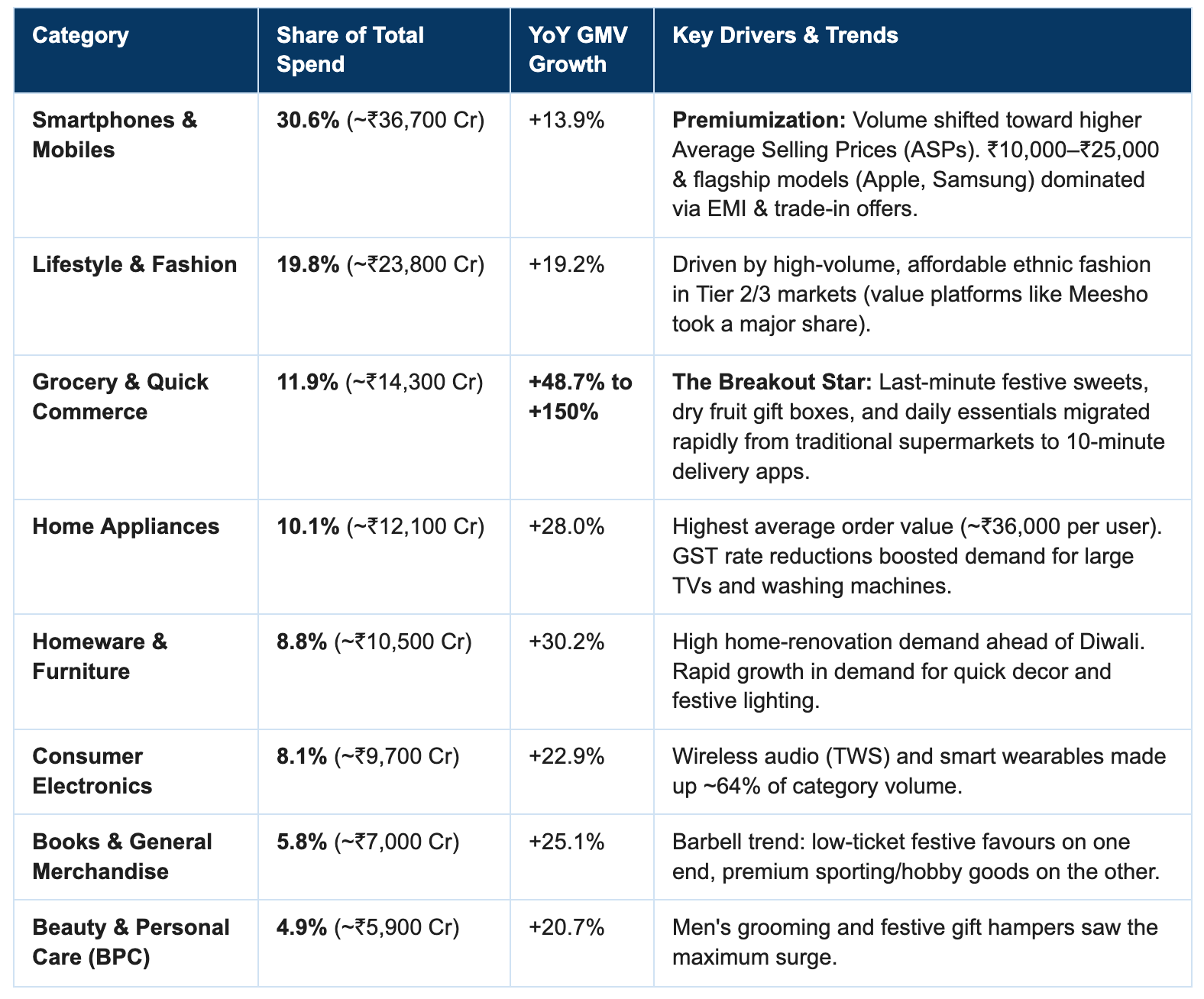
Source: Datum Intelligence - “Festive Barometer” Report (2025/2026 Editions), Redseer Strategy Consultants – India’s Festive E-commerce Market Report.
The broader retail market reflected the same trend. Overall festive retail, online and offline combined, grew by around 10–12% year over year, while e-commerce alone expanded by roughly 20–25%.
The difference highlights a larger trend: festive shopping is steadily moving online. With every season, e-commerce is capturing a bigger share of consumer spending that once went primarily to offline stores.
4. Quick Commerce Became a Core D2C Channel
Blinkit, Zepto, and Swiggy Instamart collectively closed 2025 with roughly ₹95,000 crore in annual GMV, while quick-commerce demand spiked by 60-70% during the festive week itself. Brands like IGP.com leaned into 30-minute delivery for last-minute gifting, while premium hampers remained on e-commerce platforms for more planned, considered purchases.
For D2C brands, this created a new opportunity to capture moments that traditional e-commerce cannot always serve. But the opportunity comes with a different set of economics.
For example, a skincare brand selling a ₹299 face wash. The brand may generate around 30% net contribution on a quick-commerce platform, compared with a significantly higher margin on its own website. On the surface, the quick-commerce sale looks less attractive. But the platform also gives the brand access to high-intent customers at the exact moment they are ready to buy.
In 2025, quick commerce proved that it could do more than deliver products faster. It changed when, where, and why consumers choose to buy them.
How Should Brands Prepare for Festive 2026?
A customer might see your product on Instagram in the morning, watch a creator talk about it in the afternoon, check reviews on Amazon in the evening, and finally order it through a quick-commerce app. The customer journey is no longer a straight line. For D2C brands, Festive 2026 is going to be about being present wherever the customer is shopping. I
Here are a few key points from 2025 that you should act on now to build a stronger Festive 2026 strategy, rather than waiting until October to make changes.
1. Paid Acquisition Is Getting More Expensive in 2026
This is probably the single biggest thing you should prepare for!
Paid acquisition is getting harder, with rising CAC putting more pressure on D2C brands to improve efficiency and retention.
One 2026 dataset from a D2C operator covering 200+ Indian brands found that Meta CAC increased from roughly ₹380 in 2025 to ₹502 in 2026. At the same time, repeat-purchase performance emerged as a much bigger driver of overall profitability.
2. Quick commerce is not optional for many categories anymore
Quick commerce has moved beyond “milk and groceries.”
Beauty, personal care, accessories, snacks, gifting, household products and other categories are increasingly finding their way onto these platforms. Meta reported that 45% of festive shopping in its 2025 research was happening through quick commerce, while quick commerce already represented nearly two-thirds of online grocery orders.
And in 2026, the expansion is continuing: large quick-commerce players are even exploring delivery of higher-value electronics and appliances.
3. Build a “Hero SKU” Strategy
A better approach is to build your festive strategy around a small number of products, with each one playing a specific role in the customer journey.
Start with 1 Hero SKU. This is your acquisition product, which you need to lead with in ads, landing pages, and campaigns. Then add 2–3 high-margin products that act as your profit drivers.
Introduce 1 bundle designed to increase AOV, and 1 premium product to capture customers who are willing to spend more. Finally, have 1 repeat-purchase product that gives customers a reason to come back after the festive season.
4. Creators become even more important in 2026
Consumers increasingly discover products through creators, short-form video and social content.
Meta’s 2025 festive research found that creators were particularly influential in helping shoppers evaluate deals, while AI was also becoming part of the shopping journey.
Google/Deloitte’s 2026 outlook goes even further, projecting creators to influence 30% of total retail spend as India’s e-commerce ecosystem evolves toward discovery, validation and instant purchase.
5. Regional India Is a Massive Opportunity
One of the biggest opportunities for 2026 is outside the usual metro cities. In 2025, Tier-II and Tier-III cities made up roughly 60% of festive orders in Unicommerce’s dataset. So don’t limit your festive strategy to Mumbai, Delhi, and Bangalore.
Cities like Chennai, Coimbatore, Jaipur, Lucknow, Indore, and Kochi are becoming increasingly important. But simply translating your ads won’t be enough. Understand what matters locally and build the campaign around that insight.
6. Build Your WhatsApp Database Now
A customer you acquire through Meta is valuable, but the real opportunity is turning that customer into someone you can reach directly through WhatsApp and CRM.
Start capturing key customer data like their name, phone number, city, product interest, purchase history, and purchase frequency. Then use it to build simple, automated customer journeys.
Day 0: Order confirmation
Day 7: Product education
Day 15: Cross-sell
Day 30: Review request
Day 45: New product launch
Day 60: Reorder reminder
Festive: Early access or exclusive offers
7. RTO and COD Will Matter More Than You Think
If you’re selling in India, especially across Tier-II and Tier-III cities, COD can have a direct impact on your unit economics and profitability.
Instead of trying to eliminate COD altogether, experiment with ways to reduce the risk:
COD confirmation
WhatsApp confirmation
Small prepaid incentives
Partial COD
Address verification
Pin-code level RTO scoring
Final Thoughts
The festive season can quickly turn into a race around numbers - GMV, orders, ROAS, growth percentages and sales targets. But behind all those numbers is a simpler story: people are feeling more comfortable spending, and they are shopping differently than they did a few years ago.
So, if there is one thing you should take away from Festive 2026, it is this: Don’t wait for the festive season to begin before preparing for it. Build your audience before the festive rush. Know which products belong on your website, marketplaces or quick commerce. Get your inventory, fulfilment and compliance sorted before things get hectic.
The festive rush will bring customers to your doorstep. What you do next will decide if they stay!


Dive into Vault today & unlock a world of possibilities.