


A computer science engineer who spent nearly 12 years in IT, Abhishek took an unexpected turn after his MBA at IIM Calcutta. He found himself drawn to India's overlooked food traditions and the communities keeping them alive. Today, as founder of Earth Story Farms, he works with nearly 1,600 farmers and artisans across 8 states, creating more opportunities for rural India to thrive at home.
In 2020, I had a field full of vegetables and nowhere to send them. That sentence, in many ways, is where Earth Story Farms begins. But the story started a little earlier with an engineer who didn’t quite know what he wanted to build.
The Engineer Who Wandered into Agriculture
I’m a computer science engineer. I worked in IT for almost 12 years, including a good stint at IBM, and I have no agriculture background at all. Leaving that job for B-school wasn’t easy. I had a very good role, and most people don’t quit a career after 12 years. I did my MBA at IIM Calcutta and passed out in 2019. Even then, I was already dabbling with the idea of starting something of my own. I just hadn’t figured out the what.
It started with curiosity. The more I read about agriculture, the more I realised how many challenges the sector was dealing with: fragmented supply chains, unpredictable inputs, climate risks and post-harvest waste. Back in 2018, many of the agri businesses we see today hadn’t entered the space, so there was an opportunity to look at it with fresh eyes.
But what really drew me in was something more personal. I grew up in a very traditional home where food was always at the centre of conversations. My parents, particularly my father, loved good food. I remember seeing sesame and coconut laddus slowly make their way onto supermarket shelves. They were nothing like the ones my mother made, but their presence made me think. What about all those traditional foods we grew up eating but no longer find easily? Maybe people hadn’t forgotten them. Maybe they were simply waiting for someone to bring them back.
The Field Full of Vegetables
I took up a role in Kolkata as CEO of a social enterprise working on malnutrition and rural livelihoods. It gave me the opportunity to build Earth Story Farms alongside my work. The role took me across different districts in West Bengal, Odisha and Jharkhand, where I got to understand rural communities, their livelihoods and the way local ecosystems functioned. We were also experimenting with natural and integrated farming practices on our farmland in Bankura.
Then COVID happened, and we had to rethink things quickly. Our first thought was simple: why not sell the vegetables we were already growing? We started calling people we knew and asking if they would be interested in buying fresh vegetables. Soon, we began delivering curated vegetable boxes to homes across Kolkata, keeping each family’s size, food habits and preferences in mind.
The idea worked. At a time when stepping out and accessing fresh produce was difficult, people appreciated having freshly harvested vegetables delivered to their homes. We knew this wasn’t going to be a long-term business, but it gave us something we hadn’t planned for- our first set of customers, a customer database, a landing page and even a payment gateway.
More importantly, it taught us an important lesson early on: perishables weren’t going to be our focus. Thankfully, we realised that soon enough and shut the model down before investing too much in it.
A Taste of Home, Across Generations
I was still in Bankura, known for its excellent nolen gur. But finding good-quality jaggery in Kolkata was a challenge. We felt that if we were looking for it, others probably were too. At the time, packaged nolen gur in modern formats was almost unheard of. So we introduced spout packs and small cubes. The response was encouraging - we sold 400 kilos in just two months.


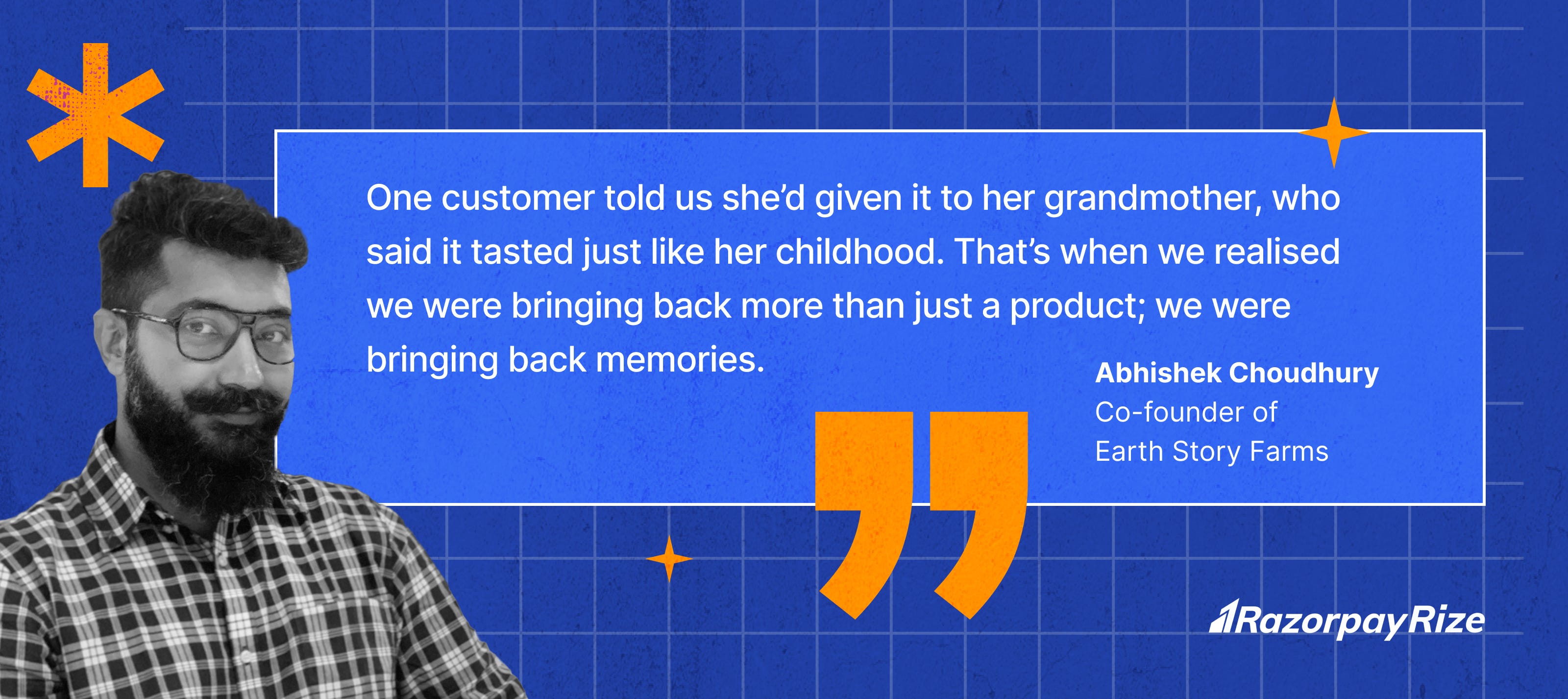
But the strongest validation came through customer feedback. One customer told us she’d given it to her grandmother, who said it tasted just like her childhood. That’s when we realised we were bringing back more than just a product; we were bringing back memories.
Palm jaggery followed, then pickles and staples. Today, Earth Story Farms offers 60 products from nine states, bringing lesser-known regional foods to consumers across India. Every pack tells a story of where it comes from, its origins and seasonality.
Lessons That Came at a Price
There were plenty of things we got wrong along the way. Some events brought us no sales, and our early attempt at offline retail didn’t work out either. We realised we were getting there too soon and decided to pull back.
Our digital presence became our biggest strength almost organically. Today, around 60% of our business comes through our website.
We’ve grown nearly threefold year on year, stayed bootstrapped and worked towards profitability from the beginning. Having Subko as our oldest B2B client, winning the Bengal Chamber of Commerce’s Agri Startup of the Year award and reaching the finals of Tiger Pitch have been important milestones in this journey.
The First Export, and What It Taught Us
We recently shipped our first export consignment to Singapore, and it came with its share of learning. Much of it revolved around paperwork and documentation, especially the health certificates required for exports. While we managed to figure out the phytosanitary and quarantine requirements, getting the health certificate took the most effort.
Packaging was another big lesson. Despite using seven-ply boxes, they weren’t quite sturdy enough for air transport, and the shipment didn’t reach the importer in the best condition.
It was our first export, and while things weren’t perfect, it gave us a much clearer idea of what to get right the next time.
The Hardest Decision
One of the hardest decisions was choosing to stay in Kolkata. Moving to Bangalore or Mumbai could have meant better career opportunities, especially since options in Kolkata were limited then and still are.
There were other compromises along the way. I took up a job with a nonprofit, which meant giving up a fair bit of the compensation I could have earned in the corporate world. Even then, many of my decisions were made keeping the startup in mind. I was constantly trying to balance a job, the business and the uncertainty of not knowing where things would eventually lead.
Another difficult question was figuring out when to leave everything else and commit to the startup full-time. It’s not an easy decision when you don’t know how things will turn out. You keep wondering whether you should wait a little longer, build more traction or take the leap. Even today, I can’t say with certainty whether I made that move at exactly the right time. I suppose you only know that when you look back.
The Bad Days and Little Wins
Running a D2C business comes with its share of difficult days. Delayed orders, even worth just ₹300 or ₹400, can lead to customers questioning your intentions. In the beginning, I used to take these things personally. Over time, I’ve learnt to develop a thicker skin. It’s part of running an operations-heavy business, and every founder goes through it.
I’m not someone who celebrates big or often. My co-founder keeps reminding me that I move too quickly from one milestone to the next. So, sometimes, I simply leave work a little early, grab a good coffee and take an hour off.
When we won the Agri Startup of the Year award, we celebrated at one of our favourite street food joints. But honestly, nothing feels quite as rewarding as hearing from your first customers that they’re coming back to buy again. That’s when you know you’re doing something right!
What’s Next?
For now, I think we’re on the right track. We want to keep building steadily, expand into more states and deepen our presence in the markets we’re already in. There’s still a lot of room to grow within India, and we believe we can scale the business significantly.
We’re also looking to strengthen our B2B business alongside D2C and explore more export opportunities. The goal is to reach ₹100 crore in revenue over the next four years!
But beyond the numbers, what matters most to me is building stronger rural livelihoods. I want to create opportunities where farmers and artisans can earn well without having to leave their homes and move to cities. Today, we work with nearly 1,600 people across eight states. Over the next couple of years, I’d like to take that number to at least 10,000.
If Not This, Then What…
If I hadn’t taken this path, I think I would have explored sound design. It was something I was genuinely interested in, and at one point, I even applied to SRFTI. I went through multiple rounds of entrance exams and a viva, so it wasn’t just a passing thought. I could have quite easily imagined myself working in that world.
And someday, if Earth Story Farms does well and things fall into place, I’d love to build a small retreat in the hills. Nothing too elaborate, just a quiet place where I can slow down, spend time with myself and enjoy a different pace of life. I’ve already been thinking about settling in Kalimpong. It’s a thought I keep coming back to.
Abhishek took the road less travelled. Years of research, grassroots exploration, and hands-on farming shaped his vision long before Earth Story Farms came to life. When challenges arose, he turned them into opportunities to learn.
Today, Earth Story Farms is reviving India’s forgotten food traditions. At Razorpay Rize, we celebrate founders like Abhishek who build patiently, sustainably, and with a deep understanding of the problems they solve.


Dive into Vault today & unlock a world of possibilities.