


Most early brands don’t fail because the logo was ugly. They stumble because the name was already trademarked, the Instagram handle belonged to someone else, and every deck, post, and invoice looked like it came from a different company.
This doesn’t need a design agency or a ₹2 lakh brand book. It needs a name that’s actually available, a simple logo, two colours and two fonts used consistently, and templates that make the next hundred designs look like the first one.
The flow is straightforward:
Name check → Buy the domain → Logo → Colours and fonts → Templates → Social handles
The Stack
There’s no need to over-invest here. Almost everything in this stack is free- enough to look like one company everywhere, until you have the revenue to hire a designer who can build on what you’ve started.
Name Check
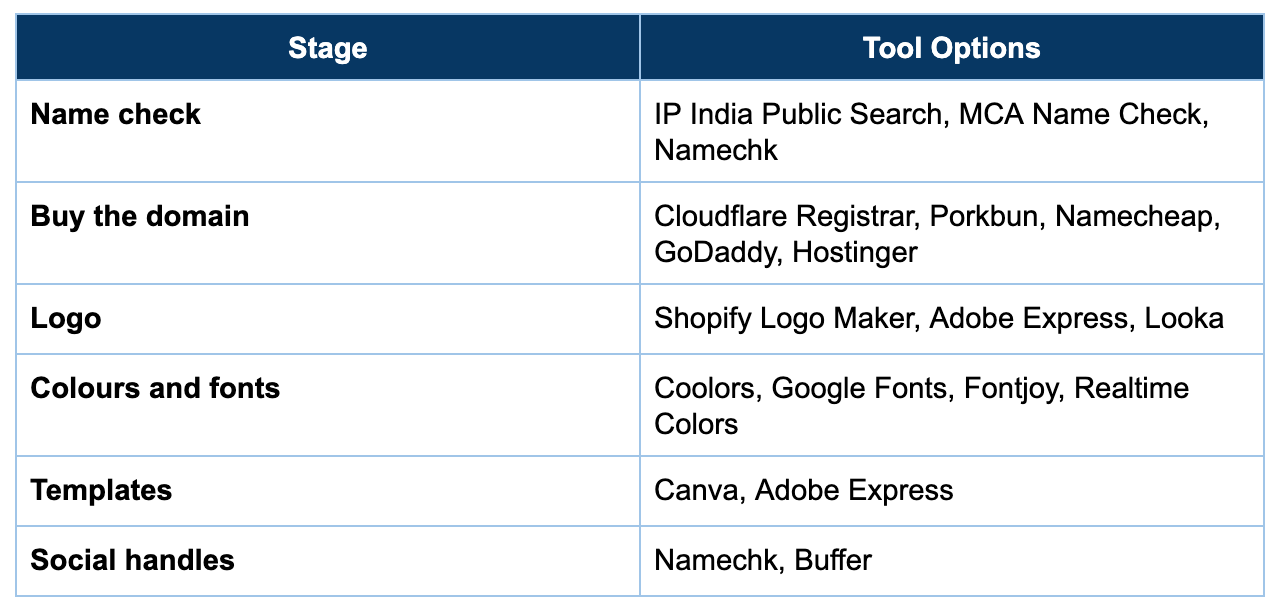
• IP India Public Search: The official trademark registry’s free search- no login needed. Run a wordmark and a phonetic search in your class before you fall in love with a name, not after.
• MCA Name Check: Free check on the Ministry of Corporate Affairs portal to see if a similar company or LLP name is already registered- worth doing before you file your incorporation.
• Namechk: Free, no card required- checks a name across 100+ social platforms and dozens of domain extensions in one search, so you see the whole picture before you commit.
Buying the Domain
• Cloudflare Registrar: Sells domains at cost with no markup- a .com is roughly $10–11 a year, and renewals cost the same as the first year. No surprise jump in year two.
• Porkbun: Low, flat pricing with free WHOIS privacy, a free SSL certificate, and email forwarding included- a simple choice if you want everything in one place without upsells.
• Namecheap: A .in domain starts at around ₹550 a year with free WHOIS privacy- a good fit if your customers are mostly in India and you want the local extension.
• GoDaddy / Hostinger: Often the cheapest first year on a .in, but check the renewal price at checkout- it can be noticeably higher from year two, and add-ons like privacy are sometimes extra.
A quick rule here: compare the renewal price, not the first-year price. The ₹99 domain is rarely ₹99 the year after.
Logo
• Shopify Logo Maker (formerly Hatchful): Completely free, no watermark, and commercial use is allowed- a quick way to get a clean, usable logo in under ten minutes.
• Adobe Express: Free plan includes the logo maker, templates, and Adobe Fonts, with PNG, JPG, and PDF downloads- more room to customise than a one-click generator.
• Looka: Designing is free; downloading is around $20 for a basic file and $65 for the full vector set. Worth it only once you’ve settled on a direction and need print-ready files.
Colours & Fonts
• Coolors: Free palette generator- press the spacebar to cycle colours, lock the ones you like, or pull a palette straight from a photo.
• Google Fonts: 1,800+ free font families, with a curated pairings tab on each font page- the safest place to pick fonts you’ll never need to license.
• Fontjoy: Free, AI-generated font pairings for heading, subheading, and body- lock one font and reroll the rest until it feels right.
• Realtime Colors: Free, no login- previews your colours and fonts on a mock website, with a built-in contrast check, so you see how they actually look together, not just as swatches.
Templates
• Canva: Free plan covers the editor, 1.6 million templates, and 5GB of storage, plus one Brand Kit with up to three brand colours. Logo and custom font uploads to the Brand Kit sit behind Pro.
• Adobe Express: Same free plan doubles as a template library for posts, decks, and flyers- useful if you already built your logo there.
Social Handles
• Namechk: Run your final name one more time on the day you claim handles- availability changes faster than you’d expect.
• Buffer: Free plan covers three channels with ten scheduled posts queued per channel, plus an AI assistant- enough to keep new profiles from looking abandoned in week one.
A useful principle: the best brand tool in this stack is consistency, not the logo maker. A simple logo used the same way on every post, invoice, and deck will build more recognition than a beautiful one used each time differently.
A sensible starting default: IP India and Namechk for the name check + Cloudflare or Porkbun for a .com (Namecheap for a .in) + Shopify Logo Maker for the logo + Coolors and Google Fonts for colours and fonts + Canva Free for templates.
The Build Checklist
☐ Check the trademark before the domain: A domain is easy to change. A trademark dispute six months after launch is not.
☐ Claim the domain and all key handles on the same day: Even the platforms you don’t plan to use yet- it costs nothing and stops someone else from taking them.
☐ Grab the .com and .in together if both are available: It’s a few hundred rupees a year, and it stops someone else from sitting on the other one.
☐ Pick two colours and two fonts, then stop: One primary colour, one accent, one heading font, one body font. More options usually mean less consistency.
☐ Test the logo at small sizes: If it doesn’t read as a 32-pixel profile picture or a browser tab icon, simplify it.
☐ Write a one-page brand sheet: Logo files, hex codes, font names, and two lines on tone of voice- so anyone helping later doesn’t have to guess.
☐ Build five core templates before you need them: A social post, a story, a deck cover, an invoice, and an email signature cover most of what an early startup actually sends out.
Measuring Whether It’s Working
Track four signals- together they tell you whether the brand is building recognition, or just looks finished:
• Consistency score: Pick ten things you’ve published or sent this month- posts, decks, invoices- and count how many use the right logo, colours, and fonts. Anything below eight out of ten means the templates aren’t being used.
• Handle coverage: The number of key platforms where you own the exact same handle. Mismatched handles quietly make you harder to find and easier to impersonate.
• Branded search: How many people search your startup’s name directly, visible for free in Google Search Console. A number climbing over time means people are remembering the name, not just stumbling on it.
• Time to make a new asset: How long it takes to produce a new post or deck from your templates. If it’s still taking an hour, the templates need work- not the brand.
At Razorpay Rize, we get it- building a startup is tough. That’s why we’re more than just a space for connecting with other founders. We’ve got programs, tools, and services designed to take some of the weight off the shoulders and make the journey just a little bit easier.


Dive into Vault today & unlock a world of possibilities.