


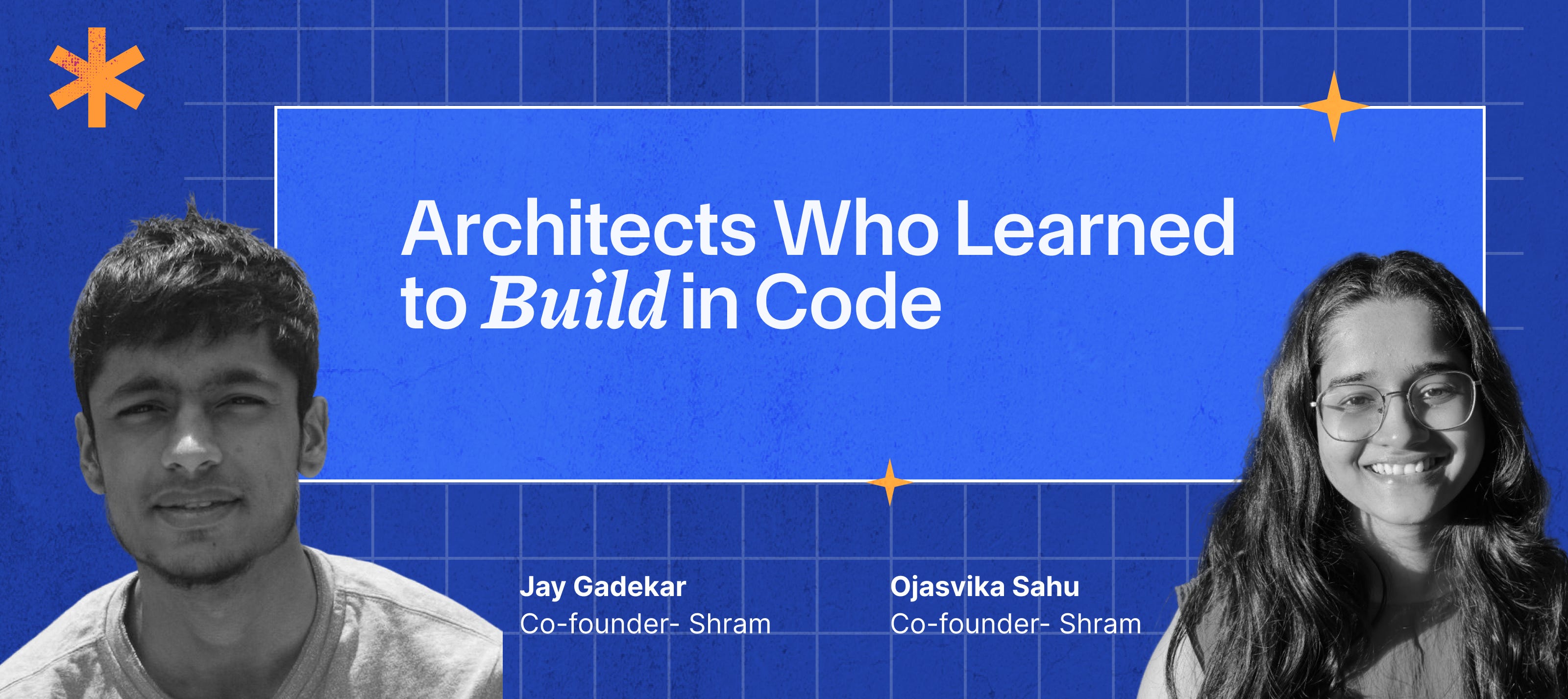
Jay and Ojasvika founded Shram to build technology that feels human. Frustrated by complex, engineer-first tools, they set out to create a product that reduces friction and works the way people naturally think.
Shram is an AI-powered work companion built to help you focus on meaningful work instead of managing endless tasks. It automatically detects what needs attention, surfaces important actions, and handles repetitive, low-value work in the background.
Jay and Ojasvika were architects first. They spent their days designing homes, experimenting with parametric models, and slowly teaching themselves how to write small algorithms to make their ideas buildable. They weren’t trained software engineers; they were just curious enough to figure things out.
Somewhere along the way, a simple thought stuck with them: If we can teach ourselves to design through code, can we also build software that people actually want to use?
That quiet question- half doubt, half ambition- eventually became Shram.
When Architects Decide to Build Software
While still running his architecture firm, Jay began working on Shram in 2020. It started as an obsession- late nights, prototypes, endless conversations. Ojasvika joined him fully around 2022–23.
At the heart of it was a frustration: Most tools built by engineers don’t speak to non-engineers. They’re efficient, but not always intuitive. Logical, but not always human.
Ojasvika often says:
“For us, it’s always been a no-sayer to design something beautifully in 3D and let it translate poorly into a 2D experience.”
As non-technical founders, they faced a choice:
Build a layer that might get disrupted in 5–10 years
Or become the disruptors themselves
They chose the more challenging path. They didn’t speak the language of code fluently. But they knew how things should flow. How friction feels. How humans respond! So, they decided to flip their biggest weakness into their greatest strength.
The Bootstrapped Years
They bootstrapped Shram for three long years - no safety net, no guarantees, and plenty of nights filled with second-guessing. When their first MVP launched in August 2023, it didn’t land. In their own words, it sucked. But instead of walking away, they paid attention. They watched where users struggled, asked uncomfortable questions, and went back to the drawing board. Then they rebuilt. And rebuilt again.
By 2025, they made the painful but necessary decision to pivot from Shram.io to Shram.ai- letting go of three years of effort to make room for something sharper and more honest. It hurt, but growth often does.
The Hardest Decisions
There were two moments that nearly broke them.
1. Firing Their CTO
The first was firing their CTO- right before signing a term sheet. The timing couldn’t have been worse. But deep down, they felt something wasn’t aligned. He lacked what they describe as “the courage of an entrepreneur”- the ownership, the hunger, the resilience required at that stage. And they understood a hard truth: a misaligned CTO would damage the company far more than losing a funding deal ever could.
So they chose integrity over security. They were willing to risk the term sheet to protect the culture. That decision quietly set the standard for how they would build the company going forward.
2. The Pivot
The second was pivoting after three years of relentless effort. Three years of bootstrapping, countless late nights and personal sacrifices. Letting go of that version of Shram was emotional. But they could see a bigger opportunity ahead, and staying attached to sunk costs would only slow them down.
That’s when they learned something important: Flexibility is survival.
Funding, Family & Validation
Bootstrapping wasn’t glamorous. It meant watching every expense, delaying personal plans, and constantly choosing the company over comfort. But deep down, they felt unready. They once had the chance to raise funding from OpeCha, and they said no.
Coming from non-technical and non-entrepreneurial backgrounds, they knew there were gaps- in understanding, in conviction, in clarity.
For Jay, fundraising was deeply personal. His parents had never really believed this would work. To them, it felt risky, unstable, unrealistic. Every year without visible “success” quietly reinforced their doubts. So when investors backed him, it was proof.
For Ojasvika, the journey with family was more layered. In the beginning, there was excitement- pride in building something of her own. But bootstrapping slowly introduced tension.
Entrepreneurship is often romanticised as a founder’s solo battle. But in reality, families absorb the pressure too. They sit through the uncertainty. They manage their own fears. They adjust expectations.
And when things finally begin to move, the relief is shared.
How They Survive the Highs and Lows
They’ve learned something most founders don’t say loudly enough: “The best days are rare.”
So they celebrate small wins.
A feature shipped? Celebrate.
A thoughtful user feedback? Celebrate.
A tiny breakthrough? Celebrate.
They have a phrase they often repeat to each other: “We build extensively. Then we trim the fat.” It reflects how they think about everything- not just the product. They tend to explore widely at first, test multiple ideas, and stretch the boundaries of what something could be. And then comes the more challenging part: cutting.
Distilling the idea until only what truly matters remains. It’s not always comfortable, letting go rarely is, but the end result is always clearer and leaner.
Who They Are as Founders
As founders, their roles are clearly defined.
Ojasvika leads design. She obsesses over emotion, experience, and the tiny details most people overlook. Jay focuses more on tech and systems. He thinks in structures- how things connect, scale, and sustain over time.
Growth, however, is never owned by just one of them. It’s collaborative. And today, they’re backed by a strong technical team that fills the gaps they once struggled with. They’re honest about what they don’t know and intentional about surrounding themselves with people who do.


They may not speak computer language fluently. But they understand humans deeply. And for the kind of product they’re building, that might matter even more.
The Books That Shaped Them
The way they think about building isn’t accidental. A lot of it has been shaped by what they read and, more importantly, what they internalise.
For Ojasvika, Unreasonable Hospitality has been a quiet guide. On the surface, it’s a book about restaurants and service. But for her, it’s about designing for humans. Her second favourite, Sophie’s World, shaped a different muscle- curiosity. It walks through the origins of philosophy, constantly asking why.
Jay resonates deeply with On the Origin of Species. The idea that survival belongs not to the strongest, but to the most adaptable, has become almost a personal philosophy.
If you look at their journey- the failed MVPs, the CTO decision, the pivot from Shram.io to Shram.ai- you can see those influences clearly.
The Bigger Dream
They’re now building auto task detection- something they’ve been quietly obsessing over for months.
For two founders who care deeply about experience, this feels like coming full circle. A more intelligent, more intuitive system- one that works in the background instead of demanding attention. One that feels almost invisible.
They’re planning a public launch soon!
If not this, then what…
Ask them what they’d do if Shram didn’t exist, and the answer is immediate: there is no “if not this.” Shram is a stepping stone toward something bigger- what they call Modularity, a vision for building new-age cities from the ground up.
The logic is simple. Sixty per cent of cities are residential. People spend half their lives at home. By 2050, over 300 million Indians will migrate to cities that aren’t built for them. Jay and Ojasvika believe every building should behave like a tree in a forest- part of a living system, not just a structure on land. That requires an entirely new building system, not just better architecture.
Shram is teaching them how to build technology companies. Modularity is where they plan to take that knowledge next.
What wouldn’t change is this: They would still be building!
What stands out about Jay and Ojasvika isn’t just that they built Shram- it’s how they built it. Coming from non-technical backgrounds, they stepped into a deeply technical world with humility, curiosity, and relentless persistence.
At heart, they are designers of systems- whether that system is a building, a product, or a company.


Dive into Vault today & unlock a world of possibilities.