


Meta Ads remain one of the most important growth channels for D2C brands. From fashion and beauty to wellness and consumer tech, thousands of brands rely on Meta’s advertising ecosystem to acquire customers, build awareness, and scale revenue.
This article explores how D2C brands are using AI to improve Meta Ads performance in 2026, the key areas where AI is creating impact, and the best practices brands can follow to build more efficient and scalable advertising systems.
Meta Ads in 2026: What Actually Changed
For years, D2C brands approached Meta Ads with a relatively straightforward formula: build detailed audience segments, stack interests, test multiple lookalike audiences, and manually optimise campaigns based on performance.
But the Meta advertising ecosystem has changed significantly.
Privacy updates, evolving user behaviour, and increasing competition have reduced the effectiveness of traditional targeting methods. At the same time, Meta’s own platform has become far more dependent on machine learning and automation.
The platform is now designed to reward advertisers who can provide strong creative inputs, clear conversion signals, and sufficient data for the algorithm to learn effectively. In other words, Meta has become algorithm-first. And increasingly, AI is the language through which brands can work with that system more effectively.
The Three Layers of AI in Meta Ads
Broadly, AI impacts Meta Ads across three key layers: creative intelligence, audience targeting, and campaign optimisation.
1. Creative Intelligence
Creative has become the most important performance driver in Meta advertising. As targeting becomes broader and more automated, the algorithm increasingly depends on user engagement with the ad itself.
AI helps brands improve creative workflows by:
Generating ad copy and hooks
Creating multiple messaging variations
Suggesting formats and creative angles
Analysing patterns in high-performing ads
For example, instead of building one or two ads around a product, brands can now expand a single product into multiple creative directions:
1 product → 20 messaging angles → 100 creative variations
This allows advertisers to continuously feed Meta’s algorithm fresh content while identifying which themes resonate most with audiences. The ability to generate and test creative variations quickly has become one of the biggest advantages AI offers advertisers.
2. Audience Targeting and Algorithm Learning
Meta’s advertising platform has evolved significantly from the days of highly detailed interest targeting and excessive audience segmentation. Today, AI systems analyse behavioural signals in real time to identify users most likely to engage or convert.
Rather than manually trying to define every customer attribute, brands now allow the algorithm to learn from:
Engagement data
Conversion events
Purchase behavior
User interactions across the platform
3. Optimisation and Scaling
The third layer of AI in Meta Ads involves campaign optimisation and scaling. Meta’s machine learning systems continuously evaluate campaign performance and automatically adjust:
Budget allocation
Bid strategies
Ad delivery
Placement distribution
One of the most widely used AI-powered budgeting features is Campaign Budget Optimisation (CBO). Instead of assigning fixed budgets manually to individual ad sets, advertisers set a single campaign-level budget, and Meta’s algorithm distributes spend dynamically based on performance. This enables campaigns to optimise dynamically based on real-time performance data.
For example, the algorithm may automatically prioritise:
A high-performing creative variation
A specific audience segment
Placements generating lower acquisition costs
The Creative-AI Feedback Loop
One of the biggest shifts in Meta advertising is that successful campaigns are no longer built around isolated “winning ads.” Instead, high-performing D2C brands are building continuous feedback systems where AI, creative testing, and Meta’s algorithm work together in a loop.
This is what turns advertising from a series of one-time experiments into a scalable growth engine. The process typically works like this:
1. AI Generates Creative Ideas
Instead of spending days brainstorming a few campaign ideas, brands can now create dozens of variations around a single product within hours.
2. Brands Test Creatives at Scale
Once creatives are generated, they are launched into structured testing systems. Rather than searching for a perfect ad immediately, brands focus on:
Testing multiple concepts simultaneously
Gathering engagement and conversion signals
Understanding what messaging patterns resonate most with audiences
3. Meta’s Algorithm Identifies Winners
As campaigns run, Meta’s AI systems analyse:
Click-through rates
Watch time
Engagement behavior
Conversion patterns
Purchase signals
The algorithm begins identifying which creatives attract attention, which audiences respond best to, and which ads generate profitable conversions.
4. Brands Double Down on High Performers
Once winning patterns emerge, brands scale the best-performing creatives by:
Increasing budgets
Expanding delivery
Creating more variations around successful angles
Reusing winning hooks across formats
Instead of starting from scratch repeatedly, brands build on proven performance signals.
5. AI Generates Iterations of Winning Patterns
The process then repeats. AI tools are used not just to generate random ideas, but to create refined iterations based on what is already working.
This creates a continuous learning cycle.
Popular AI Tools Used for Meta Ads
Most D2C brands today use a combination of tools across three key workflows: creative generation, video production, and performance analysis. The goal is usually not to build a complex stack, but to improve testing speed and creative iteration.
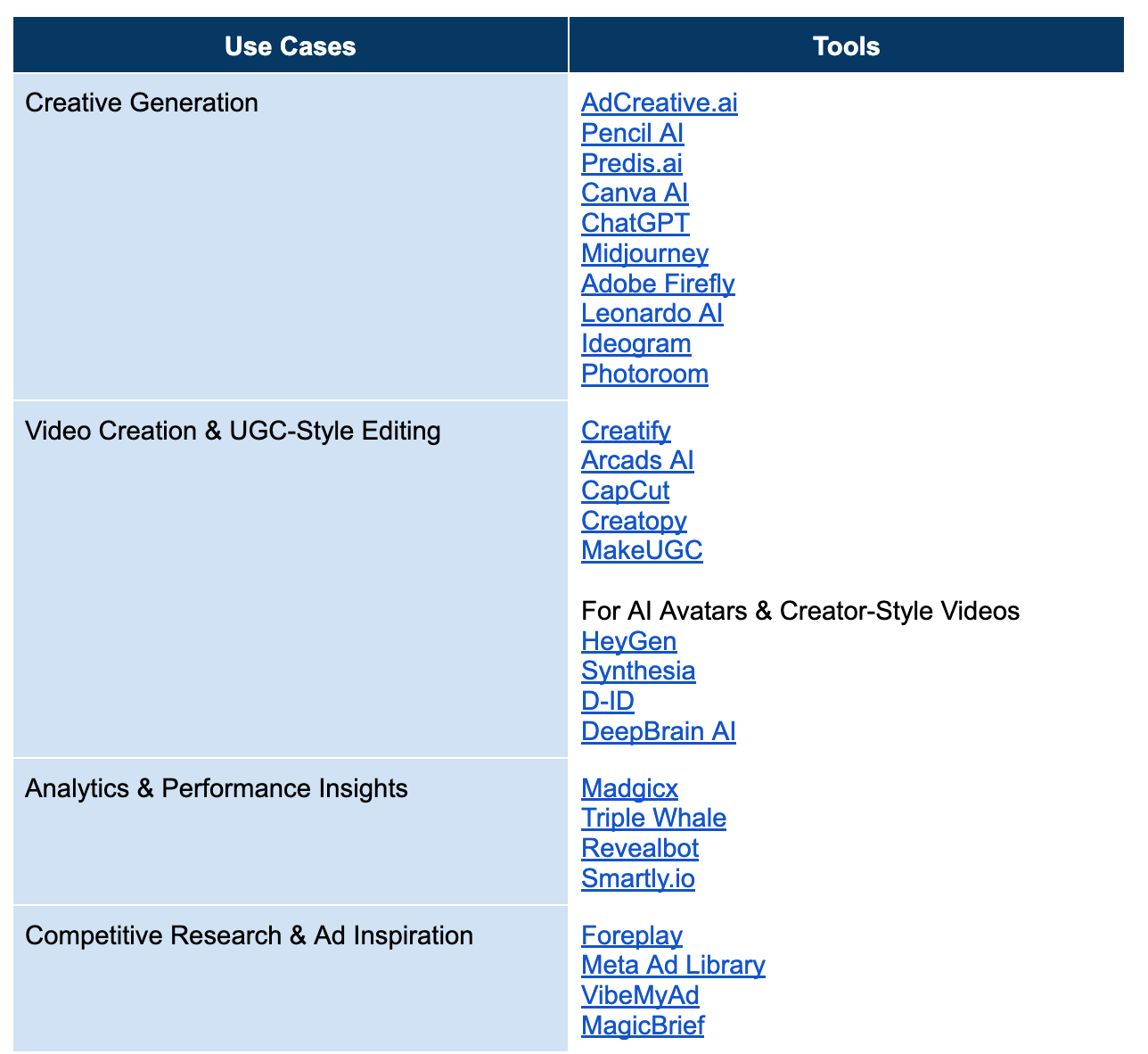
Meta itself now includes several AI-powered capabilities inside Ads Manager, such as:
Advantage+ Shopping Campaigns
AI-generated text variations
Automatic creative optimisation
Dynamic audience expansion
Automated placements
Future Trends in AI and Meta Advertising
While fundamentals such as positioning, storytelling, and customer understanding will remain important, the execution layer of advertising is becoming increasingly AI-driven.
Here are some of the key trends shaping the future of AI and Meta advertising.
1. Increased Automation in Campaign Management
Features such as Advantage+ campaigns already reduce the need for advertisers to manage multiple campaign variables manually.
In the future, campaign setup itself is expected to become more simplified, with advertisers focusing primarily on:
Business objectives
Creative inputs
Conversion signals
2. Greater Reliance on Creative-Led Performance
As targeting becomes broader and more automated, creative-first marketing is becoming the primary differentiator in Meta advertising.
3. Predictive Analytics Will Become More Advanced
Analytics tools are also evolving beyond traditional reporting dashboards. Future AI-powered systems will increasingly help brands:
Predict creative fatigue before performance drops
Forecast campaign outcomes
Recommend scaling opportunities
Identify high-performing audience behaviours
Suggest new creative directions based on historical patterns
Final Thoughts
Ultimately, most D2C brands face the same reality: rising CACs, shorter creative lifecycles, and increasing competition for attention. The difference is that some brands are still trying to manually optimise every campaign, while others are building systems that help them move faster.
Benchmarks like CTR, ROAS, or CPC matter, but they are often the outcome of something deeper- better creatives, faster testing, stronger customer understanding, and smarter use of AI. For D2C brands, the future of Meta Ads isn’t about finding one perfect ad. It’s about building a repeatable engine that creates, tests, learns, and scales, over and over again.


Dive into Vault today & unlock a world of possibilities.