


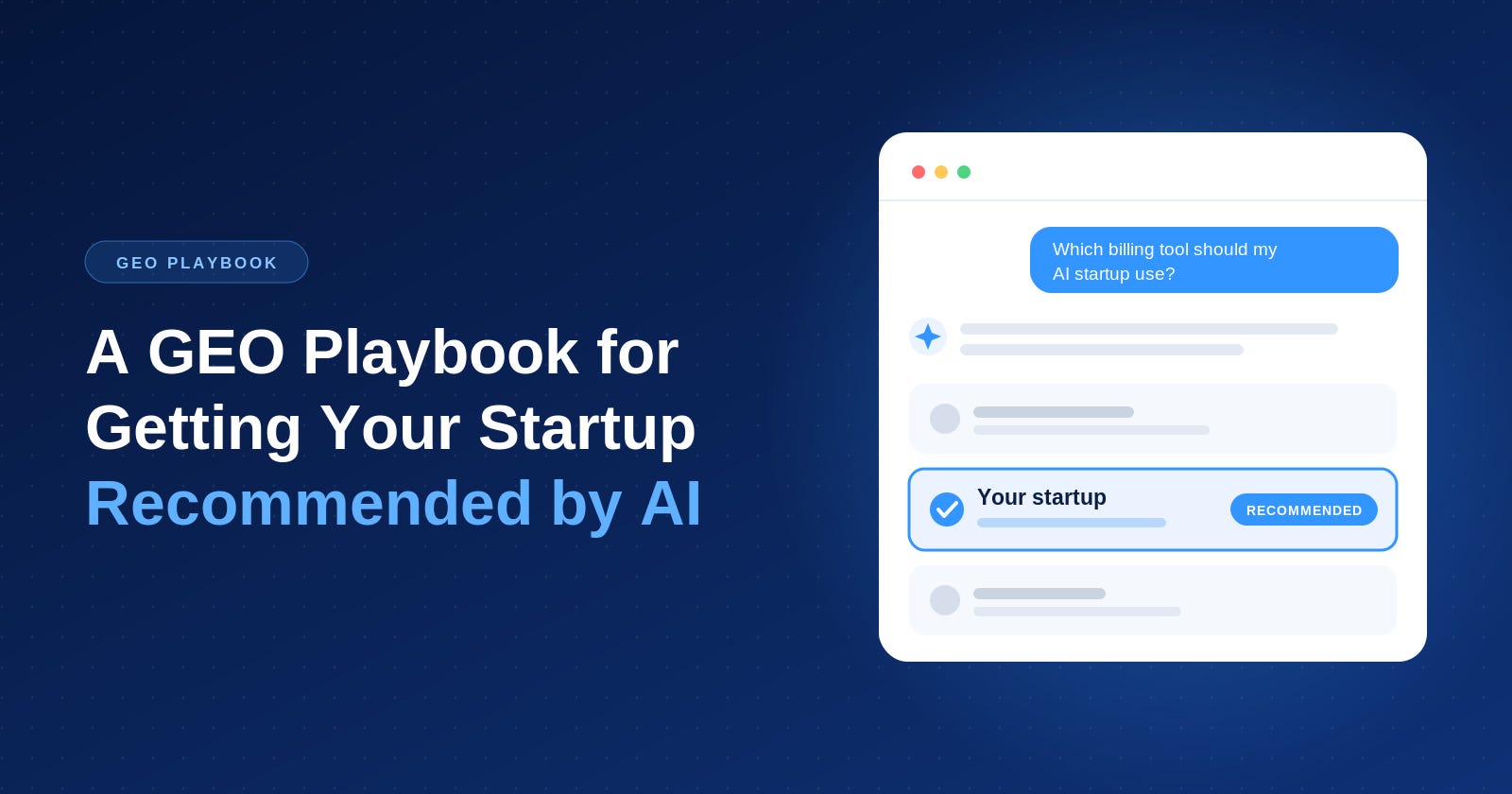
Tonight, somewhere in Pune, a founder will open ChatGPT and ask, “What’s the best billing tool for an AI startup that charges per token?” She won’t sift through pages of search results or click through endless links. She’ll read one answer, shortlist three or four companies, and book a demo with one of them.
That leaves every early-stage founder with one question: When a potential customer asks AI for a recommendation, will your company be one of the names it mentions?
The way people discover businesses is changing. More customers are turning to ChatGPT, Perplexity, and other AI tools to find products, compare solutions, and make buying decisions.
And you don’t need a huge marketing budget, a dedicated SEO team, or years of experience to get started. In this post, we’ll break down the basics of AI search visibility and explore steps you can take to help your startup show up where your next customer is looking.
How Are Buyers Discovering Startups in the Age of AI?
For years, getting discovered online meant one thing: ranking on Google. You published blog posts, built backlinks, optimised your website, and waited for the results.
But the way people search for products and services is beginning to change.
Instead of opening Google and comparing dozens of websites, buyers increasingly turn to AI tools like ChatGPT, Perplexity, Gemini, and Claude to help them decide. They ask questions like, “What’s the best billing software for a SaaS startup?” or “Which tools can help us manage usage-based pricing?” and receive a direct answer with a shortlist of recommendations.
There’s also another important shift: the way buyers arrive at your website. Someone who discovers your company through an AI recommendation may already have a clearer idea of what you offer, how you compare with alternatives, and why you might be worth considering. Of course, not every AI-referred visitor is ready to buy, but the recommendation can give them a useful starting point.
What Is Generative Engine Optimisation (GEO)?
Generative Engine Optimisation (GEO) is about helping AI tools find, understand, and recommend your business when someone asks a relevant question. You might also hear it called Answer Engine Optimisation (AEO) or AI search optimisation. The names vary, but the idea is the same: make your brand more likely to show up in AI-generated answers.
The concept gained attention through a 2023 research paper by researchers from Princeton University, Georgia Tech, the Allen Institute for AI, and IIT Delhi. Their study explored how changes to website content could influence visibility in AI-generated responses. They found that techniques such as including credible sources, relevant statistics, and expert quotations could improve a website’s visibility by up to 40% in their experiments.
So, what does GEO actually mean for your business? It builds on many of the same fundamentals: creating useful content, structuring information clearly, and establishing credibility. The difference is what you’re aiming for. With traditional SEO, the goal is often to rank higher in search results. With GEO, it’s also about getting your brand mentioned in the answers AI gives to your potential customers.
How to Get Your Startup Recommended by AI: An 8-Step Playbook
1. Find the Questions Your Buyers Ask AI
Before you write a single word, sit with your last 20 sales calls, support tickets and WhatsApp enquiries. Write down every question a prospect asked before they bought.
Then take those questions to ChatGPT, Perplexity, Gemini and Claude, with web search switched on wherever possible. Note three things for each one: who gets recommended, which sources get cited, and whether your company appears at all.
This exercise is humbling the first time. It’s also the most useful hour you’ll spend on marketing this month.
2. Structure Your Content for AI Answers
AI systems don’t read your article the way a person does. They pull passages like a definition or a comparison and stitch them into an answer. Your job is to make those passages easy to lift without losing meaning.
A few habits make a real difference:
Answer first. Open each section with a direct, two-to-three sentence answer to the question. Context can follow.
Use headings that mirror real questions. “How much does usage-based billing cost?” is far more useful than “Pricing Thoughts”.
Put comparisons in tables. If you’re comparing plans, tools or approaches, a clean table is easier for both humans and machines to parse.
Back claims with numbers and sources. The GEO research found that statistics and cited sources were among the strongest signals. Vague claims rarely get repeated.
Add a short FAQ and schema markup. FAQ and Article schema help machines understand what your page is about and who wrote it.
3. Publish Under a Founder Byline
Anonymous content from “Team XYZ” is easy to ignore - for readers and for AI. Content signed by a named person with visible, relevant experience carries more weight.
So write under your own name. Create a proper author page on your website with a short bio, your role, what you’ve built and links to your LinkedIn and X profiles. Keep that bio consistent everywhere. And publish your sharper, more opinionated takes on LinkedIn too.
4. Keep Your Listings Consistent on LinkedIn, Crunchbase and Beyond
This is the least glamorous part of the playbook, and possibly the most overlooked.
AI systems build their understanding of your company by piecing together what they find across the web. If your LinkedIn page says you’re a “fintech platform”, Crunchbase says “SaaS for SMBs”, your website says “AI-powered finance OS”, and an old news article lists a different founding year - the machine gets confused. And a confused AI tends to recommend someone else.
Pick one clear, plain-language description of what you do and who you serve. Then make it match across:
Your website: Homepage and About page
LinkedIn: Company page and every founder’s profile
Crunchbase and Tracxn: Description, category, founders, founding year, HQ, funding
Product directories: G2, Capterra, Product Hunt, GitHub (if you’re open source)
Startup India / DPIIT profile: If you’re recognised
There’s a very Indian wrinkle worth checking here. Many startups trade under a brand name that’s different from their registered company name. Just make sure the connection between the two is stated clearly on your About page and listings.
5. Earn Third-Party Mentions
What others say about you matters as much as what you say about yourself. AI answers draw heavily on third-party sources - news coverage, industry roundups, comparison articles, review sites, Reddit threads, YouTube videos and podcasts.
Show up in the places your buyers already learn:
Answer questions in relevant Reddit and Slack communities
Say yes to niche podcasts and newsletter interviews
Pitch yourself for “best tools for X” roundups in your category
Make funding announcements and launches count
6. Publish Original Data
If you do only one ambitious thing from this list, make it this. Create a resource that other people and AI systems will want to reference.
Original data works best. A benchmark, a pricing tracker, an annual survey, a calculator, a free template.
7. Let AI Crawlers Access Your Website
All the great content in the world won’t help if AI systems can’t actually read your website.
Ask whoever manages your website to check a few things:
robots.txt: Make sure you’re not accidentally blocking AI crawlers such as GPTBot (OpenAI), PerplexityBot, ClaudeBot (Anthropic) and Google-Extended
Rendering: Key content should be visible in the page’s HTML, not only loaded later by JavaScript
Speed and structure: Fast pages, clean headings and a proper sitemap
llms.txt: An emerging, optional file that points AI systems to your most important pages; low effort, worth trying
8. Measure Your AI Search Traffic
AI search attribution is still messy. Many people read an AI answer and then type your name directly into Google, so the trail goes cold.
Start with what’s available. Track referral traffic from chatgpt.com, perplexity.ai, gemini.google.com and claude.ai in Google Analytics. Add a simple “How did you hear about us?” field to your signup or demo form and make “ChatGPT / AI assistant” one of the options. And once a month, re-run your list of buyer questions across AI tools and note what’s changed.
Tools for GEO
Google Search Console
Google Analytics 4
ChatGPT, Perplexity, Gemini and Claude
Google Rich Results Test and Schema.org Validator
AI visibility trackers like Profound, Otterly.ai or Peec AI
Ahrefs or Semrush
A 30-Day GEO Plan for Founders
Week 1: Listen! Collect 30 real buyer questions. Run them through four AI tools and record who gets named.
Week 2: Clean up! Align your description across your website, LinkedIn, Crunchbase and directories. Fix your robots.txt.
Week 3: Write! Publish two to three founder-bylined pieces that answer your most important unanswered questions - answer first, with numbers and sources.
Week 4: Spread! Share those pieces on LinkedIn, contribute to one community thread and pitch yourself for one industry roundup.
Then repeat! GEO is less a campaign and more a habit.
Final Thoughts
When someone asks AI to recommend a product in your industry, will your startup be part of the conversation?
For years, being found online meant being loud: more posts, more ads, more backlinks. GEO asks you to be clear. Clear about what you do, consistent about who you are and generous with what you know.
As more people turn to AI for answers and recommendations, startups have a new way to get discovered, build trust, and reach potential customers. So, go ahead, make your brand more than memorable. Make it recommendable by AI!
At Razorpay Rize, we get it- building a startup is tough. That’s why we’re more than just a space for connecting with other founders. We’ve got programs, tools, and services designed to take some of the weight off your shoulders and make your journey just a little bit easier.


Dive into Vault today & unlock a world of possibilities.