



This in-depth guide helps aspiring founders understand what YC looks for, how to craft a strong application, prepare for the interview, and make the most of the experience.
SECTION 1: The YC Application
Q: What is the single most important thing YC looks for in an application?
A: Founders. The quality, determination, and complementarity of the founding team is consistently the #1 signal YC evaluates. A mediocre idea with exceptional founders will get funded; a great idea with a weak team rarely does. YC invests in people who are relentlessly resourceful and have a deep domain obsession.
Q: How should we describe our idea in the application?
A: Be ruthlessly concise and direct. YC partners read thousands of applications- vague or buzzword-heavy language is a red flag. The best answers follow a simple structure:
What is the problem? (1 sentence)
Who has this problem and how acutely? (1 sentence)
What is your solution, and why is it different? (1-2 sentences)
What is the current traction or evidence that this works?
Q: Does my startup need traction to get into YC?
A: Not necessarily, but traction is among the strongest signals. Revenue, users, or even compelling pilot commitments are all meaningful. Pre-revenue companies can and do get in, but the bar for founder quality and conviction is higher. If you have traction, lead with it. If you don’t, show evidence that the market pain is real and explain why you are uniquely positioned to solve it.
Q: How important is the video in the YC application?
A: Very important, possibly more than most applicants realise. The video lets partners assess your energy, authenticity, and whether you can communicate clearly and confidently. Keep it to 60 seconds. Both founders should speak. Do not read from a script. Look at the camera. The goal is to make YC want to meet you.
Q: What are common mistakes founders make in the YC application?
A: The most frequent mistakes that kill otherwise strong applications:
Being vague about the problem, saying ‘we are building a platform for X’ without explaining the specific pain
Inflating or being dishonest about traction metrics (YC will verify this in interviews)
Describing a feature, not a company- every successful company has a vision that goes well beyond the initial product
Poor co-founder dynamics or unexplained solo founder applications
Underestimating market size or using top-down TAM numbers instead of bottoms-up analysis
Not explaining why now- what has changed in the market that makes this the right moment?
Q: How many times can we apply to YC?
A: There is no limit. YC explicitly encourages reapplying, and a significant number of funded companies were rejected at least once before getting in. In fact, reapplying shows persistence and self-belief- two traits YC values highly. If you are rejected, use the feedback (if given), improve your metrics, build more traction, and apply again to the very next batch. The YC application opens twice a year, so there is no reason to wait more than 6 months between attempts.
Q: Can I make it to YC as a solo founder?
A: Yes- YC does fund solo founders, though it is harder. YC’s data shows that companies with 2-3 co-founders statistically perform better, and partners will probe solo founders more heavily on how they manage across both technical and business functions. If you are applying solo:
Be proactive- address the solo founder question head-on in your application rather than waiting to be asked
Demonstrate that you have a strong support network (advisors, early employees, domain experts) who compensate for the missing co-founder
Show exceptional individual output- a solo founder who has built and shipped product fast, or who has unique domain depth, raises the bar significantly
YC may ask: ‘Have you looked for a co-founder?’- have a thoughtful, honest answer ready
Q: Do I need to have a US entity set up before applying?
A: No. You can apply to YC with an entity incorporated anywhere. However, YC strongly recommends, and in practice requires, that you incorporate as a Delaware C-Corp before the batch begins and before you receive investment. Most YC companies from India or other countries set up a US holding company (Delaware C-Corp) with the Indian entity as a subsidiary. YC’s legal team and the YC alumni network make this process well-documented and relatively straightforward. Do not let the incorporation status block you from applying.
Q: Should we apply even if we are very early (pre-product)?
A: Yes. YC has funded many companies at the idea stage. What matters is whether you can convince YC that you understand the problem deeply, that you can execute, and that you will build relentlessly. If you are pre-product, invest extra effort in the founder quality signals: credentials, prior work, and your vision.
Q: How should we think about market size in the application?
A: YC funds companies that can become very large. A convincing market size argument is not a top-down ‘X is a $50B market’- it is a bottoms-up case: how many potential customers exist, what would each pay, and what share can you realistically win in 5 years? Alumni consistently advise: if the market is small, explain how you will expand it or move into adjacent markets.
Q: How specific should we be about the business model?
A: Be direct about how you make money. YC does not expect a polished financial model, but they do expect founders to have thought clearly about monetisation. Even if you plan to iterate, articulate your current hypothesis: subscription, transaction fee, marketplace take rate, enterprise contract, etc. Uncertainty is fine; avoidance is not.
SECTION 2: Preparing for the YC Interview
Q: What is the format of the YC interview?
A: YC interviews are approximately 10 minutes long with 2-3 YC partners. They move extremely fast. Partners will ask rapid-fire questions and interrupt frequently- this is not rudeness, it is a deliberate format to test how founders think under pressure. Do not try to give a full pitch. Answer concisely, then stop and wait for the next question.
Q: What are the most common questions asked in the YC interview?
A: Based on alumni experience, the most frequently asked questions are:
What does your company do? (You have 30 seconds- nail this)
How many users/customers / how much revenue do you have?
What is growing? What is the growth rate?
Who are your competitors and how are you different?
Why are you the right team to solve this?
Why now? What has changed that makes this possible?
What would make this fail? (Founders who have thought about this score high)
What do your best users love most?
How did you get your first customers?
What is your plan for the next 12 months?
Q: How should we prepare for the YC interview as a team?
A: Mock interviews are non-negotiable. Specifically:
Do at least 20-30 timed mock interviews with people who will ask hard, sceptical questions
Practice interruption- your partner should cut you off mid-answer and redirect
Both founders must be able to answer every question, not just the ‘domain owner’
Time your 30-second company description until it is memorised but sounds natural
Get comfortable with silence after your answer- do not over-explain or fill space
Simulate the exact 10-minute format; stopping at 10 minutes is critical
Q: How should we answer questions when we do not know the answer?
A: Be honest, not evasive. YC partners value intellectual honesty extremely highly. If you do not know a metric, say, ‘I don’t know that exact number, but here is what I do know.’ If you have not figured something out yet, say, ‘We have not cracked this yet- here is what we have tried and what we think the answer is.’ Admitting uncertainty and showing clear thinking is far better than bluffing.
Q: How should we handle disagreement between co-founders during the interview?
A: Disagreement handled well is actually a positive signal; it shows you are both engaged and think independently. If you disagree, briefly acknowledge it (’We have different views on this’), give your perspective, and move on. Do not argue or defer awkwardly. YC wants to see that you have a healthy working relationship.
Q: How do we come across as confident without seeming arrogant?
A: Confidence comes from depth of knowledge, not from bravado. The founders who impress YC most are those who know their numbers, their users, and their problem cold, and who can articulate uncertainty clearly. Arrogance shows up as dismissing competition, overstating traction, or becoming defensive. Stay grounded, specific, and curious.
Q: What should we do in the last 2 minutes of the interview?
A: Use any opportunity to show momentum. If you have just signed a new customer, raised a small round, or hit a significant milestone this week, find a natural moment to mention it. Close with clarity, not desperation- do not beg. If they give you time, ask a thoughtful question about what they see in companies like yours.
SECTION 3: What YC Really Looks For
Q: How does YC evaluate co-founder relationships?
A: YC looks for co-founders who have a history together- built something, worked together, or known each other deeply. They assess whether you communicate well under stress, whether skills are genuinely complementary (not two business people or two engineers), and whether both founders are equally committed. A co-founder who joined 3 weeks ago is a red flag; a decade-long friendship with a shared project is a green flag.
Q: What does ‘relentlessly resourceful’ mean in practice?
A: This phrase from Paul Graham describes founders who figure it out no matter what. In practice, it means: getting your first 10 customers without a product by doing it manually, travelling to where your users are to understand them, building something in a weekend to validate an assumption, or pivoting quickly when the data says you are wrong. YC looks for evidence of this trait in your history and in how you describe solving past problems.
Q: How much does the idea matter versus the team?
A: Alumni are consistent: the team matters more, but the idea cannot be irrelevant. YC has a saying: ‘We fund people, not ideas”, but only when those people are working on something with a credible path to being big and valuable. The idea matters for its market size, timing, and the founders’ ‘right to win’ (their unique insight or unfair advantage in solving this problem).
Q: What does YC mean by ‘making something people want’?
A: It means your product solves a real, felt pain- not a problem you invented or one people tolerate but do not actively seek a solution to. The best signal is users who would be genuinely disappointed if your product disappeared. YC frequently asks variants of ‘What would your users do if you shut down tomorrow?’ and ‘How did your users solve this problem before you?’
Q: Does YC have a preference for B2B vs B2C?
A: YC funds both extensively. B2B applications tend to have clearer revenue signals, which can make them easier to evaluate. B2C applications succeed when there is genuine viral growth or a massive addressable market with high retention. YC does not favour one- they favour whichever model the founders have the strongest evidence for.
Q: How does YC view India-based startups?
A: YC has become significantly more global and has funded many Indian companies across fintech, SaaS, B2B, and consumer. The key differences YC looks for in Indian companies vs. US companies are similar: clear market size, evidence of user love, and founder quality. The advantage for India-based companies is that many build for large local markets where YC has limited existing coverage- this can be a strong ‘right to win’ argument.
Q: How important is it to be based in the US or move to the US?
A: YC has relaxed this requirement significantly, especially post-COVID. Many companies now complete the batch remotely or partially. That said, YC still recommends being in the US during the 3-month batch because the density of network, investor access, and company-building support is highest there. This is worth planning for.
SECTION 4: Traction, Metrics & Growth
Q: What metrics does YC care about most?
A: YC consistently focuses on:
Revenue (MRR/ARR): the most objective signal of value creation
Growth rate: week-over-week or month-over-month, not absolute numbers
Retention: Do users come back? For SaaS, monthly churn; for consumer, D1/D7/D30
Customer acquisition cost vs. lifetime value (CAC: LTV ratio)
Net Promoter Score or equivalent qualitative user love signal
Time to first value: how quickly do new users experience your core benefit?
Q: What is considered good growth for a YC applicant?
A: YC’s internal benchmark is roughly 10% week-over-week growth for early-stage companies as the ‘ramen profitable’ target. However, this is a benchmark, not a cutoff. A company growing 20-30% month-over-month with very high retention and clear product-market fit can be more compelling than one growing 10% WoW with high churn. Show the trend, not just the current number.
Q: We are pre-revenue. What traction can we show?
A: Pre-revenue signals that carry weight with YC:
LOIs or pilot commitments from named potential customers
Waitlist signups with evidence of organic demand (no paid ads)
Deep user interviews showing acute, validated pain
A working prototype with early beta user engagement data
Domain expertise that creates a clear ‘right to win’ narrative
A previous startup or product, even if it failed, execution history matters
Q: How do we talk about our competition honestly without underselling ourselves?
A: The best framework: acknowledge what the competition does well, then explain your specific differentiation with evidence. Saying ‘there is no competition’ is an instant red flag; it signals either a small market or poor research. Saying ‘our competitors have X limitation, which is why our users switch to us’ with real user quotes or data is compelling.
Q: Should we focus on unit economics at the YC application stage?
A: You should understand them, even if you have not fully optimised them. YC does not expect early-stage companies to have perfect unit economics, but founders who do not understand their CAC, payback period, or gross margin send a concerning signal. Know your numbers, even rough estimates, and have a clear thesis for how economics improve at scale.
SECTION 5: Life at YC- What to Expect?
Q: What happens during the YC batch?
A: YC is an intensive 3-month program that includes:
Weekly Tuesday dinners with talks from successful founders and operators
Office hours with your dedicated YC partner (typically weekly or biweekly)
Group Office Hours (GOH) with YC partners and other founders
Demo Day preparation in the final 2-3 weeks
Access to the YC community of 10,000+ alumni globally
YC Deals- Discounts on tools (AWS, Stripe, Notion, etc.) worth $500K+
Q: What is the YC partner relationship like?
A: YC assigns 2-3 partners to each company. Partners are former founders themselves and take a coaching rather than a directive approach. The most value comes from being completely honest with your partner- sharing problems, failures, and uncertainties openly. The worst approach is to manage upward and only share good news. YC partners cannot help you with what they do not know.
Q: How much equity does YC take, and what do we receive?
A: YC’s standard deal is $500,000 for 7% equity (as of recent batches). This is non-negotiable. YC does not typically negotiate valuation. The value of the deal comes not from the investment terms but from the network, the brand signal (which affects your ability to raise follow-on capital), and the quality of advice and peer community.
Q: What is Demo Day, and how important is it?
A: Demo Day is a 2-minute presentation to hundreds of investors at the end of the batch. It typically catalyses significant fundraising for most companies. The preparation for Demo Day- distilling your company to its most compelling narrative in 2 minutes- is independently valuable. However, alumni advise against optimising the entire batch for Demo Day. Build the company; Demo Day follows.
SECTION 6: Advice from YC Alumni
Q: What do most YC alumni say they wish they had done differently before YC?
A: The most common regrets shared by alumni in prep sessions:
Talking to more users earlier- Most founders overbuild and undervalidate
Applying to YC earlier- Many waited for a ‘perfect’ application and lost a batch
Hiring people who do not have the startup DNA can slow everything down
Being more transparent with their YC partner about problems
Prioritising visibility over building- too much press, not enough product and growth.
Q: How do alumni describe the most valuable part of YC?
A: Almost universally: the network. Specifically, access to other founders going through the same challenges in real time, and the YC alumni Slack and forums, where you can get expert help on any operational question within hours. The peer accountability (’Are you growing as fast as these other companies?’) is also frequently cited as a powerful forcing function.
Q: What is the one piece of advice alumni give to founders applying for the first time?
A: Most distil it to: ‘Apply now, not when you’re ready.’ YC is not looking for a finished product or a proven business- they are looking for extraordinary founders working on real problems. Every batch that passes without applying is a missed opportunity for the community, the network, and the forcing function of the program.
Q: How should we think about pivoting during or after YC?
A: Pivots are extremely common at YC. Many of the most successful YC companies pivoted during the batch (Airbnb pivoted their model, YouTube pivoted from dating, Twitch pivoted from Justin.tv). YC encourages pivots when the data clearly shows the current direction is not working. The key is to pivot based on user feedback and data, not based on investor feedback or because growth is temporarily slow.
Q: What role do mental health and founder wellbeing play at YC?
A: This has become an explicit priority at YC. Alumni consistently note that the batch is extremely intense and that founders who do not invest in their own well-being (sleep, exercise, relationships) make worse decisions. YC now includes programming around founder mental health, and partners actively encourage founders to build sustainable working rhythms, not because it is soft, but because burned-out founders make bad companies.
Q: How do we stand out from the thousands of YC applicants?
A: Alumni offer a consistent framework for standing out:
Have a strong, memorable ‘why us’- your unique insight into this problem that nobody else has
Show evidence of doing things that do not scale- manually serving users, building relationships with no shortcuts
Demonstrate co-founder chemistry that is visible even in a 60-second video
Have at least one impressive data point, even one paying customer, one exceptional retention number, or one compelling user quote
Write like a human, not a pitch deck- clear, direct language beats jargon every time
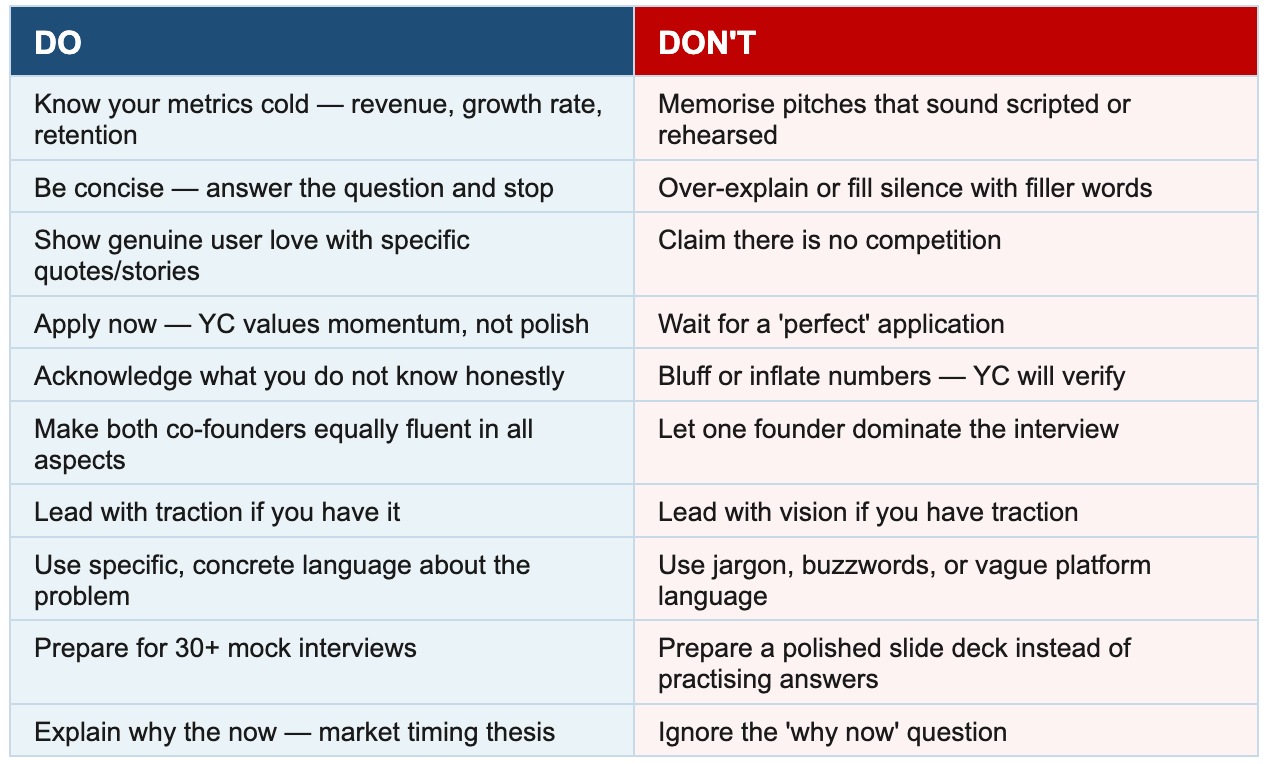
SECTION 7: Quick Reference- Do’s and Don’ts
SECTION 8: Key Resources for YC Aspirants
The following resources are most frequently recommended by YC alumni in prep sessions:
YC Application Reviewer: Refine your application on an AI tool trained on 1000+ YC application reviews and Alumni insights
Startup School (YC): Free curriculum covering all stages of company building, from idea to scale
Hacker News (news.ycombinator.com): A community where YC founders share learnings; key essays are linked frequently
Paul Graham Essays: Foundational essays on founder mindset, traction, and building companies
YC Top Companies List: Studying successful YC companies reveals patterns in idea, traction, and team
Kevin Hale’s Application Review video: Former YC partner walks through how applications are evaluated
Dalton + Michael YC YouTube: Extremely practical, direct advice on applying and company building

Dive into Vault today & unlock a world of possibilities.